

This article may contain links from our sponsors and affiliates, and Flywheel Publishing may receive compensation for actions taken through them.
Jensen Huang has lost $92 billion on paper since Nvidia’s (NASDAQ: NVDA) record close on Oct. 6, and the board of the company he led for 33 years has said it “does not intend to reinstate Jensen as CEO.” In the 9 big founder moves that preceded his, the stock beat the S&P 500 4 times over the next year and trailed it 5 times.
Apple beat the market by 55 points in the year after Steve Jobs sold the company to Tim Cook. Microsoft trailed by 43 points after Bill Gates gave way to Steve Ballmer.
If you’re a longtime shareholder who owns Nvidia because of Huang and the stock has become a significant part of your retirement savings, this review is the closest guide you have to the years without him. Read as a forecast for Nvidia, it indicates that the first year after a founder’s departure is close to a coin toss; The limitation of this reading is that none of these transfers followed a scandal, and Nvidia’s did.
Nvidia’s board of directors accepted Huang’s resignation on November 11, and its chairman, Harvey C. Jones, issued a statement regarding his reinstatement on November 17. The stock closed Friday at $125.53, down from an Oct. 6 record of $239.24.
What the 9 founder transfers did to the stock
The numbers come from 24/7 Wall St.’s new research report, “Nvidia Without Jensen,” which used closing prices from Nasdaq and the New York Stock Exchange. Each line represents the stock’s total return in the year following its founder’s resignation as chief executive, minus that of the S&P 500, in percentage points.
- Apple, August 2011 (Steve Jobs to Tim Cook): ahead of 55
- Netflix, January 2023: ahead of 27
- Alphabet, December 2019: ahead of 22
- Qualcomm, July 2005: ahead of 14
- Oracle, September 2014: late by 8
- Nike, December 2004: 9 points behind
- Starbucks, April 2017: 13 points behind
- Amazon, July 2021 (from Jeff Bezos to Andy Jassy): 25 points behind
- Microsoft, January 2000 (Bill Gates to Steve Ballmer): 43 points behind
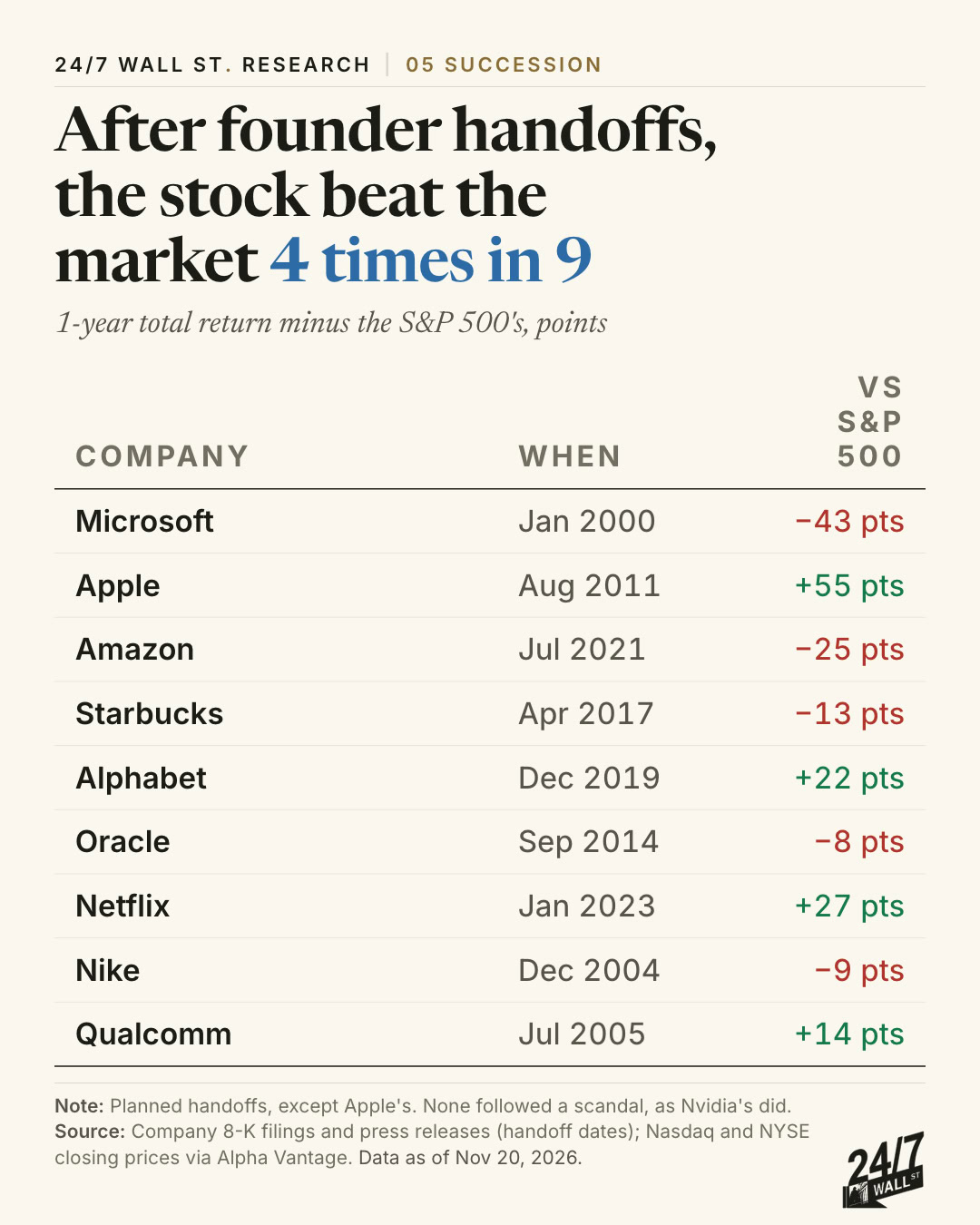
The gap between the best year and the worst is 98 points. Apple and Microsoft are at opposite ends of the list, and each just saw a famous founder give up the top job.
Time helped. Three years after the transfer, 6 of the 9 titles were ahead of the market. Starbucks and Nike were behind after one year and ahead after three.
My reading of this file: the company and the successor decided on the evolution of these actions once the founder left, and the first year tells you little about the third.
Why Nvidia’s transfer is harder to read
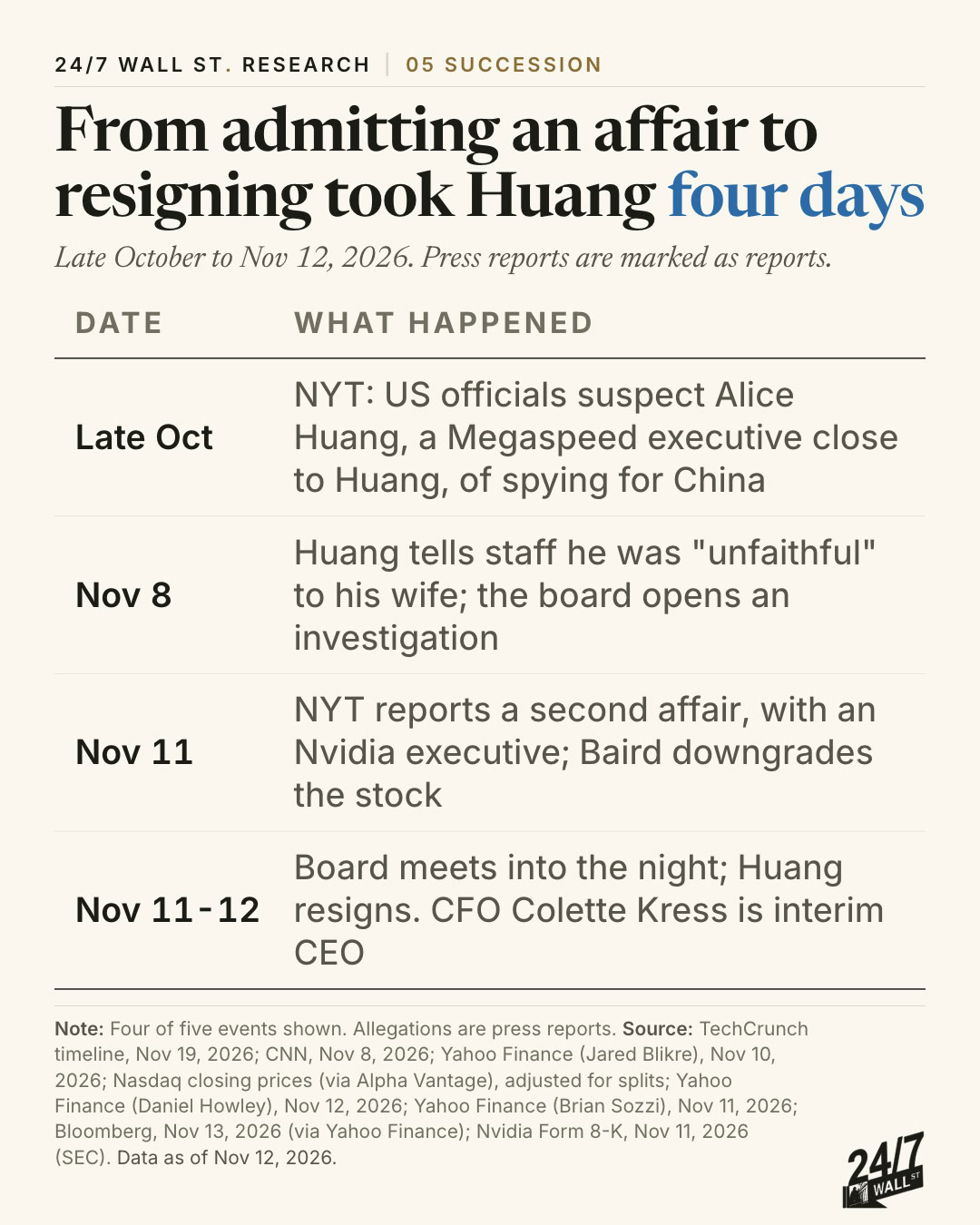
All but Apple’s were planned, and each company named its next CEO when the founder stepped down. It took Nvidia four days between Huang’s memo to his team and the company’s announcement, and the board did not name a permanent successor. Here is the month in order. News articles are marked as reports.
- Late October: The New York Times reported that U.S. officials suspected a Megaspeed executive close to Huang of spying for China. China denies it.
- November 8: Huang told staff he had been “unfaithful” to his wife, CNN reported. The board opened an independent investigation and said it did not believe national security or corporate secrets were compromised.
- November 9 and 10: The stock fell 9.5% in two trading days.
- November 11: The Times reports a second affair, with an Nvidia executive. Nvidia, Huang and the executive have not confirmed this. The board met overnight and accepted his resignation, according to the company’s 8-K filing and Bloomberg.
- November 12: Nvidia names Colette Kress interim CEO.
- November 13: The Financial Times reports that the board of directors contacted René Haas, Arm’s chief executive.
- November 15: The Financial Times reports that Huang discussed a return with his allies.
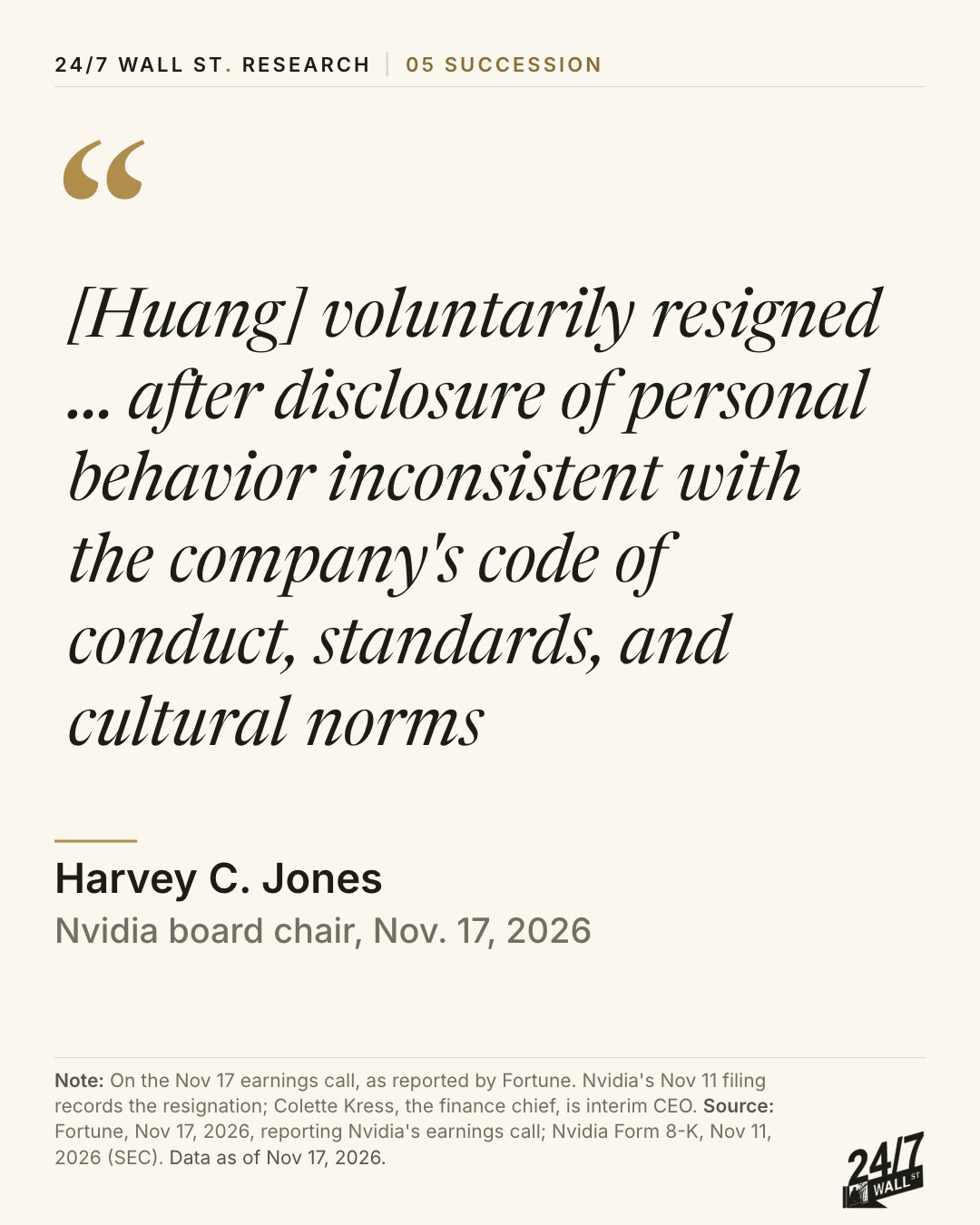
- November 17: Huang said he would be “honored” to return. During Nvidia’s earnings conference call the same day, Jones said Huang resigned “after revealing personal behavior inconsistent with the company’s code of conduct, standards and cultural norms,” Fortune reported.
- November 18: Huang agrees to testify before the Senate Banking Committee.
- November 20: Reuters reported that Securities and Exchange Commission staff were looking into possible accounting problems at Nvidia and that the stock fell 14% that day. An investigation does not constitute a finding of wrongdoing.
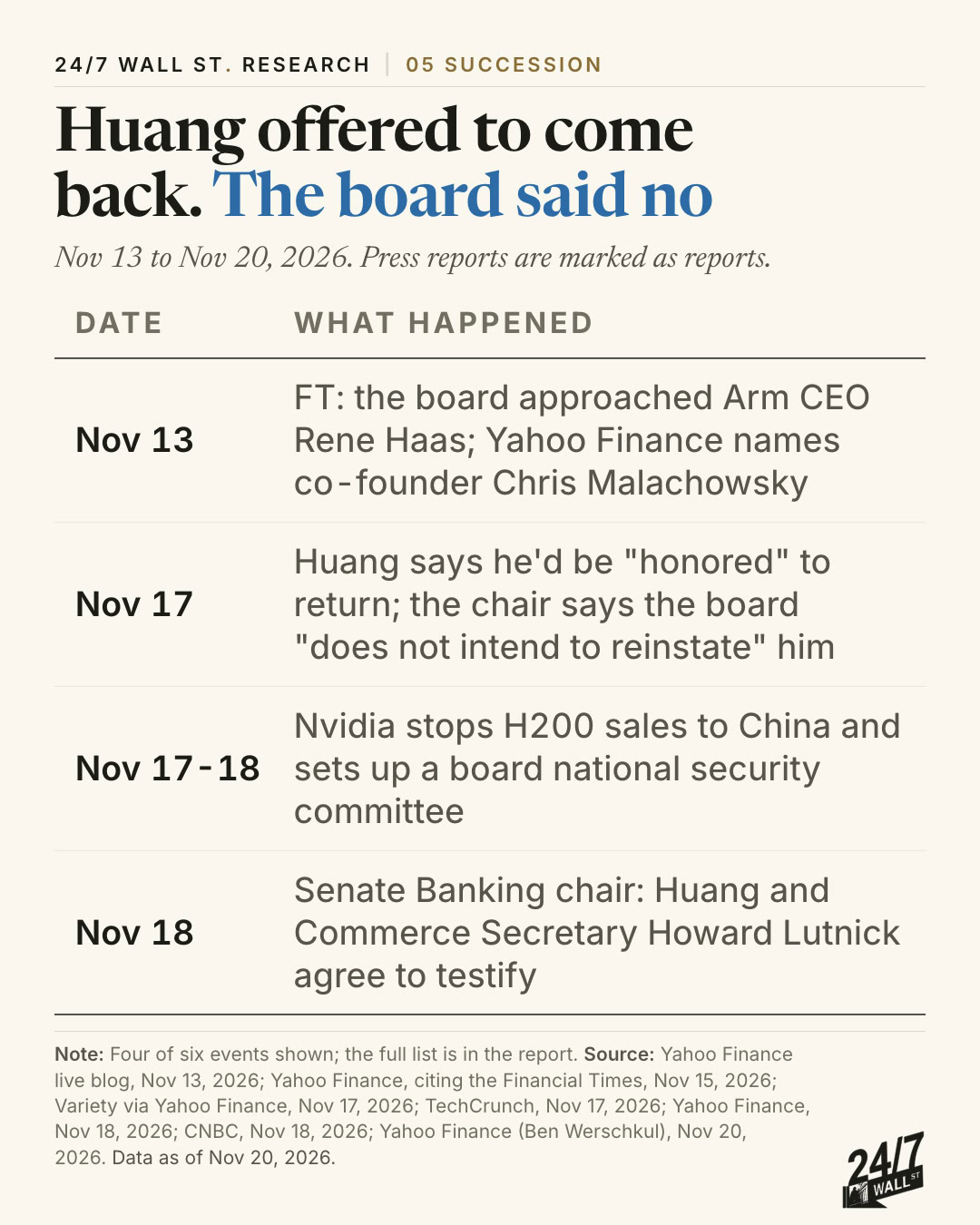
That leaves you with three open questions that previous transfers never asked: who will run Nvidia, what the board’s investigation will find, and what the SEC is looking into.
What to watch if you still own Nvidia
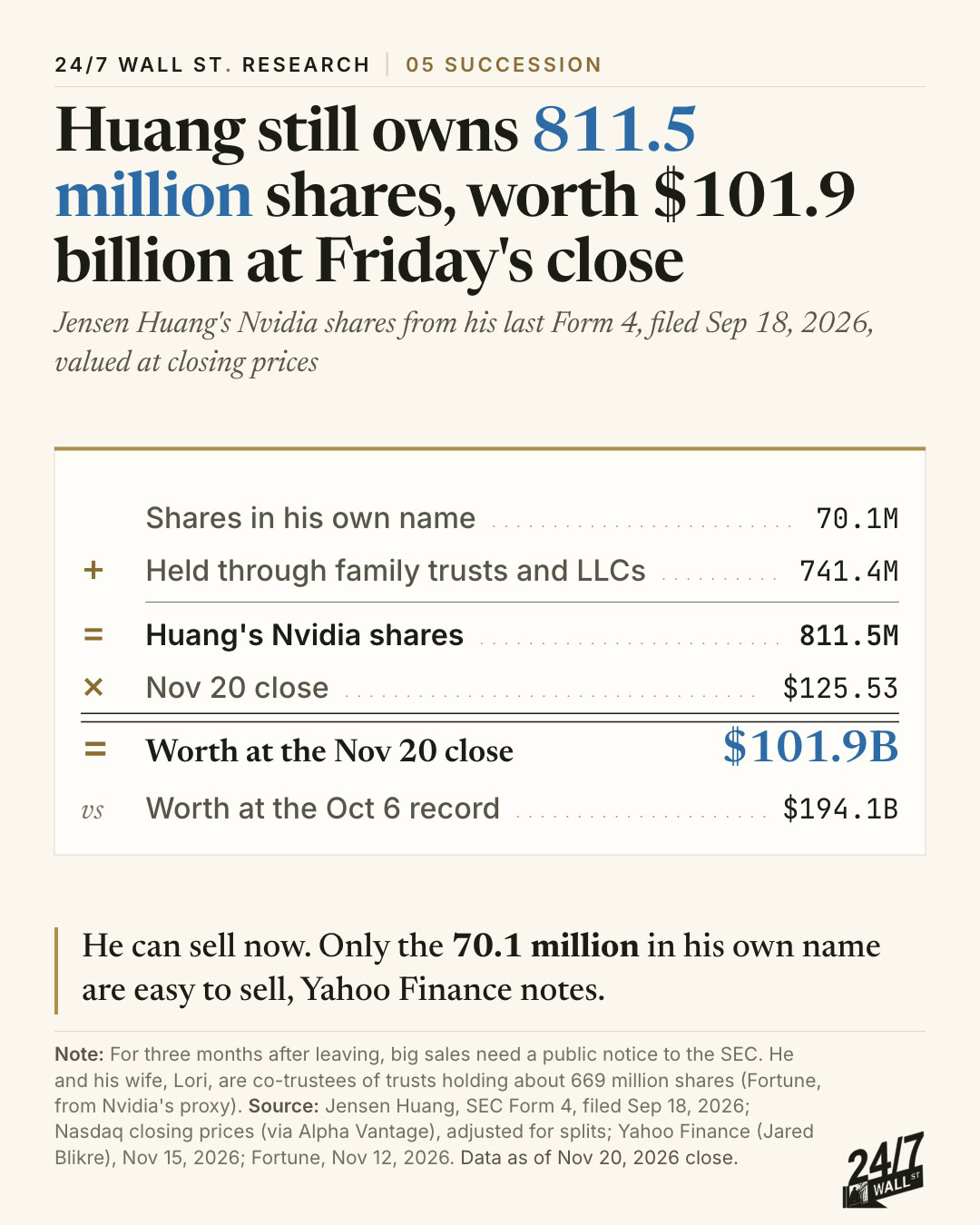
Huang still owns 811.5 million shares of Nvidia stock, according to his latest Form 4 filing with the Securities and Exchange Commission: 70.1 million in his own name and 741.4 million through family trusts and LLCs. As of Friday’s close, that stake was worth $101.9 billion, up from $194.1 billion at the Oct. 6 record. The difference is its paper loss of $92 billion.
He can sell now. For three months after his departure, he still counts as an insider, so major sales are announced to the public.
Three things will tell you where this is going:
- The successor. In each of the previous transfers, you knew the next general manager from day one. Nvidia has an interim CEO and a search.
- The two investigations. The board has not reported its findings, and Reuters could not determine what accounting issues the SEC is examining.
- The Huang Papers. If it sells a large block in the next three months, you will see the notice.
We’ll follow all three in The Daily Profit, our free weekday email, starting with the big sales Huang will bring in over the next three months. Register for free here.
My take, for analysis: expect uncertainty to hang over Nvidia’s price until the board appoints a successor and both investigations are resolved. History gives you no reason to sell a large company just because its founder left. It also doesn’t promise you a quick rebound, since most of these stocks lagged the market in their first year.
Bottom line: If Nvidia has become a significant part of your savings, set your position size based on how long you can wait. The balance sheet favored shareholders who could give three years to a new CEO.
Contact (email protected) for any questions or corrections.
Gn bussni