The future Ford CVN-81-class aircraft carrier will remain the USS Doris Miller, the US Navy has confirmed.
“There is no intention to change the name of the USS Doris Miller,” a spokesperson for the Secretary of the Navy told Military Times.
In August, speculation about whether the Navy was considering naming CVN-81 after President Donald Trump sparked outrage, particularly among Miller’s descendants. Thomas Bledsoe, Miller’s great-nephew, told CNN at the time that the possibility of such a move “was quite a shock.”
Asked in August about this potential pivot, the maritime service told Military Times that “the Navy has no announcements to share at this time.”
The confirmation comes as HII’s Newport News Shipbuilding announced the ceremonial keel laying of the Doris Miller on December 5 in Newport News, Virginia. The Navy’s fourth Gerald R. Ford-class aircraft carrier, originally planned for 2032, was pushed back to February 2034 due to “constraints” at the HII shipyard and is expected to take 15 years to complete.
CVN-81 will be the first U.S. aircraft carrier named for a Black American and the first named for an enlisted sailor. Miller’s namesake was chosen by Acting Secretary of the Navy Thomas Modly in 2019.
Miller, born in rural Texas to sharecroppers and the grandson of slaves, joined the U.S. Navy in September 1939 after struggling to find work in the Jim Crow South.
During this time, black sailors were not only excluded from promotion, but were also sent to the messman’s branch, where they were tasked with the menial work of making beds and shining shoes for their white officers and waiting for them in the officers’ mess.
According to historians Thomas W. Cutrer and T. Michael Parrish, by regulation, black men could not be trained or assigned to any other specialty, such as signals, engineering, or artillery. Their combat station was below decks, in the “hole” or magazine, where they transmitted ammunition to the gunners. They were not even allowed to wear buttons marked with the Navy insignia, an anchor intertwined with a chain, and instead had to wear plain buttons.
It was under these circumstances that on December 7, 1941, Miller found himself stationed on the USS West Virginia. When the first Japanese torpedo hit the ship, Miller was downstairs, doing laundry. However, as six successive torpedoes – a seventh of which failed to explode – shook the battleship, Miller sprang into action. After finding his battle station and ship’s magazine already flooded, Miller requested reassignment.
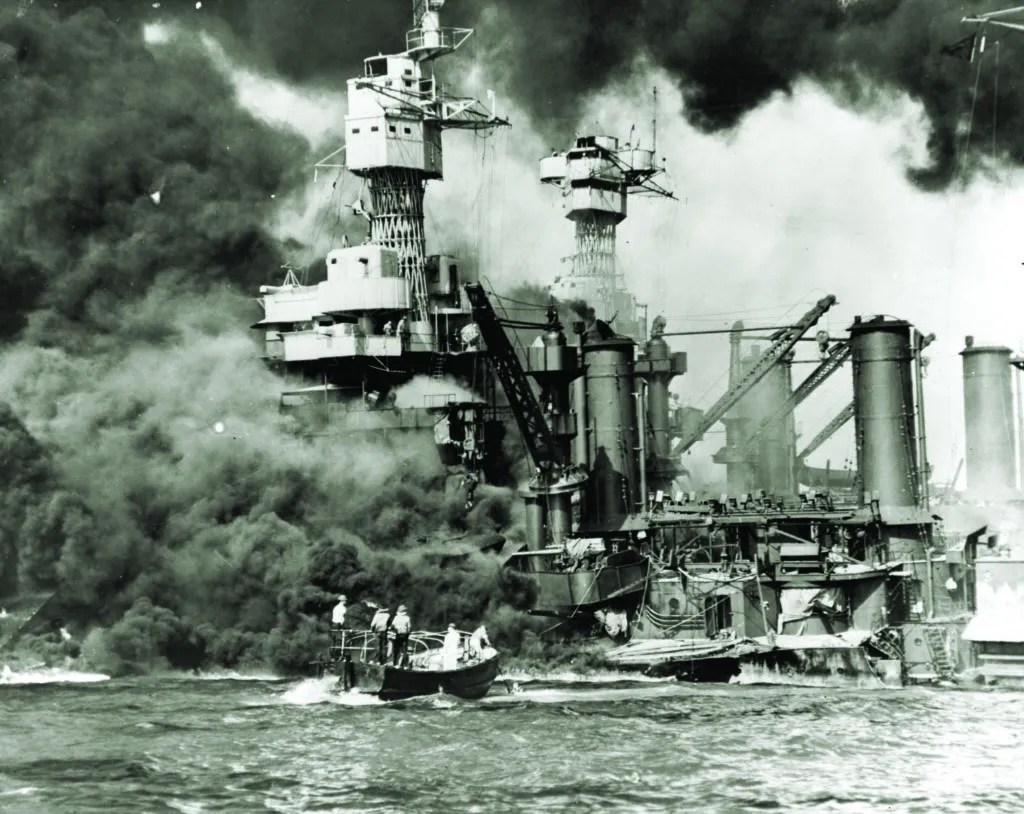
Once in the water, Miller, the ship’s heavyweight boxing champion, was ordered to transport the mortally wounded commander of the West Virginia, Captain Mervyn Sharp Bennion, to relative safety. After placing Sharp in a sheltered location just aft of the turret, under the port anti-aircraft guns, Miller again looked for his next mission.
While the ship was already starting to list poorly, the starboard guns were still operational. Finding an unattended .50 caliber Browning machine gun, Miller, without any training, began shooting.
“It wasn’t difficult,” he later recounted in 1942. “I just pulled the trigger and it worked fine.”
It was only when his gun ran out of ammunition and orders sounded to abandon the ship’s bridge that Miller left his post.
From there, according to the action report from Cmdr. RH Hillenkoetter, Miller was “instrumental in transporting people through oil and water to the poop, thus undoubtedly saving the lives of a number of people who might otherwise have been lost.”
As water from the oil slick flooded the West Virginia’s lower decks, the surviving senior officer gave the order to abandon ship.
Doris Miller was one of the last three men to leave West Virginia. One hundred and six crew members perished on that day of infamy, many of them drowning as the compartment hatches closed.
In the aftermath of Pearl Harbor, there was a push to award Miller the Medal of Honor, but Georgia Democrat Carl Vinson—the House Naval Affairs Chairman and a staunch segregationist who would later oppose Brown v. Board of Education and the Civil Rights Act of 1964 – asserted that Miller’s actions did not merit the nation’s highest honor for bravery. William Franklin Knox, the Secretary of the Navy, agreed.
Over the next few years, there were numerous calls for Miller’s Navy Cross to be upgraded to the Medal of Honor.
In March 2025, Maryland Congressman Kweisi Mfume introduced a bill to award both the Medal of Honor and the Congressional Gold Medal to “Dorie Miller so that he can finally be recognized with a long-overdue American salute,” Mfume wrote, using Miller’s nickname.
As of the date of this report, there have been no updates on the award campaign.
Gn usa