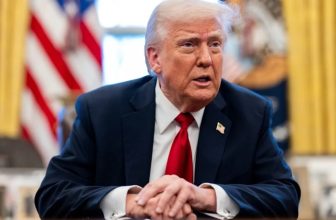
President Donald Trump wanted Jensen Huang to return as head of Nvidia. Now that the chip magnate is reinstated, Trump is rejoicing alone in Washington.
Trump celebrated and claimed Huang’s reinstatement to Nvidia’s board on Monday, a stunning return to power for the embattled CEO. During a nearly hour-long phone call with CNBC, the president went so far as to say he had “made a deal” to bring Huang back.
But Trump’s jubilation contrasts sharply with the reaction of his most loyal allies on Capitol Hill, who pushed back after the reinstatement and vowed to continue their investigations into Huang — whose relationship they fear with a potential Chinese intelligence agent has endangered U.S. national security.
“The risk remains that a Chinese spy knows information about a key individual in the supply chain, and that’s not worth it,” Sen. Kevin Cramer, R-N.D., said Tuesday on CNBC’s “Squawk Box.” “We might even have to give Jensen Huang a babysitter for crying out loud… just to make sure he doesn’t do something that would endanger the United States.”
Trump’s rare isolation from his party over Huang comes after the GOP was throttled in the midterm elections, as Democrats rode a blue tsunami to capture the Senate and the largest House majority this century. And it suggests that Republicans, who have spent a decade at the president’s side, may have found an issue on which they cannot bring themselves to side with Trump.
“I can accept what the president did,” Cramer said. “But we need to put safeguards in place to protect the United States of America.”
Many midterm voters identified Silicon Valley’s most visible outcomes, artificial intelligence and data centers, as the top concerns motivating them to vote for Democrats. The October CNBC All-America Economic Survey found that 63% of registered voters oppose an AI data center within 10 miles of their home, while only 13% support one.
By timing his extraordinary intervention in Nvidia so soon after the Republican Party’s historic losses, Trump could spark a national debate about corporate governance and accountability, said former Deputy Secretary of State Richard Stengel.
“With the rejection of Trumpism in the midterms and voters’ revulsion at corruption, I believe there will be a return to more value-based due diligence for corporate boards and away from the current maximization of shareholder value,” Stengel told CNBC in an email.
“Directors are citizens first, shareholders second. The idea that profit comes before national security should disgust shareholders, not please them,” wrote Stengel, who worked in the Obama administration.
Bipartisan lawmakers are now racing to pass a series of export control bills before the end of the year, a call that has only intensified since Huang’s reinstatement.
President Donald Trump disembarks from Air Force One at Joint Base Andrews, Maryland, November 19, 2026.
Mandel Ngan | Afp | Getty Images
There is “not just political frustration or concern, but also real and substantial national security concerns on the part of both Democrats and Republicans,” Chris McGuire, senior fellow for China and emerging technologies at the Council on Foreign Relations, told CNBC.
“This has always been a bipartisan issue,” McGuire said. “Democrats and Republicans generally agree that we should not send our most advanced chips to China.”
“If it happened in large quantities, people want to know why, how, and they want to make sure it doesn’t happen again,” he said. “And putting the thumb on the scale in such a clear way seems like it could undermine those efforts.”
The White House did not immediately respond to a request for comment on the political dynamics of Trump’s involvement in Huang’s reinstatement.
Republicans ready to investigate Huang and Nvidia
Republicans will have the first chance to investigate Huang next week before handing power to Democrats in January. Democrats have promised to conduct their own investigations into the Nvidia CEO and his ties to the president and his cabinet. The Democrats who will lead these investigations now hope that the Republicans will join them.
“I saw a lot of Republicans outraged and outraged by what just happened,” Maryland Democrat Jamie Raskin, a member of the House Judiciary Committee, said Tuesday on “Squawk Box” when asked whether Republicans could support a bipartisan investigation into Nvidia.
“When else in American history can you think of a time when a president of the United States called a meeting of the board of directors of a company and then basically dictated who their new CEO was going to be right after firing them?”
Throughout his second term, Trump repeatedly stated that AI dominance was necessary for the United States to maintain global superiority. His administration has championed the rapid growth of the country’s tech giants and forged close ties with its leaders, particularly Huang, while removing constraints on the industry and opposing some new regulatory efforts.
At the same time, Trump defended Commerce Secretary Howard Lutnick against accusations of slow export controls from China, the fiercest competitor in the AI race. And although Trump recently discussed AI in an in-person meeting with Chinese President Xi Jinping, he appeared to make few demands and get few assurances about Beijing’s efforts to acquire American chips.
“Saying we can’t keep AI safe because of China, and then actively relaxing controls on China, makes no sense,” McGuire said.
Some of Trump’s fiercest allies have expressed similar reservations.
“Reinstating Jensen Huang will harm our national security,” MAGA activist Laura Loomer wrote in a post Monday. “Ultimately, there will be accountability for endangering U.S. national security. China did not gain access to Nvidia chips by accident.”
Newt Gingrich, the influential former Republican Speaker of the House, wrote in an article after Huang’s reinstatement: “Congress should really address this issue as a national security issue of enormous proportions and also as a significant failure of the federal bureaucracy.” »
Their criticism stands in stark contrast to the praise coming from Silicon Valley and some of the pro-Trump voices, like Elon Musk, who wrote Monday: “The mistake has been corrected.”
But it’s a shrinking political constituency, McGuire said.
“The tech rights perspective is very disconnected from where most of the Republican Party stands on these issues, let alone the Democratic Party,” he said.
“These positions simply won’t be sustainable for very long,” he added. “I think they’re already becoming unsustainable.”
Gn headline