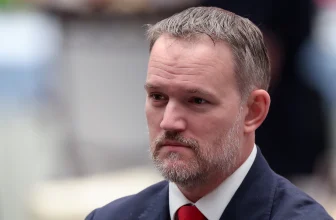
He was on the rise among China’s political elite, hosting tech executives and senior U.S. officials. But now Shanghai party chief Chen Jining, a member of the country’s influential Politburo, appears to be the latest top official toppled by President Xi Jinping’s sweeping purge.
The hammer unexpectedly came down on Chen in the form of a two-line bulletin released Tuesday by the Xinhua news agency: He is “suspected of serious violations of Party discipline and law and is currently under disciplinary review and surveillance investigation” — a common euphemism for the crackdown on corruption against officials in Xi’s ruling Communist Party.
Such public announcements usually mark the end of a political career in China. Chen has not made any public statements.
He is the fourth politburo member to be purged in less than two years, part of a broader crackdown that has swept aside top military leaders as Xi consolidates his power. He is expected to extend his term next year, at a party congress held every five years and taking place in the preceding months.
But Chen’s abrupt fall surprised many careful observers of China, given that his profile and career path generally point to a bright future.

“It was potentially going to the highest level, which would be the standing committee. And I think from many Western observers, people thought he had even better prospects,” Damien Ma, director of the Singapore-based Carnegie China think tank, told NBC News.
Xi’s quest for loyalty
Some analysts have speculated that Xi, increasingly seen as likely to rule for life, might have eliminated a viable replacement. Steve Tsang, director of the SOAS China Institute in London, said, however, that Chen was “someone who could rise further, but not as a successor.”
Chen, a 62-year-old technocrat known as a friend of foreign business and an advocate of AI, was an environmental scientist who studied in London and quickly rose through the party ranks. He served as China’s environment minister, mayor of Beijing and party secretary in Shanghai – a post once held by Xi and widely seen as a springboard to bigger things.
Last month, Chen hosted Apple Chairman Tim Cook, urging the U.S. tech giant to “fully exploit Shanghai’s strengths” and bring more products to the city, a financial and cultural center that has long served as a link between China and the international community.
In his final public appearance last week, during a tour of a shipping facility, Chen called for advancing the industry’s digital transformation.
On Wednesday, Chen’s name was removed from some official websites. A web page on the Shanghai government website showing this meeting with Cook now displays a 404, or not found, message.

Chen is just the latest senior official in the crosshairs of Xi’s long anti-corruption campaign and emphasis on party discipline, which analysts say is as much about loyalty as reform.
“This is a warning to all technocrats, because Chen was a rising star among technocrats and had no apparent failures from a technocratic point of view. So the message is: adhere to strict party discipline and show unquestionable loyalty to Xi or otherwise,” Tsang said.
The party’s Central Committee, which has about 200 leaders, mostly men, vowed to “ensure more rigorous enforcement of discipline and make full use of discipline as a guide, restraint, guarantee and incentive” during its closed-door gathering, the Fifth Plenum, last month.
“What they’ve built as part of this disciplinary machine over the last 15 years is sort of implementing their sort of internal operating system of how they deal with, let’s say, bad eggs within the party,” Carnegie China’s Ma said.
“The top leaders are normalizing this fight against corruption, this self-cleaning,” Ma said. “It has become part of the normal expectations of the party, and they are trying to integrate it over time and at all levels,” he added.

The Chinese government has not announced any charges against Chen, who was the youngest member of the country’s decision-making elite. The 24-member Politburo was unveiled in 2022, but it has only 21 members after the purges. Last month, Senior General Zhang Shengmin was elevated to corps rank, a rare addition.
Chen’s defeat comes a year before a reshuffle of the party’s top leadership at the 21st Communist Party Congress, when Xi is expected to further consolidate his control and cement another five-year term as leader of the country.
From London to Shanghai
Born in 1964, Chen studied at the prestigious Tsinghua University, which has long been an important pathway for senior party officials and where he served as president from 2012 to 2015. His name has now been removed from the online list of former Tsinghua presidents.
After studying at Tsinghua in the 1980s, he moved for a decade to Britain, where he earned a doctorate at Imperial College London in 1993.
Chen returned to Tsinghua’s environmental science and engineering department in 1998 before being named president of the university in 2012, according to an official biography.
He is the author of dozens of articles, including on reducing carbon emissions and monitoring water quality.
Chen, relatively young, cycled around campus and built a reputation as a promoter of institutional reforms during his three years at the helm of the university, according to an article in People’s Digest, a magazine affiliated with People’s Daily, the official newspaper of the community party.
The article, titled “From University President to Cabinet Minister,” was published in 2015, the same year he was chosen to lead the Ministry of Environmental Protection. In 2017, Chen became mayor of the capital, Beijing, where he oversaw the 2022 Winter Olympics during the Covid pandemic.
Gn world