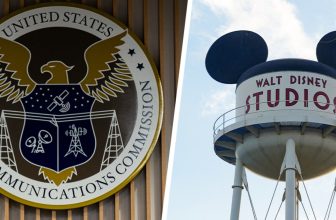
A federal judge largely sided with ABC in its First Amendment lawsuit, saying an FCC order to revise its broadcast licenses was an act of retaliation by the Trump administration, which from the start has attacked its news content, The view and Jimmy Kimmel.
U.S. District Judge Loren AliKhan on Wednesday issued a preliminary injunction barring the FCC from taking any further action in its review of its license, finding that the network was “likely to succeed in its request for retaliation.”
“This is not a conclusive case,” she wrote, concluding that the network had demonstrated that the public interest favors court intervention in agency action.
“No one doubts that the Commission can apply the law as it sees fit,” AliKhan wrote. “But in doing so, Defendants cannot retaliate or punish Plaintiffs and other broadcast licensees for disfavored speech.”
She also rejected the FCC’s efforts to dismiss the lawsuit on jurisdictional grounds.
“Given the extreme, even existential, nature of the possible penalty plaintiffs face – the loss of their broadcast licenses – the court concludes that an early license renewal proceeding creates sufficient risk to chill a broadcaster of ordinary firmness,” the judge wrote.
Read the judge’s decision in ABC v. FCC.
In emphasizing the urgency of legal action, AliKhan cited steps the network has already taken over fears of losing its licenses. They include the choice to place James Talarico’s appearance on Jimmy Kimmel live on YouTube, outside of the FCC’s authority, as well as ABC’s decision to livestream Trump’s July speech in prime time over fears of retaliation from the administration.
“These changes to Plaintiffs’ editorial decision-making demonstrate the extent to which the Commission’s early license renewal proceedings have already reduced Plaintiffs’ protected activity,” the judge wrote. “Whether an objectively reasonable broadcaster, faced with the same existential threat, would follow suit is beyond debate. »
The network is the first major media conglomerate to challenge the FCC’s wave of investigations since the start of Donald Trump’s second term.
ABC filed suit against the FCC in August, claiming the agency was violating the First Amendment by ordering the network’s broadcast stations to submit their licenses for expedited review.
The channel stressed that the agency’s action was unprecedented, creating a chill in its discourse and that of other broadcasters given the risk of losing the licenses of their eight owned stations. The first of the licenses was not due to expire until 2028.
In claiming regulatory retaliation, the network cited Trump’s attacks on Kimmel and his media coverage, as well as warnings from FCC Chairman Brendan Carr.
The judge referenced Trump’s attacks and warnings in her opinion and noted that three of the show’s co-hosts The viewas well as Kimmel and ABC News reporters have entries on the White House “media offenders” web page. She said Trump and Carr’s “call and response” was “not a coincidence.”
She also highlighted the FCC’s timing of ABC stations undergoing licensing review, a day after Trump posted on Truth Social that Kimmel should be fired for a skit the previous week.
The FCC argued that the early license renewal was related to its failure to obtain documents from the network as part of an investigation into its diversity, equity and inclusion practices. But near the end of a two-hour hearing last month, the judge asked the agency whether it could have chosen other, less drastic alternatives rather than revising the permit. And in her decision, AliKahn wrote that she did not find the agency’s explanation credible.
She wrote: “Furthermore, Chairman Carr took President Trump’s rhetoric as his marching orders. The same week, he was named President Trump’s FCC chairman, after months of calls from President Trump for ABC to lose its license for the way it covered the presidential campaign. Then-Commissioner Carr hailed the “license revocation” as a “cure” to “deter this kind of conduct.”
At the hearing, network representative Beth Wilkinson compared ABC’s situation to the French Revolution, with people being guillotined, wondering if anything was going to happen. According to her, the loss of broadcasting licenses amounts to a “death sentence” for stations.
The FCC argued that the network should wait until the review process is complete before challenging it, and that the D.C. Circuit Court of Appeals, not district court, is the proper venue to hear such a case.
But AliKhan concluded that ABC’s First Amendment retaliation claim did not fall under the type of statutory review set up in the Communications Act, directing challenges to the federal appeals court and likely adding months of delay.
The judge wrote: “It is certain that plaintiffs would suffer even greater harm if the FCC ultimately denied their renewal applications. But that does not mean that they are not currently harmed by being allegedly singled out for differential treatment, that is, by facing early license renewal proceedings years before standard expiration dates, as a stick with which to eradicate unfavorable content about President Trump.”
Carr initiated investigations and reviews of all major broadcast networks. Among other things, he launched an investigation into The view earlier this year and whether she would have to comply with the agency’s equal time rule.
The judge’s decision was limited to the license renewal procedure. She also denied ABC’s request for a broader injunction that would prohibit any action by the FCC “to coerce or threaten” ABC with sanctions in order to influence its content. AliKahn wrote that such an injunction could not be issued against something “merely feared.”
An ABC News spokesperson said: “Today’s decision is an important victory for the First Amendment. We thank the court for its careful consideration.”
An FCC spokesperson said in a statement: “While we appreciate that the district court denied Disney’s request for a preliminary injunction in part, the portion of the decision granting Disney’s motion is wrong on the facts and erroneous on the law – as the Supreme Court’s controlling precedent makes clear. The FCC looks forward to fully prevailing in this case. We will continue to use our legal authority to hold broadcasters accountable for their public interest obligations.”
Anna Gomez, the FCC’s lone Democrat, said in a statement: “For nearly two years, the agency used its licensing authority as a weapon to retaliate against broadcasters who exercised their right to free speech, and now a federal court has stepped in to check that conduct. This brings much-needed accountability to a Commission and an Administration that have politicized the machinery of government in a sustained campaign of censorship and control.”
Gn headline