The Russian cargo ship Sparta II in the Gulf of Finland on November 22, 2026.
Finnish Border Guard / Document via REUTERS
Russia’s maritime power has always depended on its reach across multiple seas, even beyond its maritime borders. But that power projection is now under threat after Ukraine carried out strikes against Russia-linked ships near Libya and in the Gulf of Finland, making Russia’s presence at sea more costly and politically more complicated to defend.
The Merkury’s strike on November 22 is particularly significant because the corvette is believed to have refueled and resupplied in Benghazi, where its crew likely thought it would be safe. At sea, a ship can disperse and maneuver away from threats and rely on multi-layered defenses. Tied to a dock, it is much more vulnerable. By striking it at port, Ukraine demonstrated that Russian naval assets cannot simply withdraw from the Black Sea and ensure their safety in a Mediterranean port.
This does not necessarily mean that Ukraine has established a permanent military presence in Libya. The political and legal sensitivities are obvious: Libya is in a fragile state, home to competing authorities with different relationships with foreign powers. But Russia must now assume that its ships may be vulnerable in Libyan ports and along Mediterranean transit routes, even when refueling.
The political consequences are just as important. Authorities in eastern Libya condemned the Benghazi attack as a violation of Libyan sovereignty, while the internationally recognized government in Tripoli warned against foreign forces operating from Libyan territory. The UN mission in the country further complicated the response, as it called for an independent investigation.
For Kyiv, these frictions are manageable, but they are not free. Ukraine risks complicating its relations with governments that do not want their territory used as a base for attacks if kyiv sees an opening.
For Moscow, however, the message is more damaging: Russia’s maritime presence in North Africa – a region in which it has become accustomed to flexing its muscles with little backlash – is now a potential flashpoint.
Learn more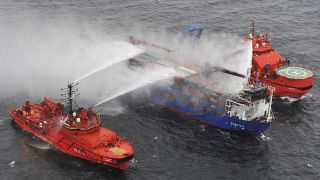 Zelensky confirms Ukraine was behind drone attack on Russian cargo ship in Gulf of Finland
Closer to home, the attack on the cargo ship Sparta II the day before in the Gulf of Finland conveys a different but equally important message. The ship was bound for Kaliningrad, the Russian Baltic enclave that serves as a key military and logistics hub. Due to Kaliningrad’s dependence on Russia, a collision with a ship heading there forces Russia to reconsider the safety of each incoming ship. Any additional security measures, whether escorting ships or strengthening port controls, will be costly and reduce operational flexibility.
Politically, the strikes create a problem that goes beyond any immediate military damage. Moscow has long presented its naval presence abroad as a sign of strength, reach and global relevance. When these symbols are struck, this narrative of strength becomes more difficult to maintain. Each successful Ukrainian operation forces Moscow to explain why a ship was vulnerable, why security failed and why the consequences of the war are spreading to new regions.
It also creates internal pressure, forcing military planners to think about how they will respond. Operations are also becoming much more complicated for naval commanders who must improve the security of their ships, while port authorities tighten procedures and commercial operators must reconsider itineraries. None of these responses is free and each adds cost, complexity and political visibility.
These strikes also complicate Russia’s relations with third countries whose waters or ports have been affected. Moscow cannot easily view these incidents as purely internal matters because they involve foreign territories, sea lanes and political interests.
Learn more Ukrainian drone strike sparks fire, inflicts serious damage on Krasnodar refinery
The psychological impact is perhaps the most underestimated consequence. War is not only about destroying assets, but also about shaping expectations. An army that believes its ships are safe in certain ports or at certain distances from the front must rethink its plans when its confidence is shaken. Russian commanders must now assume that any ship, anywhere, could be a target.
This pressure also extends to Russia’s trading partners and operators. Shipping companies, insurers, port authorities and local governments must now consider that they could be victims of collateral damage from Russia-linked maritime activity.
Ukraine cannot necessarily destroy the entire Russian naval and commercial fleet, but it can make it slower and more expensive. The likely trajectory is toward more attacks on high-value, slow-moving, predictable targets who cannot change their schedules or hide their movements.
If kyiv persists, the question will no longer be whether Ukraine can reach Russian ships beyond the Black Sea. It will be a question of how far kyiv can go and how far Russia can adapt before cumulative pressure begins to reshape its naval posture and the political narrative it has built around its global reach.
The author of this article confirmed that AI was used before submission to translate the first draft from Bulgarian to English.
Gn headline