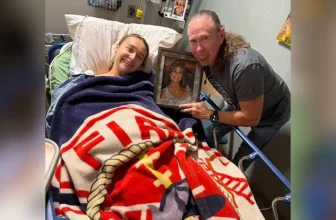
For two months, Mandi Budd has no longer been able to use her legs: she is paralyzed due to a mosquito bite which almost cost her her life.
The culprit was West Nile virus, a disease that is reaching levels in California not seen in more than a decade.
In 2026, the state recorded the second deadliest year on record, with 45 deaths and 617 infections so far.
“I’m happy to be on the good side,” Budd told AFP with a sigh.
“I could have been one of the victims of this virus, and that’s a terrifying thought.”
California has experienced unusually high heat and humidity in recent months, creating favorable conditions for mosquito breeding.
West Nile virus was first discovered in Uganda and did not reach the United States until 1999. Mosquitoes become infected after biting birds carrying the disease and then transmit it to humans.
It remains poorly understood, with no vaccine or specific treatment.
Most people who contract it have no symptoms or experience little more than a mild flu-like illness.
But some people are unlucky: In about 1 percent of cases, West Nile can cause a life-threatening brain infection, triggering neurological complications such as cognitive impairment and paralysis.
This is what happened to Budd, a consultant to humanitarian organizations, in September. She felt pain in her hip that she initially mistook for sciatica.
Finally, she collapsed when her legs could no longer support her.
Once at the hospital in Burbank, near Los Angeles, her fever rose to 103F (39.5C) and doctors fought to keep her alive.
“It’s scary,” she told AFP between physiotherapy sessions at the hospital, as she learns to stand again.
Budd said that after living most of her life in Florida — a southeastern state with a tropical climate, where mosquitoes are common — she never imagined she would contract a disease like West Nile virus on the West Coast.
“I didn’t expect to have this here in California, with its perfect weather,” Budd said.
– Impacts of climate change –
The extent of West Nile virus continues to grow, an expansion driven in part by climate change, said Ryan Harrigan, a biologist at the Center for Tropical Research at the University of California, Los Angeles.
“As the climate warms, these diseases that we historically considered more tropical in nature are moving north,” the researcher said.
“We’re seeing the same thing in Europe as well, this sort of northward march of West Nile virus toward temperate regions.”
This year, more than 2,000 cases of West Nile virus have been detected in 20 European countries, a record.
The most affected countries are Italy, Greece and France, where the virus is now spreading well beyond the Mediterranean regions.
California, for its part, experienced a record heat wave in the spring and a sweltering summer fueled by the El Niño phenomenon. The unusually warm fall was also marked by a tropical storm.
This created the ideal scenario for mosquitoes, which breed in stagnant water.
“We’re seeing favorable conditions for many of these vectors, starting in spring and well into winter. This prolongs the amplification cycles of West Nile virus,” Harrigan told AFP.
In Los Angeles County, where the outbreak is most severe, the first infected mosquito was detected in May, much earlier than usual.
That’s two months ahead of schedule, said Susanne Kluh, head of the local mosquito control authority.
Its teams take steps to inhibit mosquito breeding cycles, including treating storm drains with larvicide every month and releasing sterile male mosquitoes into the wild.
They also work to thwart breeding grounds on poorly maintained properties or in neglected pools.
But “it’s very difficult for us to be in everyone’s backyard,” she said.
Kluh advises locals and tourists to use mosquito repellent, especially at dawn and dusk.
The precaution is all the more important as the El Nino weather phenomenon increases precipitation in California, creating even more favorable conditions for mosquitoes as soon as the weather warms up.
Kluh said the key question is how long the increased rainfall will persist until spring and whether it will coincide with higher temperatures.
“Those are definitely concerns,” she said.
RFO/MDO/JGC
Gn Health