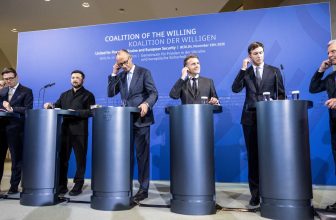
U.S. Special Envoy Jared Kushner during a joint press conference following the Coalition of the Willing summit in Berlin, Germany, November 19, 2026. (Halil Sagirkaya/Anadolu via Getty Images)
U.S. President Donald Trump’s envoy and son-in-law Jared Kushner praised Russian President Vladimir Putin and repeated the Kremlin’s controversial claims about Russia’s war against Ukraine in a Nov. 25 interview with Politico, offering insight into how one of Washington’s top negotiators views Moscow and its leader.
Kushner, who has met Putin at least four times and spent hours talking with him, rarely gives interviews. Ukrainian officials privately describe him to the Kyiv Independent as a useful asset in peace talks, saying he regularly brings new ideas to the process and is “heavily invested” in reaching a deal – unlike fellow US envoy Steve Witkoff.
“Jared is always on his MacBook, writing something and coming up with new ideas,” a senior Ukrainian official familiar with the peace talks told the Kyiv Independent.
But Kushner’s comments in the interview suggest that his views on the war and its instigator – Vladimir Putin – are closely aligned with those of Russia.
Throughout the interview, Kushner repeatedly praised Putin’s leadership and appeared to accept several Kremlin narratives about the war, some of which even Trump himself later questioned.

'A grandmaster of politics'
Throughout the interview, Kushner described Putin as a “grandmaster of politics” and “a historical figure” who “wants peace.”
“People may not like what he did, but he is undoubtedly a great master of politics,” the envoy said. “My assessment is that he doesn’t just want peace, he wants to try to change the relationship with America.”
The praise comes despite Putin’s record of transforming Russia into an increasingly authoritarian state, dismantling independent media, crushing the political opposition and jailing and killing his critics, including prominent opposition figures.
On the international stage, the “grandmaster of politics” has launched a full-scale invasion of Ukraine in 2022, apparently expecting a quick victory and the subjugation of kyiv.
Instead, the war escalated into a bitter conflict that cost enormous numbers of lives and depleted Russia’s resources, while Ukrainian strikes destroyed about half of the country’s oil refining capacity.
Kushner’s assertion that Putin wants to improve relations with Washington also overlooks Moscow’s support for countries hostile to the United States.

In April, US General Dan Caine, chairman of the Joint Chiefs of Staff, confirmed that Russia supported Iran in its war against the United States.
Moscow has provided Tehran with intelligence and weapons since the start of the conflict and has also helped Iran target U.S. military assets in the Middle East to help it kill American soldiers, although the White House has downplayed the importance of that support.
Putin has also repeatedly rebuffed Trump’s efforts to negotiate an end to Russia’s war against Ukraine, rejecting or not accepting several proposals from Washington.
kyiv, by contrast, agreed to an unconditional ceasefire in March 2025 – the very measure Trump had sought from both sides.
Moscow’s continued refusal to agree to the same terms has prevented Trump’s ceasefire efforts from producing the breakthrough Washington hoped for.
Kushner went further, saying the Russian president had “shown restraint” by not using nuclear weapons against Ukraine. Even though Russia has not launched a nuclear strike, its conventional attacks continue to kill Ukrainian civilians daily.
Russian attacks across Ukraine on November 25 killed at least 10 people. The Kremlin’s stated interest in peace was also on display in kyiv just hours after the Kushner interview. Late on November 25, Russian forces launched a massive ballistic missile attack, hitting a shopping center in the capital and injuring seven residents.
Kushner called European military assistance to Ukraine a “proxy war” against Russia. This assertion was not disputed during the interview, although it overlooked a fundamental distinction: Ukraine is defending itself against a full-scale Russian invasion, while European countries are helping a sovereign state resist that aggression.
Their support did not start the war; Russia’s decision to invade did just that.
Throughout the interview, Kushner repeatedly praised Putin and described Russian envoy Kirill Dmitriev as an “incredible friend.” He was less complimentary when discussing President Volodymyr Zelensky, accusing the Ukrainian leader of attacking Trump and suggesting he should show the U.S. president more respect.
Repeating disputed Russian claims
Kushner’s praise of Putin was accompanied by comments that echoed a Russian claim about an alleged Ukrainian attack on the Russian president’s residence — an accusation that Trump himself later questioned.
According to Kushner, peace talks between Ukraine and Russia have stalled in early 2026 after kyiv allegedly attacked Putin’s residence in Valdai.
Kushner said he had been asked to join peace negotiations in November 2025, as Washington was “making progress.”
“Then there was the Ukrainian-led attack on Putin’s house in late December, which I think set him back,” Kushner said.
The incident he is referring to took place on December 29, when Russia accused Ukraine of launching 91 drones at a residence used by Putin. This allegation emerged while peace negotiations between Ukraine and Russia were underway.
Putin personally raised the accusation with Trump in a phone call. Trump initially said he was “very angry” about the alleged attack, but later expressed skepticism after reviewing additional information.

“We don’t think that happened now that we’ve been able to verify it,” Trump told reporters aboard Air Force One on January 4.
Zelensky dismissed the Russian allegations on December 29, calling them a “new lie,” saying Moscow was using them to justify further attacks on kyiv.
The US Central Intelligence Agency (CIA) also assessed that Ukraine had not targeted a residence used by Putin, confirming kyiv’s immediate denial.
Kushner’s remarks raise questions about how he interprets Russia’s claims at a time when he is helping to lead U.S. efforts to negotiate an end to the war.
While Ukrainian officials view him as a committed negotiator who brings new ideas, his interview suggests he continues to take Moscow’s speech at face value — even though it has been challenged by his own president and by U.S. intelligence assessments.
Gn headline