
Photo by Gareth Cattermole/Getty Images for Warner Bros.
When a 1996 issue of Tiger Beat asked Brad Pitt about his favorite actress, the safe money was on another idol. Julia Roberts, maybe. One of his explosive co-stars. Instead, he brought in a theater-trained actress in her forties and quietly rewrote the terms of the fantasy. “She’s my favorite actress. For me, Dianne Wiest is the most beautiful woman on screen,” Pitt said. Adolescent brain cells didn’t stand a chance, everywhere.
The day Brad Pitt crowned his greatest actress
By the mid-’90s, Pitt had gone from active actor to certified phenomenon. His short but seismic tour Thelma and Louise
turned it into a poster on the walls of a million bedrooms, and Hollywood quickly decided its job was to smolder at just the right time. The James Dean comparisons arrived. The studios treated him like a walking cheekbone.
Pitt, for his part, didn’t entirely believe it. When reporters tried to introduce him as the new dean, he pushed back. Why copy a legend whose story ended in a car accident at age 24 when you’re trying to survive yours? Instead, he spoke of integrity and longevity, singling out Robert Redford as one of the few men he truly admired. “I appreciate old movies because they show a man who stands up for his principles,” Pitt said in the same conversation with Tiger Beat. Redford, to him, was the kind of man men wanted to be and women wanted men to be.
In this context, his answer about actresses seems even more precise. Pitt drew a clear line between hype and substance. “The greatest actors are not the ones who are considered sex symbols,” he said. Then came the kicker: his favorite actress was Dianne Wiest, and in his eyes, she was the most beautiful woman to ever appear on screen. For a teen magazine built on smashed shiny objects, it was a small act of rebellion.
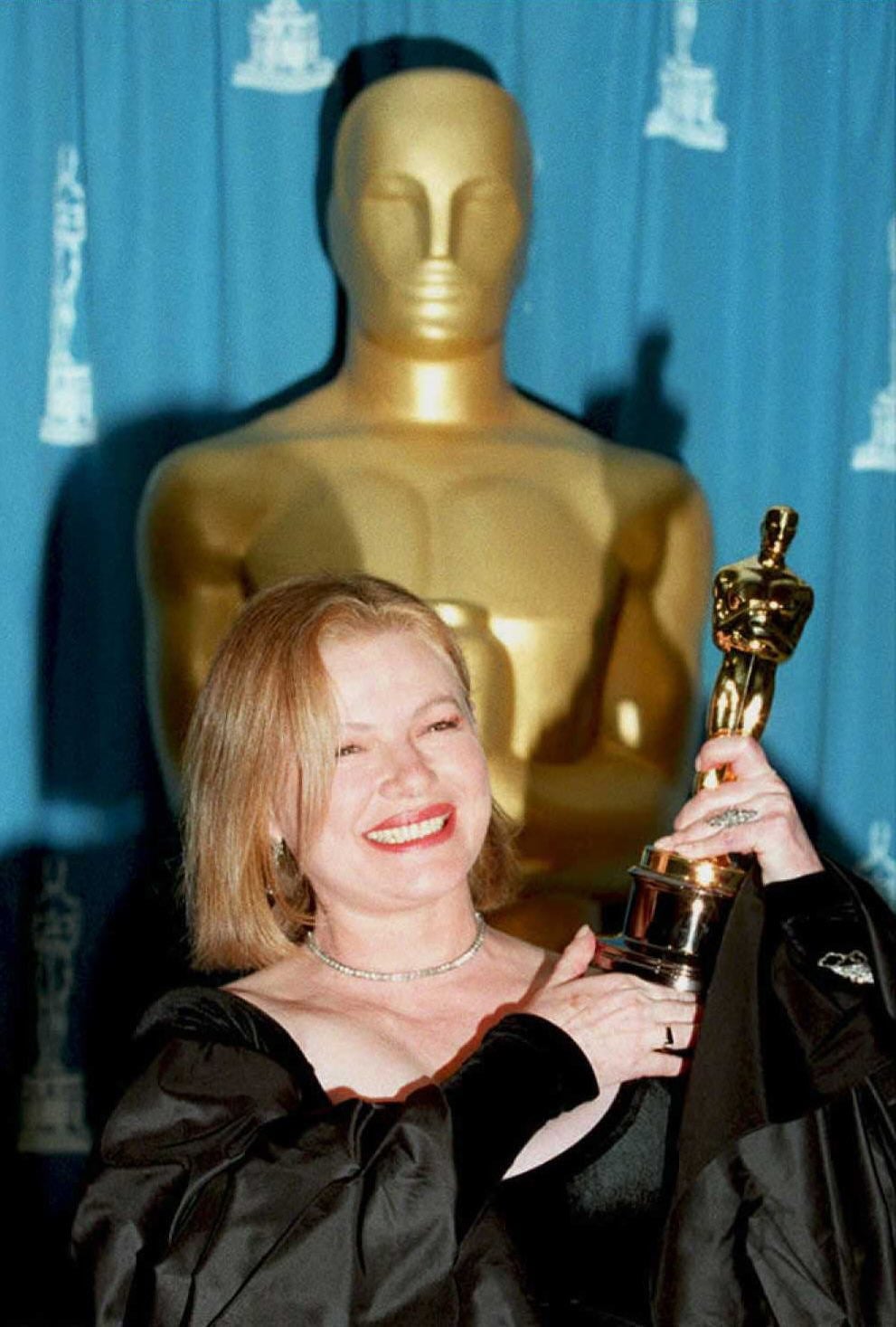
LOS ANGELES, UNITED STATES: Actress Dianne Wiest smiles as she holds the Oscar she won at the 67th annual Academy Awards March 27 in Los Angeles. Weist won the Academy Award for Best Supporting Actress for her role in “Bullets Over Broadway.” AFP PHOTO (Photo credit should read JEFF HAYNES/AFP via Getty Images)
Beauty, Sex Symbols, and What Brad Pitt Really Likes
Pitt was also quietly dismantling the idea that beauty is what your eyes take in in the first three seconds. “When you look at someone, do you only notice their appearance? It’s just a first impression,” he said, before describing the person who doesn’t catch your eye at first but who becomes “the most beautiful in the world” as soon as you talk to them. This is the kind of thing you expect to hear from your wisest friend at 2 a.m., not the guy on the Calvin Klein mood board.
Consider the dissonance: the industry is selling Pitt as the ultimate surface, and he’s sitting there telling a teenage audience that the surface is the least interesting part. He separates his own image from his job in real time. The sex symbol label may sell tickets, but in its hierarchy it sits below the principles, conversation, and quiet electricity of a fully inhabited character.
By choosing Wiest as his “prettiest,” Pitt is actually choosing a value system. It aligns beauty with moral weight, wit, vulnerability, and the way a face can rearrange itself around a single devastating reading. It’s less “Who’s hot?” » and more “Who makes you feel something honest?”
Who is Dianne Wiest?
If your Wiest point of reference begins and ends with “the mom in this movie,” your watchlist needs urgent attention. Born in Kansas City in 1948, Dianne Wiest was educated in theater, then spent the ’80s and ’90s quietly dominating every movie smart enough to cast her. By the time Pitt was talking about her in 1996, she already had two Best Supporting Actress Oscars, both with Woody Allen: Hannah and her sisters And Balls on Broadway.
Wiest’s filmography reads like a program of controlled feeling. In Edward Scissorhandsas Peg Boggs, she plays the kind of suburban mom who could have been a joke but instead becomes the beating heart of the film, all sweetness and rugged kindness. In The bird cageshe’s the bourgeois wife who gradually loses her grip on decorum, her comic timing so precise you can practically hear the editors constructing cuts around her reactions.
His gift is vast without brilliance. She can go from fragile to fierce in a single scene, often in the same sentence. This is true in little cult favorites like Practical magic
and in television work such as In treatmentwhere his psychologist has raw nerves and enormous empathy. Wiest is rarely the one on the poster, but she’s the one you keep thinking about on the way home.
Gn entert