Raam party leader Mansour Abbas asserted in an interview broadcast Saturday evening that he and his Arab-majority party consider Hamas a terrorist organization, potentially removing a major obstacle to his party joining a government led by Yashar President Gadi Eisenkot.
Interviewed by Channel 12, Abbas avoided making an explicit statement, but confirmed that his party had co-sponsored a bill introduced this week in the Knesset that describes Hamas as a terrorist organization, and that he himself had voted for.
He also said he affirmed the four conditions set by Eisenkot as conditions for joining his coalition, namely that he recognize Israel as a Jewish and democratic state, that he accepts the values of the Declaration of Independence, that he supports compulsory national service for all citizens, and that he recognizes Hamas as a terrorist organization.
The interview comes as party leader Yashar continues his efforts to build a coalition, eight days before the end of his mandate. Reports have indicated that Eisenkot is preparing to form a government next week, with his 48-seat four-party bloc joined by the Haredi United Torah Judaism party and with support from Ra’am and a backstop from the Joint List.
Prime Minister Benjamin Netanyahu on Saturday made a last-ditch attempt to push for a so-called unity government, offering Eisenkot the top spot in a rotation government that would include all of Netanyahu’s allied parties and exclude Arab-led parties, which the prime minister again called “supporters of terrorism” in his statement. Eisenkot responded to the statement with skepticism, but agreed to meet Netanyahu on Sunday morning to discuss the offer.
Raam – who was an integral part of the government led by Naftali Bennett and Yair Lapid from 2021 to 2022 – has said he wants to be part of the next government coalition. A Jewish candidate, Yoav Segalovitz, joined the party and ran as his party’s No. 2 candidate in last month’s elections, aiming to broaden his base and signal his willingness to play a role in government.
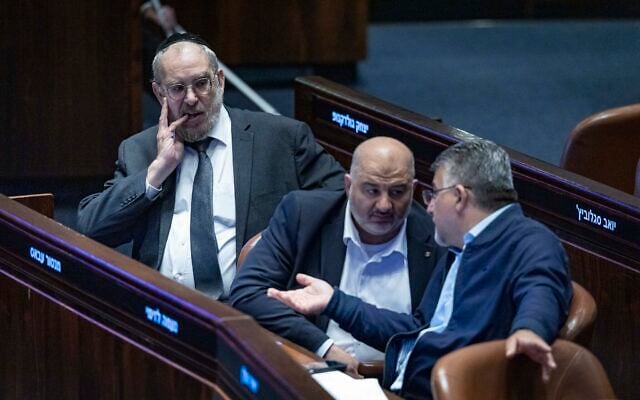
Abbas said again on Saturday that he wanted to be part of Israel’s next government, adding that he hoped his designation of Hamas as a terrorist group would put the issue aside after it became one of the hottest political issues following last month’s elections.
In response to the interview, Netanyahu’s allies accused the Arab party leader of lying, with National Security Minister Itamar Ben Gvir saying: “You were a liar! You will always be a liar!”
“It is interesting to see that now, just before receiving the presidency of the government, you remember that these monsters raped, murdered and massacred us. We do not believe you!” declared the far-right minister.
To explain himself, Abbas said his party had co-sponsored a bill introduced this week in the Knesset that describes Hamas as a terrorist organization, and which he himself had voted for.
Asked by interviewer Dana Weiss, she read the text of the bill, which calls for the creation of a state commission of inquiry into the Hamas-led invasion on October 7, 2023. Abbas read: “…the Hamas organization, along with other terrorist organizations, in a large-scale terrorist attack from the Gaza Strip against the State of Israel…”
“Now you are a signatory to this bill, right? Weiss asked him.
“Yes,” Abbas replied.
Weiss said, “And what does it say here?”
Abbas replied: “Terrorist organizations, first and foremost Hamas. »
“זהו, נגמר האירוע”: יו”ר רע”ם מודה בריאיון לדנה ויס – חמאס הוא ארגון טרור
צפו בריאיון המלא | https://t.co/enxRqaGkSq pic.twitter.com/P0U7p1h3Mv
– החדשות – N12 (@N12News) November 28, 2026
“The only way to understand this is that a bill that you signed…contains black and white writings…” Weiss said as she waited for him to finish his sentence.
“You define Hamas as a terrorist group,” Abbas responded.
“So we closed this issue?” » she asked.
“For me, this issue has been closed for some time,” Abbas said.
Later in the interview, Weiss and Abbas returned to the issue.
Abbas: “You have the bill, don’t you?
Weiss: “Yes. »
Abbas: “What is written is what is written. »
Weiss: “Which one?” »
Abbas: “Hamas is a terrorist organization. Don’t you see that written here? That’s all, case closed.”
“Our hesitation as to whether or not it was about their actions, their position or their conduct. We condemned and defined these actions as terrorist actions, full stop, etc. But there are people who are using this as a political instrument, and so they have pushed us into a corner. Beyond that, we also want to make sure that this is not used to declare total war on every Palestinian baby, on every Palestinian woman, on the entire Palestinian people,” he declared.
He further clarified that someone “defined everyone in the Gaza Strip as Hamas, as a terrorist organization, meaning they would eliminate them all, or expel them all, or throw them into the sea. And so the reason I’m careful about how I express myself is because I don’t want to sound like I’m giving approval or support for (this person) to do what they want.”
Eisenkot set four conditions for potential coalition partners in any government he leads, and Abbas’s comments in the interview appeared to satisfy them. He confirmed in the interview that he recognized Israel as a Jewish and democratic state, accepted the values of the Declaration of Independence, supported compulsory national service for all citizens and recognized Hamas as a terrorist organization. This latter condition also speaks of a commitment to dismantling Hamas’ military capabilities and governance, a sub-clause that Abbas has not specifically confirmed.
“My life is certainly threatened”
“Did you put your family in danger?” Weiss asked Abbas, who has previously said that declaring Hamas to be a terror group could potentially endanger him and his family.
“Someone will think, he’s our enemy, let’s go eliminate him,” he said.
Abbas said some Israeli Arabs told him not to label Hamas a terrorist organization, while others urged him to do so in order to “already close this chapter.”
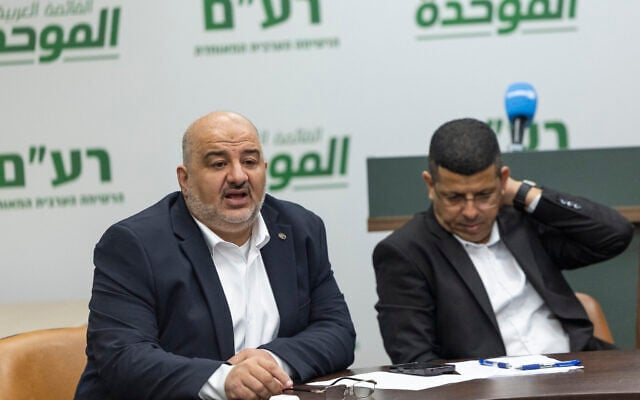
He also said he had “made peace” with the idea that he might be assassinated – presumably by someone on the right – for supporting the coalition that Eisenkot is forming.
Abbas warned that if Arab parties did not operate differently in an environment of incitement by political figures against Arabs, there would be a repeat of the internecine violence that ravaged mixed cities in 2021.
Abbas also criticized the Joint List party’s decision to stand down during the singing of the Israeli national anthem during the Knesset swearing-in on November 10. All MPs from Abbas’s party, except him and Segalovitz, also left the party.
The event, he said, “was meant to be an expression of a different approach to political behavior on the part of all Arab parties, not just Raam.”
He pointed out that in the past, Joint List faction leaders would stay in the room without singing. “Stand and give respect to this state occasion,” he said.
Expanding on his party’s role in a possible Eisenkot-led government, Abbas said Raam “does not enter a government to decide and manage Israel’s security and foreign policy,” amid accusations that a coalition that depends on Arab parties will not be able to go to war against Israel’s enemies.
“We want to protect the personal security of people in general, and in particular that of Arabs,” Abbas stressed.
The goal of negotiations with Eisenkot is not only to replace Netanyahu, he said, but also to “create a government that will last four (full) years and work.”
He stressed that his party is “in a state of preparation; we want to see that coalition building moves forward, step by step, deal by deal.”
Abbas also explained that the prime minister’s speech during the Knesset swearing-in – in which Netanyahu accused Arab parties of supporting terrorism – prompted him to go public with how Netanyahu had told him about an implicit deal he had with Hamas leader Yahya Sinwar in 2021.
In the Channel 12 interview, Abbas said he was thinking about the “huge gap between the man who attacks us, incites us to attack us, accuses us of being supporters of terrorism… (and) the conversation I had with him at (the prime minister’s residence) on Balfour Street, during Operation Wall Guard, in which he told me about his relationship with Sinwar.”
“Let them both understand each other,” he said.
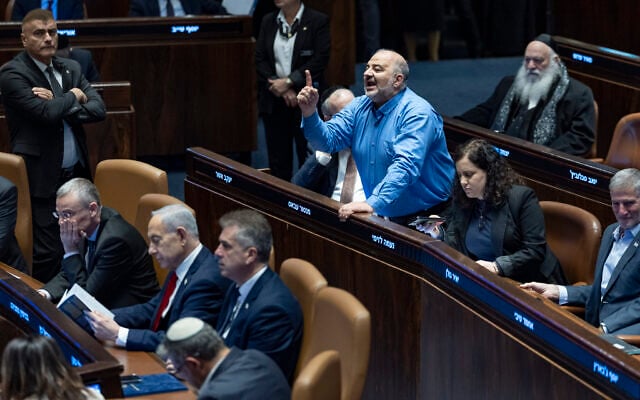
Shortly after Netanyahu’s angry speech earlier this month, in which he denounced the Knesset’s two Arab-majority parties as unsuitable partners for government and accused their members of seeking to destroy Israel and supporting terrorism, Abbas revealed the conversation for the first time.
He said he had intended to reserve the conversation for a commission of inquiry into October 7, but decided to make it public after being attacked at an event meant to be a non-political celebration.
Netanyahu’s Likud party said Abbas’ claims were “a complete lie”, adding: “Nothing like this has ever happened.”
Gn world