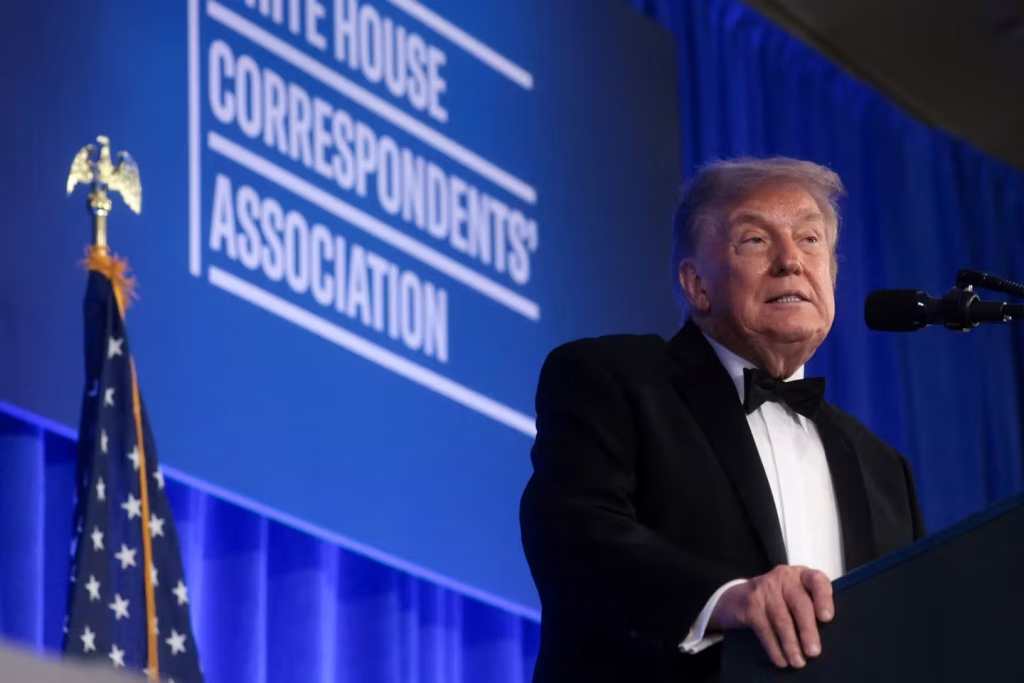

Launched almost two years ago, the controversy surrounding H-1B visas was reignited by the new draft regulations from the Trump administration published last week. This text would require employers to pay a one-time fee of more than $100,000 for any new application for a temporary visa for skilled workers. A sum that would be added to the current costs, which range between $2,000 and $5,000.
This is not the American president’s first attempt: he had already published a presidential decree in September 2025 imposing a temporary fee of $100,000 on H-1B visa applications. The measure was finally suspended last June by a federal judge, who ruled that this payment constituted an illegal tax.
Also readTo force immigrants to “self-expel,” Trump relies on fines
While this decree only applied to people applying for a visa from abroad, the new Trumpian version seems to extend to foreign nationals residing in the United States on a student visa. However, the latter represent a growing share of H-1B visa beneficiaries.
The new regulations should take several months to come into force, but they promise many virulent reactions. Billionaires in the US tech sector – the largest employer of H-1B visa workers – have spoken out in the past in favor of the program, which they say helps attract the world’s brightest minds to Silicon Valley.
Its detractors, both on the left and on the right, denounce a system aimed at filling low-skilled positions with underpaid foreign workers who are entirely dependent on the goodwill of their employers to be able to live and work in the United States.
A visa system that “has been subject to massive abuse”
Each year, the US government issues 85,000 H-1B visas, of which 20,000 are reserved for holders of a postgraduate degree obtained at a US institution. This figure is significantly lower than the number of requests recorded by employers, which exceeded 344,000 in 2025. Each year, in April, the government therefore organizes a draw to determine which requests will be accepted.
More than half of the holders of this visa work in the IT sector: technical assistance, programming, systems analysis, etc. Moreover, almost three-quarters of H-1B holders were born in India.
Supporters of Donald Trump’s reforms point to the growing role of IT recruitment and outsourcing agencies, often based in India, in filing H-1B visa applications. According to them, this model allows American companies to outsource the recruitment of foreign workers to third-party companies, which avoids them having to comply with legal provisions requiring them to pay visa holders the same salaries as their own employees.
Also readIn the United States, the Supreme Court strengthens the migratory tightening desired by Trump
According to the American government, several large American companies – whose names it does not disclose – obtained the validation of thousands of visa applications for foreign workers while at the same time laying off thousands of employees. A computer engineer even filed a lawsuit against Tesla in 2025, alleging that Elon Musk’s company hired approximately 1,355 H-1B visa holders while laying off more than 6,000 employees in the United States.
“This (visa) system has been massively abused,” according to Hal Salzman, professor of planning and public policy at the Edward J. Bloustein School and senior fellow at the John J. Heldrich Center for Workforce Development in New Jersey.
For this expert, the idea that H-1B visa holders would fill a chronic shortage of qualified labor does not hold water: “We must ask ourselves why the information technology sector is the only one to maintain for more than 25 years that there is a shortage, without managing to remedy it. These jobs require skills and a certain talent, but not a doctorate level. (…) These are not very rare positions but common jobs in IT support and administrative services.”
Workers in a state of “contractual servitude”
Although its advocates say it aims to address labor shortages, nothing in the H-1B program requires companies to prove that they first attempted to fill their positions with U.S.-born workers. Online debates about these visas therefore often take a nativist and sensationalist turn among Trump supporters, but this program has fierce opponents in both the ranks of Democrats and Republicans.
Also readIn the United States, even soldiers’ families are no longer spared from ICE
Democratic Senator Bernie Sanders, in particular, described this system as “contractual servitude” in 2025. For years, Republican Senators Chuck Grassley and Democrat Dick Durbin have been campaigning for new legislation aimed at increasing the wages of foreign workers and forcing employers wishing to recruit H-1B workers to publish their job offers on the Department of Labor website.
“The fundamental problem with this program is its labor policy, not its immigration policy: what it seeks to do is define the rules governing the labor market, because foreign workers – such as H-1B visa holders – do not enjoy the same (employment) rights as a citizen or permanent resident,” explains Ron Hira, lecturer in the political science department at Howard University in Washington.
This fervent defender of H-1B visa reform explains that the total dependence of foreign workers on their employers prevents them from demanding better wages or better working conditions, or even from defending themselves against abuse in the workplace. H-1B visas last on average between three and six years, and access to permanent residency depends on whether their application is sponsored by their employer.
“In the case of the H-1B, it is the employer who holds the visa and who controls the legal status of the worker. The latter, in the event of dismissal, must leave the country within 60 days”, continues Ron Hira, who illustrates his point with a concrete example: “If you are a worker, in the United States for four years and wish to stay permanently, and your employer tells you: ‘If you do not stay until 10 p.m., I will fire you’, or if he threatens you, you will be much more docile, right? Your negotiating power is much less. This therefore places these workers in a situation of inequality.
A fee of 100,000 dollars not necessarily dissuasive for employers
Workers’ rights advocates have long called on the US government to review salary rules for foreign workers, which currently allow H-1B visa holders to be paid much less than workers born in the United States for the same skills and position.
This pay gap is on average 16% to the disadvantage of foreign workers, according to an article by economist George Borjas published last February. A salary gap that would even reach 30% for software developers and computer programmers, according to this expert who was also senior economist at the Council of Economic Advisers (2025-2026) – a group responsible for advising the American president on economic policy. Other economists have disputed his findings.
Also readLand law in the United States: 150 years of jurisprudence at the heart of the standoff launched by Trump
While Donald Trump wants to increase the cost of H-1B visas for employers, another proposed regulation initiated by the Department of Labor tackles the problem from a different angle. It aims in particular to raise the salary threshold for H-1B visa holders by doubling the minimum range of remuneration offered to them – while keeping them below the median income in the United States.
For Hal Salzman, “these set wage levels do not reflect the real market wage, that is, what employers pay in the market for a given skill level. They were therefore able to underclassify these workers, which allowed them to legally underpay them. This is an attempt to classify them more correctly at adequate wage levels.”
For his part, Ron Hira understands the logic of the fee proposed by Donald Trump. “This increase in fees actually attacks the profitability that employers get from these workers,” he explains. “It will force them to be more demanding and more selective regarding the profiles for which they submit an H-1B visa application.”
The amount requested – more than $100,000 – is not going to deter all employers, the expert continues: “This may seem like a large sum, but in the case of an H-1B visa valid for six years, it represents between $16,000 or $17,000 per year. Which is not a huge sum considering salary scales in the United States.” And Ron Hira concludes: “So this will push employers to say to themselves: ‘If I can earn $30,000 per year from this employee, then it’s worth paying this $16,000 per year.'”
This article has been adapted from English, you can consult the original here.