Black holes do many things.
They sit in space, sucking in matter, drawing space-time around them like a cozy blanket, and firing powerful jets of plasma at near the speed of light.
What they’re not particularly good at is letting go.
But when physicist Antonino Flachi of Keio University in Japan built an analog black hole on a chip, something strange happened at its tiny event horizon – something that, in a real black hole, would be forbidden by the laws of general relativity.
When he drilled a hole – metaphorically speaking – the black hole started leaking.
It’s an experiment that gives physicists a new tool to determine which properties of black holes are universal – and which might change when the rules of physics change.
“Digital circuits thus form a reconfigurable class of gravitational analogs,” writes Flachi in a preprint (yet to be submitted for peer review) uploaded to arXiv, “and realize an analog black hole as a cellular automaton.”
 ))>
Their tendency to absorb light and let nothing detectable escape their event horizons means that they are invisible to most of the tools we use to study the cosmos – telescopes that rely on the electromagnetic spectrum.
However, the mathematics describing the behavior of black holes can be used to construct laboratory experiments that replicate some of their properties and behaviors so that we can study what they are capable of.
One way to do this is to use sound.
Sound waves traveling through a moving fluid can behave very similarly to light traveling through curved spacetime around a black hole. If fluid flows inward faster than sound can move outward, the sound waves are trapped and unable to escape the current.
This creates what physicists call an acoustic black hole.
But what if you could build an acoustic black hole without all the mess of speakers, fluids, and currents?
This is what Flachi did, replacing the entire kit and kaboodle with a compact digital circuit.
“We built an analog black hole from logic gates,” he writes.
“Its horizon is not a property of wiring but of state: a closed curve in a 32-bit word array along which the emergent flow carries disturbances inward exactly as fast as they propagate outward.”
He calls his system a “digital acoustic black hole,” a circuit that contains a grid of cells, each storing information as a series of bits – the ones and zeros that form the basis of digital computing. The grid stored a total of about 604 million bits.
With each tick of a clock, logic gates update information in each cell according to a set of rules based on fluid dynamics, creating the digital equivalent of water flowing down a drain.
These rules also govern how disturbances travel through the network. Where the simulated flow carries these disturbances inward as fast as they can move outward, an acoustic event horizon emerges.
Unlike a physical fluid, which can be unpredictable and difficult to control, the precisely defined rules for the digital acoustic black hole make the digital fluid much more controllable. Experiments can even be repeated under identical conditions, down to individual bits.
To test his creation, Flachi measured five properties of the simulated black hole: the stability of its event horizon, the horizon itself, how disturbances propagate through it, its response to disturbances (the ringdown), and a phenomenon called superradiance, in which waves can gain energy from a rotating black hole.
He played brilliantly. The event horizon remained stable for 3 hours and the circuit demonstrated ringing and superradiance, consistent with mathematical predictions.
But Flachi became curious. He wanted to know what would happen if he changed one small thing.
Inside the event horizon it turned around A of the system’s 604 million bits – and it was as if the black hole had sprung a leak.
The reversal of the drill created an acoustic disturbance in the black hole. Most of it remained contained beyond the event horizon – as you would expect for something happening behind that boundary.
But a small fraction of the disturbance escaped, carried by short-wavelength waves that could propagate faster than the effective speed of sound in the circuit.
So the event horizon worked as expected for longer waves, but was not as impenetrable for shorter waves.
And the more Flachi turned the bit towards the interior of the horizon, the less the disturbance escaped. The leakage decreased exponentially with distance from the boundary.
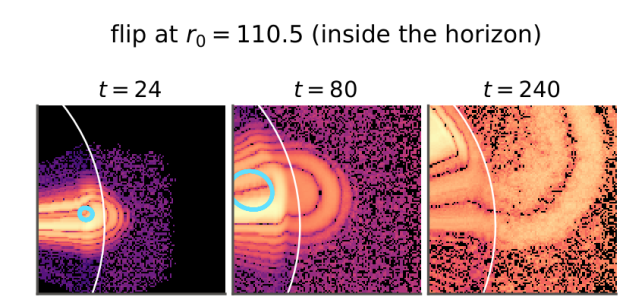
This doesn’t mean that real black holes have leaky event horizons, but it does reveal something important about black hole analogues. The behavior of their horizons is not necessarily universal, but may depend on the underlying physics of the system in which they emerge.
And Flachi’s system offers a new way to stitch them. He showed that a functional analogue of a black hole can be constructed entirely from digital logic – logic whose underlying rules are precisely known and finely controllable.
This means it can be used to probe the physics of black hole horizons and to explore new scenarios that reveal what might be possible if the rules of physics were bent just one iota.
The paper has not yet been peer-reviewed, but a preprint is available on arXiv.
This article was fact-checked by Rebecca Dyer and edited by Rebecca Dyer. Although we are proud of our process, we are only human. If you spot an error, please let us know.
Gn tech