Thanks to its Intel Arc G3 Extreme chip, you get top-notch graphics for $350 less than its closest rival.

RATING: 8.2 / 10
- More affordable than the MSI Claw 8 EX AI+
- Excellent performance
- Bright 8-inch screen with 120Hz refresh rate
- Comfortable and familiar layout
- Solid battery life
- Still quite expensive
- Speaker sound is distorted at high volumes
- No USB-A port
Modern handhelds began as add-on devices, compact systems designed to help you play on the go when you didn’t have access to your powerful setup at home. But as the category has matured, we’ve seen manufacturers seek higher levels of performance. This has culminated more recently with systems like MSI’s Claw 8 EX AI+, which offers serious graphics power at an equally serious $1,800 price tag. But now Acer is trying to undercut the current framerate champion with the Predator Atlas 8, equipping it with the exact same chip used in MSI’s machine, but for $350 less. The result is a compelling package that hits many of the same heights while easing the burden on your wallet.
Design and display

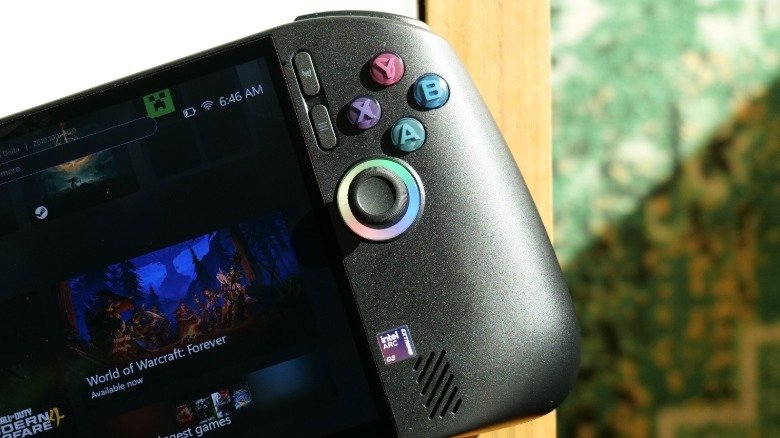
With the Predator Atlas 8, Acer hasn’t strayed too far from the base model we’ve seen on so many other laptops. The middle of the system is dominated by a large 8-inch TFT LCD display with 120Hz refresh and a respectable 500 nits of brightness. On the outside, you get TMR analog sticks as well as an Xbox-style button layout. I have to admit that I’m not a huge fan of Acer’s circular D-Pad because it’s a bit mushy and doesn’t feel very precise. But if you don’t play fighting games or similar titles, it’s more than useful for navigating menus. And if I’m really nitpicking, the colors on the Predator’s TFT screen aren’t as rich as what you get from MSI’s machine, but it’s the kind of difference you only really notice when you look at the two systems side by side.
On the back, Acer included a pair of rear paddles, two shoulder buttons, and analog Hall effect triggers with plenty of travel, the latter of which are perfect for racing games. Along the top edge of the system, you’ll find all of the Predator Atlas 8’s ports, which include two USB-C jacks with Thunderbolt 4 support, a microSD card reader for expandable storage, a 3.5mm audio jack, and a power button with an integrated fingerprint reader.
 Sam Rutherford for Engadget
All told, this is a pretty standard setup, although the Predator doesn’t have a USB-A port like the one on the MSI Claw 8 EX AI+. I also noticed that while the Acer’s dual two-watt speakers can get surprisingly loud, the sound distorts at higher volumes (above 50 TK), resulting in crackly or crunchy sound. That said, the speakers are so punchy that I found I never really needed to turn them up that high. Unless you’re trying to throw a house party with this thing, you might not even notice.
Performance and software

The real star of the Atlas 8 is its Intel Arc G3 Extreme processor, which is the exact same chip used in the MSI Claw 8 EX AI+. The main difference is that Acer’s handheld has 512GB of storage instead of 1TB and 24GB of shared memory (compared to 32GB on the MSI). This gap almost entirely explains the price gap between the two systems. But for people looking for top-notch performance while trying to save a few bucks, the framerate delta in games isn’t as pronounced as you might think.
When I tested this in Cyberpunk 2077 at 35 watts in FHD, medium graphics, and XeSS tuned for performance, the Predator Atlas 8 achieved 88 fps, just over five percent less than the 95 fps I got with the Claw 8 EX AI+. But it’s important to note that this used Acer’s highest performance mode. When I set the system to 15 watts (which you could do while playing on battery power alone), the Predator and Claw were essentially dead, even in Back in FHD and average graphics (60 fps for the Acer against 59 fps for the MSI). This means that if you’re trying to choose between the two, you really need to think about how you plan to use your handheld and what types of games you’ll be playing.
Similar to other high-end Windows handhelds, the Atlas 8 comes with Microsoft’s Xbox Experience. This software lets you boot into a dedicated gaming user interface instead of having to deal with the traditional desktop operating system. This also makes it super easy to download all the most popular launchers and storefronts like Epic, Steam, Battle.net and more, and since it’s Windows underneath, you get better compatibility than you get from SteamOS-powered laptops. That said, if you’re the type who travels with a portable monitor, keyboard, and mouse, you can always switch to the classic Windows interface to get some work done as well.
Battery life

The Atlas 8 is powered by an 80Wh battery which provides ample longevity, although it can vary significantly depending on what you’re playing. However, without even doing anything to increase its longevity, I was able to play World of Warcraft: Forever in FHD on medium settings for an hour and 45 minutes on a single charge while maintaining frame rates consistently above 90. On the other hand, when I played a less demanding title like Warhammer Survivors, The Acer machine had more battery life than I knew what to do with: it lasted more than three hours before needing to be plugged in. Notably, both of these games were played using the handheld’s 30-watt Balanced Performance mode, so if you’re not afraid to play around with its settings, there’s plenty of room to tweak this thing to get even longer tetherless gaming sessions.
Conclude

I’m still not sure how I feel about handhelds that cost well over $1,000. To me, that’s just a ton of money to spend on a system that can’t multitask as well as a similarly priced gaming laptop. However, for mobile gaming enthusiasts looking to strike the right balance between price, performance and portability, Acer has carved out an interesting niche for itself with the Predator Atlas 8.
At $1,450, it costs $350 less than the MSI Claw 8 EX AI+, while sporting the exact same processor and offering essentially 95% of the performance. That said, Acer’s more affordable price leaves the Predator with slightly less RAM and storage, although having a microSD card slot is a workaround for the latter. There are also some minor differences, like the lack of a USB-A port, a slightly less colorful TFT screen, and speakers that sound a little wonky at high volumes. But these flaws could very well be a worthwhile compromise for anyone looking for optimal handheld gaming performance without completely breaking their budget.
Gn tech