
The AI boom has been supporting U.S. growth for more than a year. But Jan Hatzius, Goldman Sachs’ chief economist, says that support is about to peak, and Torsten Slok, Apollo’s chief economist, says the benefits that were supposed to replace it haven’t materialized.
“Despite massive investments and widespread hype around artificial intelligence, the technology has brought no financial gains to U.S. businesses outside of technology,” Slok wrote in a note Saturday.
Hatzius wrote in a note to clients on Monday that the growth impulse from the AI boom is expected to peak in late 2026 or early 2027 “even before concerns about the sustainability of the AI investment boom intensify in recent weeks.”
AI is one of many reasons why Hatzius believes the risks to growth are to the downside. Prices of gasoline, diesel, jet fuel and natural gas in Europe and Asia have returned near or above their March and April peaks on fears of further escalation in the Middle East. Long-term interest rates have risen by about 100 basis points on average across developed market yield curves since the start of 2026. Hatzius attributes this rise in part to large deficits and “AI-related borrowing”, and estimates that this will subtract a cumulative 0.6% from GDP if it lasts.
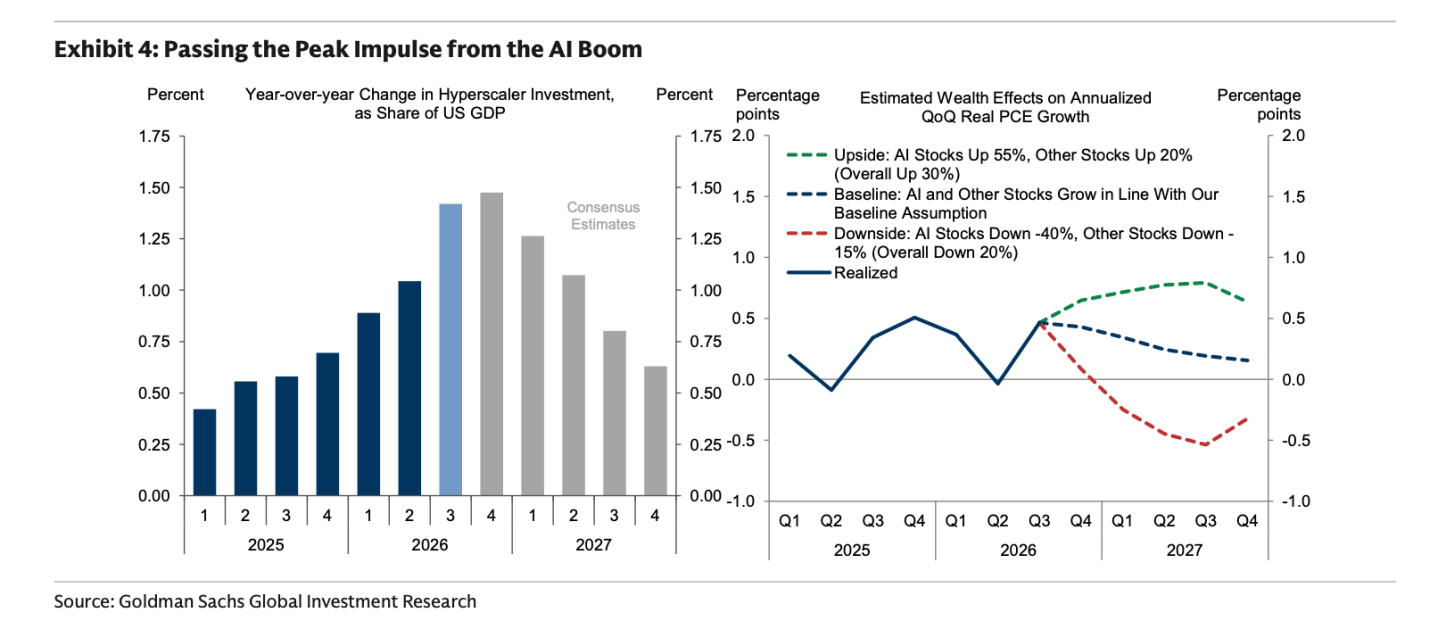
Investments in AI continue to increase rapidly, Hatzius wrote. But he expects growth as a percentage of GDP to slow over the next year. This, coupled with the diminishing effect of increased depreciation reserves in the US last year, will weigh on capital spending growth, particularly in the US (the One Big Beautiful Bill reinstated a 100% depreciation bonus, allowing companies to immediately cancel their equipment purchases).
The boom also attracted consumers through the stock market. Goldman estimates that AI’s “wealth effect” added 0.4 percentage points to growth in U.S. consumer spending over the past year, or 0.25% of GDP. Hatzius expects this figure to decline over the next year. The decline would be gradual if stocks move in line with Goldman strategists’ “reasonably optimistic” expectations, and more pronounced if AI-related stocks continue to fall.
The S&P 493
Slok’s note explains why the boost was so concentrated. Inflation-adjusted income per worker and profit margins are up for the Magnificent 7 and flat for all other members of the S&P 500, which he calls the S&P 493. Productivity growth also shows no improvement in AI, he wrote, citing the San Francisco Fed’s use-adjusted measure of total factor productivity.
“Without any impact on the bottom line, large American companies are stepping back and starting to view token spending not as a source of growth but as a cost center that strains margins,” Slok wrote.
Meanwhile, venture-backed companies are spending more and more on tokens, he wrote, pointing to data from the Ramp AI index and the work of Ramp chief economist Ara Kharazian. Large American companies “do not need the latest model and are not willing to pay for it.”
“As long as agentic AI and token spending are confined to a small part of the economy, the macroeconomic effects of AI will be very limited,” Slok wrote.
Where they parted
The two economists separated over the next steps. Goldman’s base case is that investments in AI “will eventually pay off in higher productivity and economy-wide benefits,” Hatzius wrote.
Slok was much less sure. The question, he writes, is whether traditional companies can turn “increasingly cheap intelligence” into higher revenues and margins as models become commoditized. “This may be harder than it looks,” he wrote. “AI may be a great calculator, but in business, intelligence is all about judgment.”
Hatzius’s optimism has a catch. One of the main channels of this fallout, he writes, is the disruption of the labor market, “which has negative macroeconomic effects in the short term”.
Labor markets in developed economies appear generally strong, he writes. But Goldman sees clearer signs that AI’s impact extends beyond technology. Across U.S. non-manufacturing sectors, the share of companies using AI in their regular business functions now has a statistically significant negative correlation with employment growth and a statistically significant positive correlation with unemployment.
Generative AI was used for research assistance and/or transcription of this article. The journalist independently reported and verified the factual claims in this article, and a human editor reviewed it before publication.
Gn bussni

