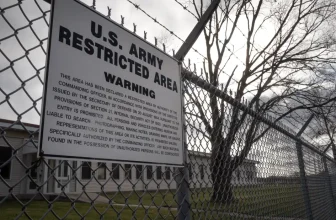
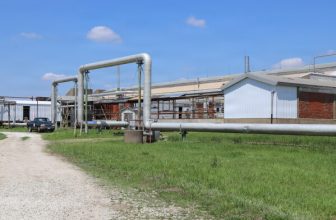
The plan sparked widespread fear and anger among local residents in the days leading up to the explosion, with many people saying they had not been given enough warning. Residents in the plume’s potential path rushed to change their Thanksgiving plans, taping up windows, covering yards, buying cleaning supplies and, in some places, flying their families out of town.
Jill Holler, who has a family farm about 20 miles west of Middletown, said she spent Sunday night taking soil samples for future comparisons of lead concentrations.
“I was in the dark getting the soil samples, and it’s just frustrating,” she said.

Lead is a potent neurotoxin and no exposure is safe. It is the biggest threat to children’s health. Exposure is associated with learning disabilities, reproductive health problems, mental health problems, and increased risk of hearing loss, among other effects.
Once deposited on the surface or in the ground, lead particles can remain there forever unless physically removed.
Army officials argued it was safer to detonate the chemicals in a controlled manner, with mitigation measures in place, rather than risk a surprise explosion.
“I take seriously the military’s warning that the choice is between a planned detonation and an uncontrolled explosion,” Iowa Gov. Kim Reynolds said in a statement Tuesday. “I believe, based on the information provided to me, that the danger is immediate and I hope the military will do everything in its power to protect those who may be affected.”
She declared a state of emergency for three counties expected to be affected.

Army officials said before the explosion that they would use a series of mitigation strategies to keep as much lead dust as possible from the munitions plant.
This included two stories of “HESCO” barriers – modular, collapsible structures filled with sand – built around the explosion site and a plan to spray water during the detonation to capture small particles. Officials also said aqueous foam blocks, gel blocks and two “water walls” made of four water tanks of 16,000 gallons each would help absorb the blast.
According to emergency authorization documents submitted to the Environmental Protection Agency, the military expected the explosion to leave a crater about 38 feet wide and 5 feet deep.

The Army said in a statement Tuesday that after the detonation, environmental monitoring teams would follow the path of the plume “to collect samples of soil, surface water and surface wipes to check lead levels against baseline models and to guide any localized cleanup.”
If a residential property is found to exceed a certain threshold for lead contamination — 200 parts per million — the Army said “remediation crews will remove affected soils, clean surfaces and remediate the property at full government expense.”
It offers few details, however, on how or when such testing will be carried out – or on the process or timeline of any government-led remedial work.
Andrew Whelton, a professor of civil, environmental and ecological engineering at Purdue University in Indiana, said even the documents in the Army’s emergency permit did not describe those plans in detail.
“Based on the document I reviewed, there are no plans to apply an evidence-based approach to determining whether homes, schools and businesses are safe after detonation,” he said Tuesday.
Peter Thorne, a pulmonary toxicologist and environmental health specialist at the University of Iowa College of Public Health, said scientists plan to conduct independent monitoring of the lead dust plume.
“We have monitoring equipment that will tell us how much lead has gotten into the air and moved with the wind,” he said Tuesday. “Our models will be able to tell us how much lead is deposited on the ground and on playground equipment, etc. And from that we can make estimates of the degree of danger associated with that exposure.”
Thorne wondered how these explosives could become so dangerous over time. The national stockpile of lead azide — once used to make bomb triggers but phased out about 15 years ago — was transferred to the munitions plant in 2009, officials said.
“Why wasn’t this problem fixed a long time ago when they could have chemically degraded and the lead azide would no longer pose a danger?” he said. “This should have been fixed in the past, but today it has become a crisis with very few good options.”
Gn usa