

Democratic Reps. Terri Sewell (left) and Shomari Figures of Alabama appear at a May voting rights rally on the steps of the state Capitol in Montgomery, Alabama.
Jake Crandall/USA TODAY Network via Reuters Connect
hide caption
Jake Crandall/USA TODAY Network via Reuters Connect
A ruling this year by the U.S. Supreme Court that further weakened the Voting Rights Act raised the possibility of a record decline in black representation in Congress.
But a Democratic blue wave during the midterm elections has avoided such a decline for the moment.
Most notably, Rep. Shomari Figures, a black Democrat, won re-election despite Alabama state Republican leaders making his district much more Republican-friendly after the court ruling.

Black representation in the U.S. House of Representatives is expected to decline further next year, according to an NPR analysis. The next Congress is expected to include 60 members of the Black House, including non-voting members, compared to 63 in the current House. This is just one away from the record loss of four black representatives after the 1876 election, near the end of the Reconstruction era.
In addition to the unprecedented mid-decade redistricting fight, usual political turmoil, including members retiring or running for higher office, contributed to the next year’s declining results.
But high black voter turnout, particularly in the South, fueled Democratic victories that offset a coming decline in the number of black members in the House.
Voting rights advocates and redistricting experts warn, however, that redrawing districts in coming years, including after the 2030 census, continues to pose a threat to Black representation in Congress.
A ‘Black Wave’ Helped Black Democrats Overcome Redistricting Obstacles in the South
Heading into this year’s midterm elections, Figures had a strong chance of retaining his House seat in Alabama, where the vote was racially polarized between a white majority supporting Republicans and a black minority supporting Democrats.

Figures joined Congress after the 2024 elections as the first Black representative from the state’s 2nd Congressional District. As part of a long-running redistricting battle, a lower federal court had ordered that the district be drawn to include a black population large enough to have a realistic opportunity to elect its preferred candidate.
However, for the midterm elections, the Supreme Court’s conservative majority allowed the Republican-controlled Alabama Legislature to redraw the district. The ruling came weeks after the High Court handed down its landmark ruling in Louisiana v. Callaiswhich weakened the Voting Rights Act’s protections against racial discrimination in political mapping.
The new lines in Alabama’s 2nd District, the lower court previously ruled, were “tainted by intentional discrimination on the basis of race” and would provide “no chance for Black-preferred candidates to win.” Based on the redrawn map, Figures appeared poised to leave Congress, like Rep. Cleo Fields, the Louisiana Democrat who decided not to run again after the Supreme Court ruling. Callais the decision overturned the Black Opportunity District that Fields represents.
“It took a remarkable level of participation for (Figures) to win,” says Cliff Albright, co-founder and executive director of Black Voters Matter. “Some people call it a blue wave. For us, particularly here in the South, we call it a black wave because what we saw was that the black electorate was motivated by the attacks on our voting rights, by the gerrymandering that was taking place.”
New electoral maps in Texas and Florida have led to the destruction of some districts represented by blacks, but resounding victories for Democrats in other states are helping to offset those losses.
North Carolina’s GOP-controlled Legislature redrew the district of Rep. Don Davis, one of three black representatives in the state, but Davis defended his seat. And two new black House Democrats — Cyril Jefferson and LaKesha Womack — flipped districts long represented by white Republicans.
Democratic socialist Reps.-elect Melat Kiros in Colorado and Donavan McKinney in Michigan also add to the tally.
And Democrats are poised to take control of Texas state legislative offices and chambers and other places that have long been Republican strongholds.
By breaking up the Republican trio in Georgia, for example, the blue wave has reduced the threat of redistricting facing the state’s congressional districts represented by black Democrats. Last week, outgoing Georgia Republican Gov. Brian Kemp announced he would not call a special session on redistricting before handing over in January to Gov.-elect Keisha Lance Bottoms, who will be the nation’s first Black woman elected governor.
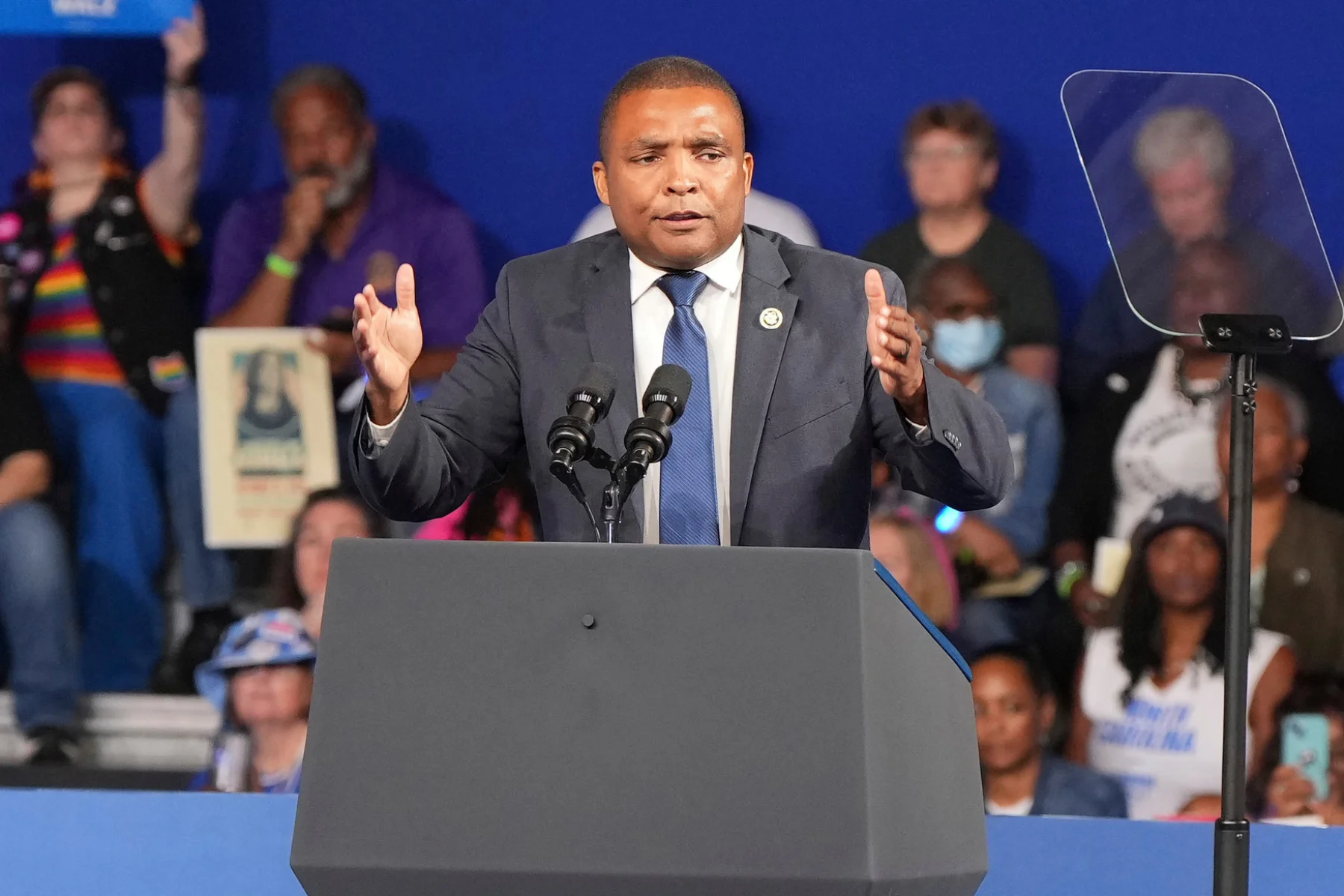
Rep. Don Davis, a North Carolina Democrat, speaks during a 2024 campaign event for then-Vice President Kamala Harris in Greenville, North Carolina.
David Yeazell/AP
hide caption
David Yeazell/AP
Upcoming redistricting could lead to fewer black representatives
But Black Voters Matter’s Albright sees this year’s midterm elections as unique.
“What happens in two or four years, where it won’t be the same wave year, where there won’t be the same economic realities across the country, where you won’t necessarily have the same number of white voters who decide, ‘Oh, I guess I can vote for this Democrat’?” Albright said. “It’s just not sustainable for Black voters to be divided and their voting power to be diluted and not have an impact over a more prolonged period of time.”
And while midterm successes are leading some Democratic politicians to herald a generational shift in American politics, Kareem Crayton, a redistricting expert and vice president of the Brennan Center for Justice’s Washington, D.C., office, is taking a more wait-and-see approach.
“It sounds a lot like what people were saying in 2009 after a lot of massive changes happened, including in the South, with the election of Barack Obama. And it wasn’t two years later that people were left in the dark, looking at the results that basically erased many of those changes that favored Democrats, including black Democrats,” Crayton says. “It could be that this is the start of a generational change, but it might not be. And if you think about how the rules should be developed, I think the cautious approach is always better to ensure that rights in the worst case conditions are protected, as opposed to the most optimistic scenarios.”

Crayton says current redistricting rules, shaped by Supreme Court decisions Callais and other cases, set up the potential dismantling of more opportunity districts for black and other racial minority voters in the years to come. Last year’s redistricting rush was limited in part because Callais The decision came too late for many states to redraw their maps in time for the midterm elections.
“I think people looking at the recent Supreme Court decision regarding Callais and how that would be implemented, it was always understood that the biggest reaction to that would not be in 2026, but rather in 2028, 2030 and beyond,” says Dedrick Asante-Muhammad, president of the Joint Center for Political and Economic Studies, which tracks black representation in Congress.
And that reaction will likely extend beyond Congress, adds Janai Nelson, president and director-counsel of the Legal Defense Fund, which represents a group of black voters in Louisiana in the United States. Callais case.
“When we look at state legislatures, when we look at city councils, when we look at school board maps and when we look at any other elected office that relies on districts, those have been largely untouched by Callais so far,” Nelson says. “But as we enter a new state legislative process where these maps could be redrawn, we could then see a devastating impact on the electability of black voters across the country and particularly in the South.”
There is, however, no redistricting for U.S. senators. And on this side of the Capitol, black representation is on the rise. The blue wave of the midterm elections brought the number of black senators in the new Congress to an all-time high of seven. They include Illinois Lt. Gov. Juliana Stratton and fellow Democrat Scott Colom, who is poised to become Mississippi’s first black senator since Reconstruction.
Edited by Benjamin Swasey
Gn headline

