
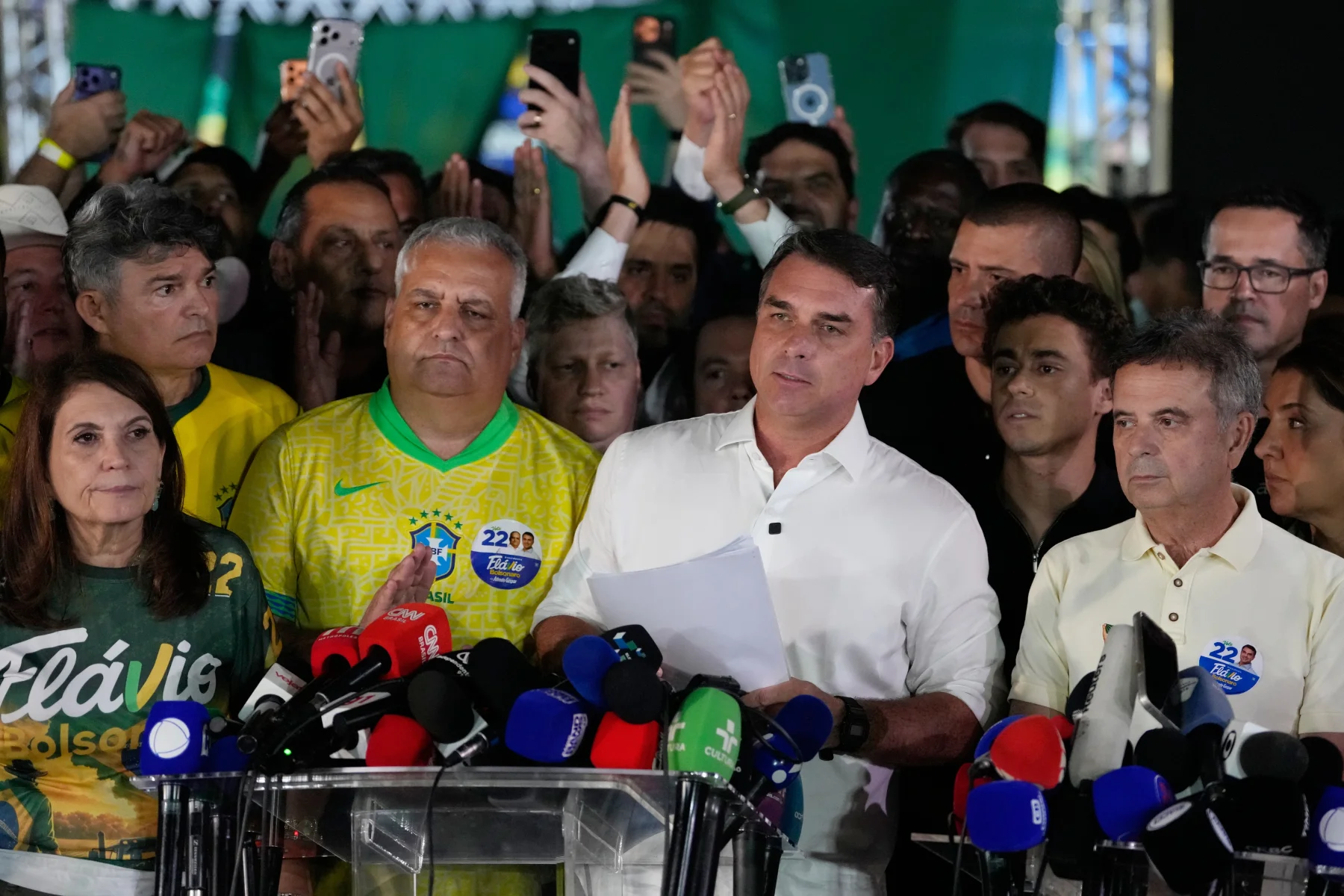
Opposition presidential candidate Senator Flavio Bolsonaro speaks after the presidential election runoff in Brasilia, Brazil, October 25.
Eraldo Peres/AP
hide caption
Eraldo Peres/AP
BRASILIA, Brazil — Brazil’s Liberal Party, the party of defeated presidential candidate Flávio Bolsonaro, recognized the results of Sunday’s presidential election, acknowledging the victory of incumbent President Luiz Inácio Lula da Silva. But Bolsonaro himself has not yet officially recognized his defeat.
The party’s president, Valdemar Costa Neto, said in a statement Monday that the party recognized the election results but believed “the questions raised about the vote” still needed to be clarified.
The concession comes as President Trump has questioned the legitimacy of the election, telling reporters Monday, “I didn’t take sides, but it looked like another rigged election.” Trump has presented no evidence of fraud.
Bolsonaro initially said he would seek to overturn the election results, citing alleged irregularities including a last-minute extension of voting hours.
On Sunday, the Supreme Court ordered polling stations to remain open for two more hours, until 7 p.m., following an appeal from Lula’s campaign, which cited disruptions to public transportation. Bolsonaro’s campaign also requested an extension, citing heavy rains in southern Brazil.
In a video released Monday, Bolsonaro changed his approach, saying he would seek to have Lula’s electoral victory disqualified due to alleged abuses of political and economic power. “The law must apply to everyone,” he said. “Competition must be fair and equal, which has not been the case.” Bolsonaro has not provided any evidence to support this claim.
Bolsonaro also said Brazilian federal police ordered him to surrender his passports after he visited his father, former President Jair Bolsonaro, in Brasilia.
The far-right former president is under house arrest after being sentenced to 27 years in prison for his role in the 2022 coup attempt against Lula.

“I was ordered in the street to hand over my passports, and I am also prohibited from leaving the country,” he said in the video. Bolsonaro said the order was based on remarks from his brother Eduardo, who lives in the United States, suggesting he should leave Brazil if he lost the election. The passport order was issued by Supreme Court Justice Alexandre de Moraes as part of a separate investigation.
Lula won just over 51% of the valid votes, or about 64.2 million, compared to more than 48%, or nearly 59.8 million, for Bolsonaro.
The result marks a major comeback for Lula, who trailed his opponent in the first round, and ends a string of right-wing electoral victories in Latin America.

Supporters of Brazilian President Luiz Inácio Lula da Silva celebrate in São Paulo on October 25 Lula’s re-election with more than 51% of the vote, defeating Flávio Bolsonaro.
Alexandre Schneider/Getty Images
hide caption
Alexandre Schneider/Getty Images
Celebrations of Lula’s victory resounded across Brazil on Sunday evening. Near downtown Rio de Janeiro, fans hugged, shouted and sang the national anthem. Gains in major cities, including Rio de Janeiro and São Paulo, helped Lula overcome his first-round defeat, along with support from younger, older and working-class voters.
In his victory speech in São Paulo, Lula singled out young people who helped mobilize support for his campaign.
“I wanted to thank the Brazilian people for the generosity they have shown me for a long time,” he said. “And in this second round, I want to thank the Brazilian youth for their generosity in taking to the streets. They took to the streets to defend democracy in the country.”
Brisa Pereira, 17, cast her first vote at a busy polling station in one of Brasilia’s sprawling suburbs. She said Lula’s journey from poor factory worker to president inspired her. She also wanted to send a message to Trump and what she described as his drive to dominate Latin America.
“We are not in the 90s anymore. We have rights and Donald Trump cannot speak for all of America,” Pereira said.
Lula had to convince voters from different demographic and geographic groups to defeat Bolsonaro. He received more than 10 million more votes than in the first round, thanks to increased turnout and support from voters who had supported other candidates or who had previously stayed away from the polls.
“It’s no wonder that pollsters said a Lula victory was almost impossible,” said Thiago Vidal, a political analyst at Prospectiva.
“It was a national victory, a systemic victory – top to bottom and left to right,” Vidal said.
The decisive margin gives Lula a mandate to govern, Vidal said, but the next four years will be difficult. Bolsonaro’s Liberal Party made significant progress in Congress, leaving Lula facing conservative opposition and a deeply divided electorate.
Vidal said Lula also learned important lessons about communicating with voters, particularly through social media. The president, who had relied more on traditional media, has adopted a more digital campaign in recent weeks.
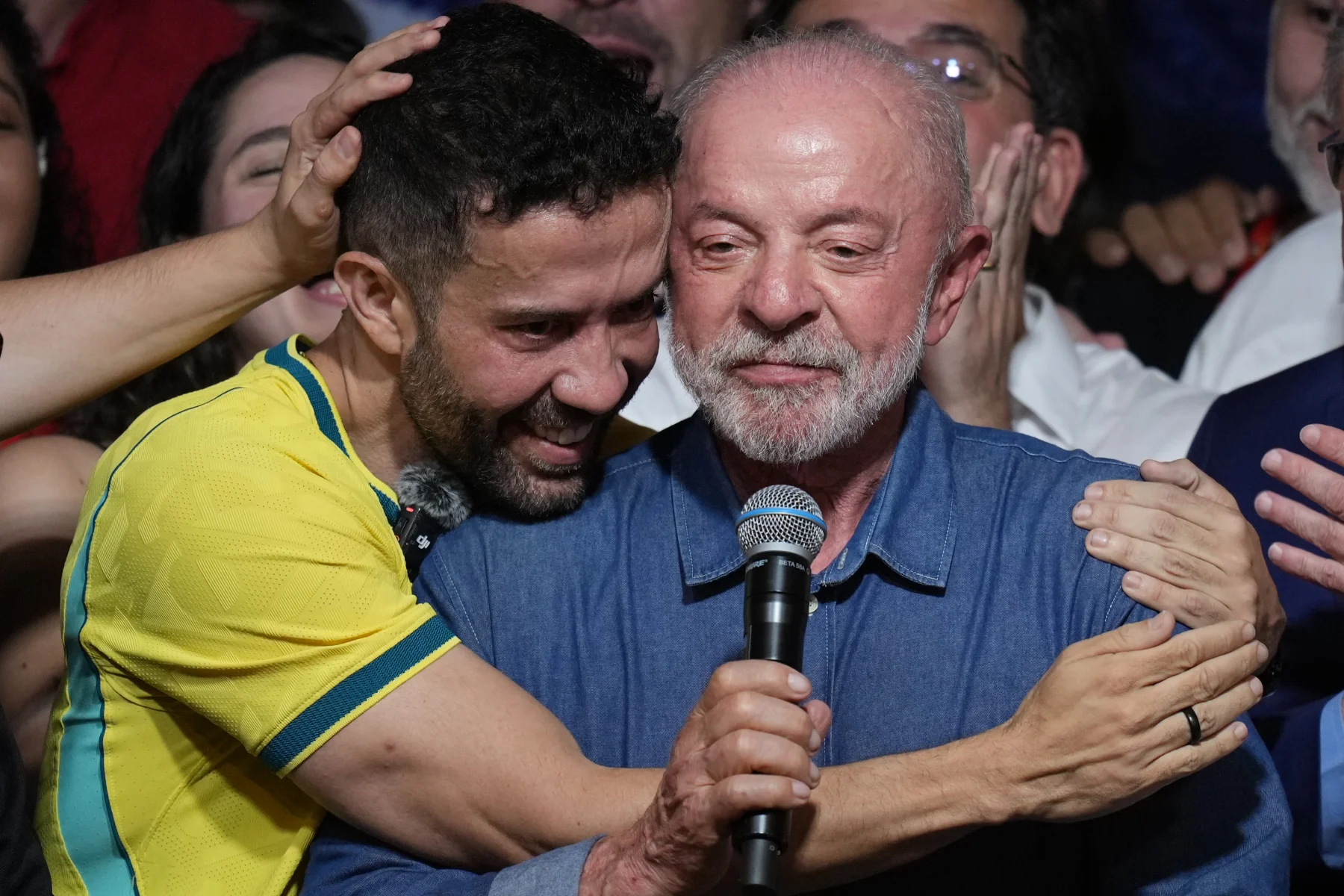
Brazilian lawmaker André Janones embraces President Luiz Inácio Lula da Silva as he delivers a victory speech after winning a fourth term in a presidential runoff October 25.
André Penner/AP
hide caption
André Penner/AP
“Part of it is communication, and part of it is Lula abandoning traditional media and turning to digital,” Vidal said.
Much of that change has been attributed to André Janones, a congressman from the flagship state of Minas Gerais who helped lead Lula’s online campaign. Janones used Instagram and WhatsApp to reach young voters and mobilize his supporters. His WhatsApp channel, nicknamed “Lula’s Army,” has attracted more than 10 million followers.
In an Instagram post on election night, Janones captured the spirit of the celebrations with a message summing up the campaign: “Nothing is more powerful than when the people come together.”
Gn headline

