
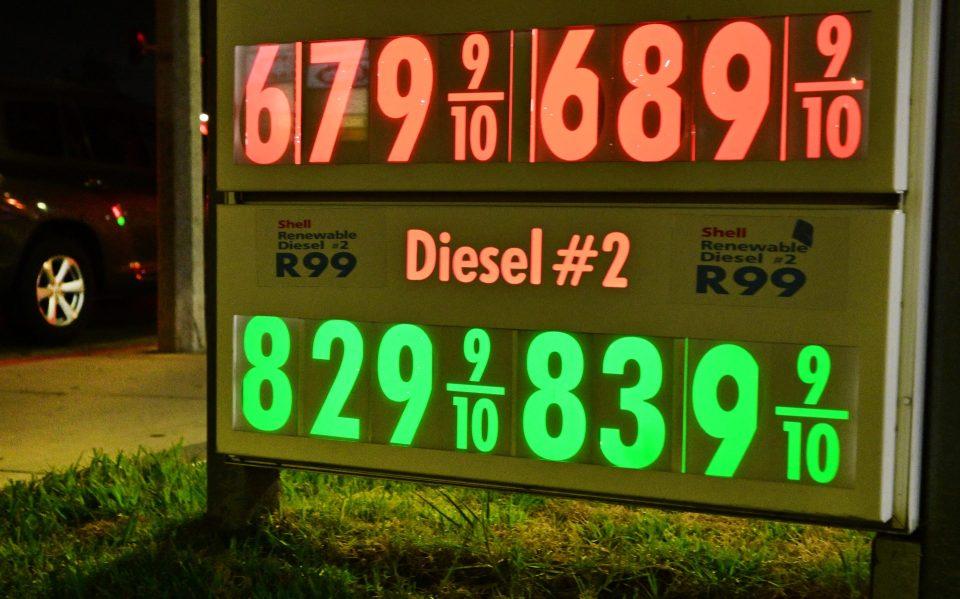
Diesel prices have reached all-time highs in recent weeks, but the key industrial fuel has already shaken things up in the economy and financial markets, making affordability a bigger issue in the midterm elections.
The national average for diesel is about $6.277 a gallon, according to AAA, down from its high of $6.528 but still 71% above last year’s levels. In contrast, the price of U.S. crude oil is up 56% from a year earlier as damage to refining capacity in the Middle East and Russia caused a deeper crisis in fuel markets.
With diesel being a critical input in manufacturing, agriculture and logistics, the recent price surge has been widely felt. The latest consumer and producer price indexes showed rising transport costs, while purchasing managers’ surveys reported sharp rises in prices paid by businesses.
“This is why commodities are trading at double the price of crude over the past few months, which has never happened before. Ultimately, it is diesel and gasoline that are driving inflation, not crude oil,” Amrita Sen, director of market intelligence and co-founder of Energy Aspects, wrote in the newspaper. Financial Times Wednesday.
And while rising fuel prices keep inflation expectations high, markets are pricing in a more hawkish Federal Reserve, ready to raise rates further. Bond yields have risen in anticipation of tighter monetary policy, raising borrowing costs for consumers.
Crude prices previously moved in tandem with refined product prices and had long been a proxy for those costs, but that relationship has broken down, according to the senator.
“In fact, since May, for the first time ever, 10-year U.S. Treasury yields have been more closely correlated with diesel prices than with crude,” she added.
That’s why the Trump administration has recently started paying more attention to lower diesel prices, Sen said.
In the past week alone, President Donald Trump has taken steps to ease the cost burden. On Monday, he signed an executive order to delay the 24-cent-per-gallon federal tax on diesel until the end of the year, although most states have separate levies on diesel.
And on Friday, he said he had struck a deal with Vladimir Putin to get diesel from Russia, a stunning reversal after years of U.S. pressure on Moscow following its invasion of Ukraine.
Russia will now supply more than 300,000 tons of diesel, followed by another 500,000 tons in November and a million tons “immediately thereafter,” according to Trump. Russia will then deliver an additional 3 million tonnes “in a short period of time”.
The surprise announcement is all the more shocking because Trump signed a sweeping sanctions law last month that imposes high tariffs on major buyers of Russian energy.
Frédéric J. BROWN / AFP via Getty Images
But Trump’s efforts to reduce diesel costs are unlikely to significantly improve affordability.
Farmers and truckers said his diesel tax executive order would provide little relief, especially since prices per gallon are $2.60 higher than a year ago, while the federal tax is just 24 cents per gallon. Likewise, energy experts said the Russian diesel deal is also unlikely to have a major impact.
“It’s kind of a mix of deck chairs on the Titanic,” Michael Lynch, a distinguished fellow at the Energy Policy Research Foundation, told the Associated Press. “If we get diesel from Russia, that basically means their existing customers won’t get it and they’ll have to go elsewhere, which will keep the price at the current level.”
And even if Trump were somehow able to end his war in Iran or slash fuel prices, Republicans might not see an improvement with voters in November.
According to a new Politico poll, just 10% of undecided voters said they would be more likely to vote for a Republican if the price of gasoline fell by $1 a gallon, compared to 29% who said it would have no impact and 57% who didn’t know.
The results are similar when asked how the end of the war in Iran and a sharp drop in inflation could affect their choices in the medium term.
“Trump can’t do anything, and frankly, even if he did, no one would believe him at this point anyway,” a Republican Party operative working on field races told Politico.
Gn bussni