
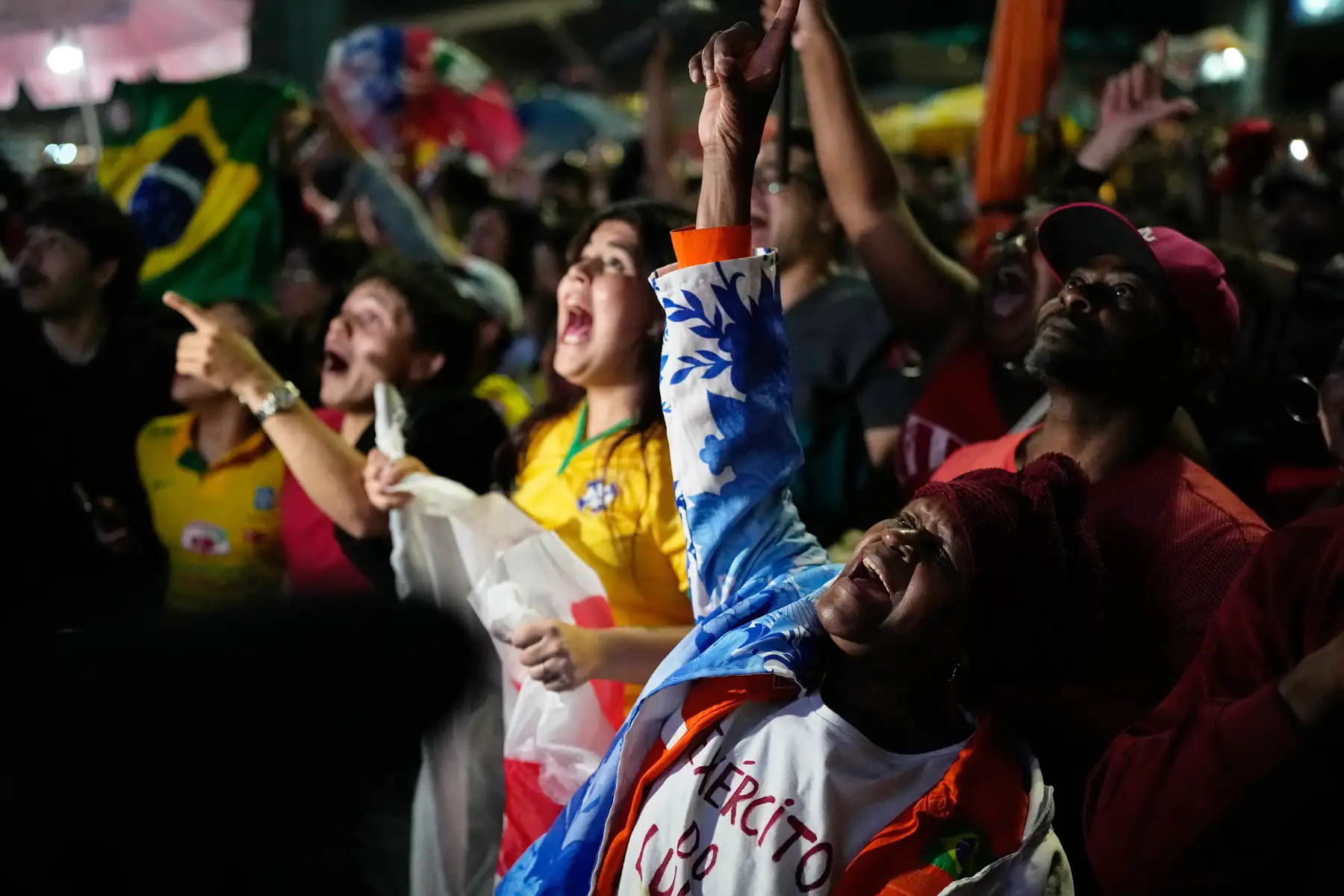
Supporters of President Luiz Inácio Lula da Silva applaud during the announcement of the results of the second round of the Brazilian presidential election in São Paulo, Sunday, October 25, 2026.
Natacha Pisarenko/AP
hide caption
Natacha Pisarenko/AP
BRASILIA, Brazil — In a stunning comeback, President Luiz Inácio Lula da Silva was elected president of Brazil, according to official results from Sunday’s runoff, with more than 96 percent of the votes counted. Lula won more than 51% of the vote, while Senator Flávio Bolsonaro received more than 48%.
Lula defeated Bolsonaro, 45, fending off a right-wing political dynasty that had promised closer relations with President Trump and extending a career that already included three non-consecutive presidential terms.
Election day was chaotic. Around midday, Lula’s campaign called for an extension of voting hours, arguing that some local authorities had reduced bus service, making it more difficult for voters to reach polling stations. Bolsonaro also requested an extension, citing heavy rains in some states.
Supreme Court Justice Cristiano Zanin ultimately ordered the vote to be extended two hours beyond the normal closing time of 5 p.m. But the order reached some polling stations after officials disabled their electronic voting machines, meaning voting could not resume there.
At a polling station in Rio de Janeiro, accountant Manuela Tunas, 36, arrived shortly after 6 p.m., hoping to vote after her flight to the city was delayed. She couldn’t vote. “It’s absurd,” she said. “If some people can vote and others can’t, that’s unfair.”
The hotly contested elections drew international attention for their implications for a growing right-wing movement in Latin America, the future of the Amazon rainforest and the fate of Brazil’s roughly 40-year-old democracy.
Flávio Bolsonaro is the son of former President Jair Bolsonaro, who narrowly lost to Lula in 2022 and is serving a 27-year prison sentence for plotting a coup to overturn that result. His son had promised to forgive him.
Because the elections pitted two well-established political camps against each other, Brazilians showed little enthusiasm for street campaigns in the first months. But Bolsonaro’s first-place finish in the first round of voting on October 4 energized the poll, and in recent days, supporters of both candidates have packed rallies and flooded social media in an effort to sway voters.
In the end, Lula’s message of continuity and focus on social spending prevailed.
“I think people became aware of the risk of a Bolsonaro government after the first round, and the mobilization made the difference,” said Alessandra Miguel, a 35-year-old spa worker who voted for Lula in Rocinha, a favela in Rio de Janeiro.
Lula will govern a deeply divided country. Brazilian political scientist Jairo Nicolau, who studies presidential elections, said one of the most striking features of this year’s vote was the rigidity of Brazilians’ political allegiances.
Unlike previous years, he said, “people’s tribal affiliation has become more important than how they view different policy options.”
This is a breaking story and will be updated.
Gn headline

