
When it comes to health, not all temperatures are equal.
Evidence suggests that cold temperatures are mysteriously beneficial for longevity, helping to boost metabolism and producing positive effects at the cellular level.
On the other hand, excessive heat does not seem to have great effects on the human body.
But what’s so beneficial about coldness in comparison?
In a new study in NatureResearchers have identified a mechanism that contributes to this effect, driven by a metabolic substance called dihydrobiopterin (BH2).
“We are excited to show that slightly cool temperatures trigger significant production of a specific metabolite, BH2, which is synthesized, stored and then released by muscle tissue,” explains molecular biologist David Vilchez of the University of Cologne in Germany.
“BH2 then travels to other parts of the body, where it helps maintain protein homeostasis and contributes to tissue health during aging.”
While scientists have known for more than a century that cold temperatures increase the longevity of animals, including worms, flies, fish and rodents, researchers weren’t sure how cold did this.
Originally, scientists hypothesized that this might be the result of passive thermodynamic effects, but more recently, research suggests that cold-induced longevity is an actively regulated process inside the body, triggering specific biological pathways that help organisms survive.
A few years ago, Vilchez and his fellow researchers discovered that cold temperatures caused the nematode worm to shed clumps of harmful proteins. Caenorhabditis elegansactivating cellular structures called proteasomes that break down protein waste.
In their new work, the researchers investigated the systemic signals behind such responses, hypothesizing that metabolites – small molecules produced by metabolic processes – might be involved.
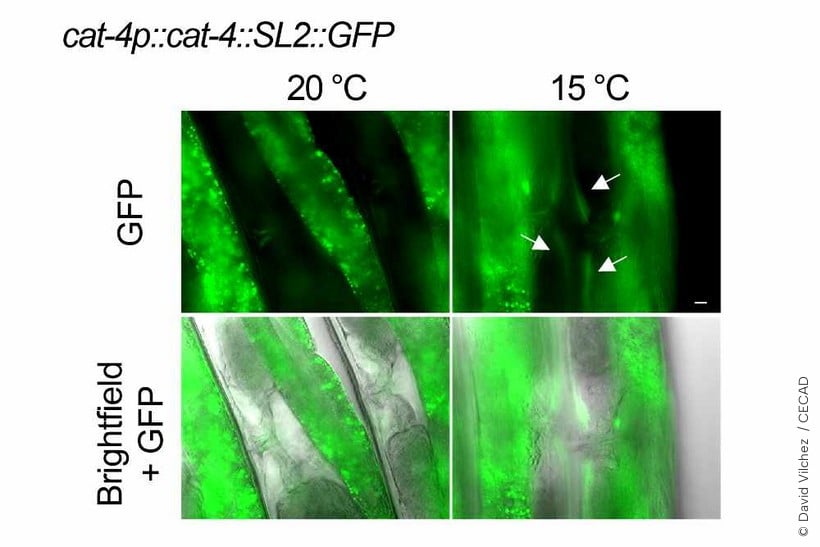
In experiments with C. elegansResearchers have found that exposure to moderately cold temperatures (15°C, or 59°F, which extends the lifespan of worms) increases the production of an enzyme called CAT-4, largely in the worms’ muscles, which in turn stimulates production of the metabolite BH2.
Once produced, BH2 is then transported to other tissues, where it is converted into a bioactive molecule called tetrahydrobiopterin (BH4), which allows an enzyme called PAH-1 to produce the amino acid, tyrosine.
The team found that disrupting this pathway reduced the lifespan benefits observed in cold-exposed worms, suggesting that the longevity effects of lower temperatures are not simply a passive consequence of slower metabolism, but are in part due to an actively regulated biological process that begins in muscle cells.
In separate experiments, the researchers found that the pathway they identified also strengthened healthy protein homeostasis (or proteostasis), suppressing the aggregation of harmful proteins in a worm model of Huntington’s disease.
“These results suggest that specifically targeting a single tissue, such as muscle, could provide body-wide protection,” says Vilchez.
“This opens new avenues for therapeutic approaches.”
Perhaps most interestingly, the researchers found evidence to suggest that cold temperatures are not necessary for the pathway to function.
By genetically increasing CAT-4 levels in the worms’ muscles, the team was able to extend their lifespan even at normal or warmer temperatures, suggesting that it is possible to replicate some benefits of cold without lowering body temperature.
“We were genuinely surprised to find that supplementation significantly extends lifespan, even at standard and warmer temperatures,” says Vilchez.
“Further experiments in human cells encourage us to look for treatments that mimic the beneficial effects of cold without requiring changes in body temperature.”
In separate experiments involving human cells engineered to expand proteins associated with Huntington’s disease and amyotrophic lateral sclerosis (ALS), the researchers found that supplementing the cells with BH2 reduced the accumulation of abnormal proteins.
Additionally, another experiment showed that BH2 and tyrosine supplementation reduced signs of programmed cell death in human motor neurons with an ALS-associated mutation, suggesting that this pathway may also help protect against neurodegeneration.
It is worth emphasizing that so far these results have only been demonstrated in experiments involving nematodes and human cells, and we will need much more research before we can think about how these effects could be safely transferred to living human patients.
But the results show that we are getting closer to understanding how cold produces its effects on longevity, and one day we may be able to do it.
The results are reported in Nature.
This article was fact-checked by Fiona MacDonald and edited by Fiona MacDonald. Although we are proud of our process, we are only human. If you spot an error, please let us know.
Gn Health

