
Things that once gave pleasure lose their appeal. Getting out of bed, talking to friends, or completing daily tasks becomes more difficult. For someone suffering from depression, treatment can offer a way to reintegrate into daily life.
People undergoing cancer treatment may also have depression or anxiety and take medications for their mental health as well as medications for their tumors. Researchers are currently investigating an unexpected link between these treatments.
A new analysis found that patients taking common antidepressants had fewer deaths more than two years after starting immunotherapy, a treatment that helps the immune system attack cancer.
“The simplest way to put it is that SSRIs can trigger a second brake on immunity that is right next to the release of checkpoint inhibitors,” oncologist Cho-Hao Lee of Tri-Service General Hospital and the National Defense Medical University in Taiwan told ScienceAlert.
SSRIs, short for selective serotonin reuptake inhibitors, block the reuptake of serotonin, a chemical messenger. The group includes fluoxetine, sertraline and escitalopram.
To study their potential link to cancer progression, researchers examined the medical records of adults with depression or anxiety and solid tumors, excluding blood cancers.
All were starting treatment with immune checkpoint inhibitors. These immunotherapy drugs block signals that can stop immune cells from attacking tumors.
Led by physician Po-Huang Chen of Tri-Service General Hospital and National Defense Medical University, the research identified eligible patients through the TriNetX electronic health record network who started immunotherapy between 2015 and 2025.
In the study, 1,567 SSRI users were compared to 1,567 people taking benzodiazepines, medications prescribed for problems such as anxiety and insomnia. The matching covered 49 baseline characteristics, including demographics, tumor characteristics, other diseases, medications, and laboratory results.
The goal was to compare patients who were as similar as possible. The main comparison therefore involved two psychiatric medication groups, rather than antidepressant users and people not taking any psychiatric medications.
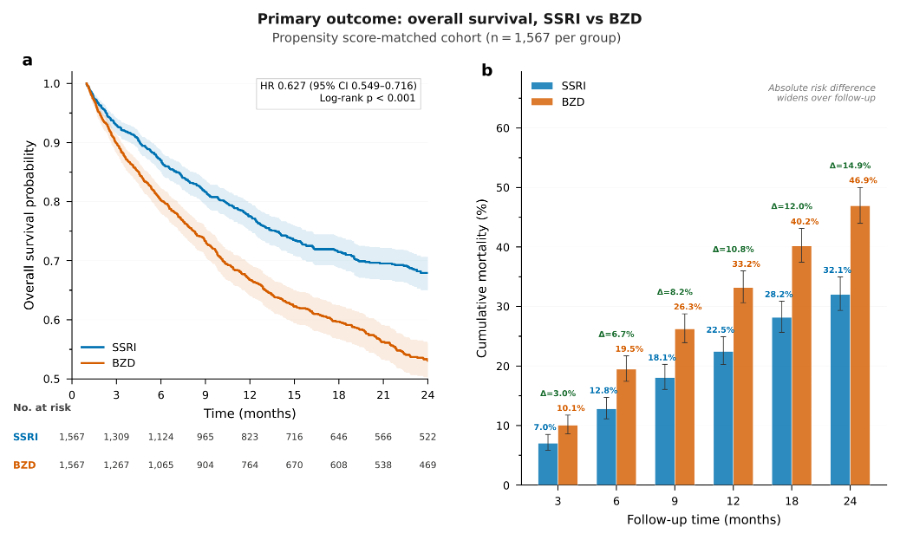
During the two-year results window, 368 patients in the SSRI group died, compared to 539 in the benzodiazepine group: 23.5% versus 34.4%.
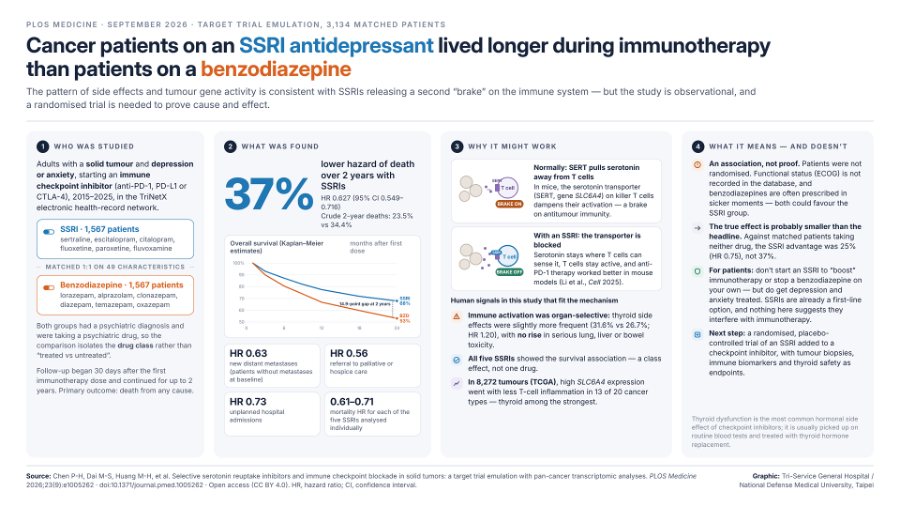
An analysis accounting for the timing of deaths associated SSRI use with an approximately 37% lower risk of death. This describes a lower relative mortality rate during follow-up, rather than patients living 37 percent longer.
All five SSRIs that could be examined individually were associated with lower mortality. Compared to matched patients not taking either drug class, SSRI users had about a 25% lower risk of death.
One possible explanation lies in the effects of serotonin beyond the brain. Cancer-fighting T cells also respond to this chemical messenger.
A 2025 study published in Cell identified the SSRI-blocking protein serotonin transporter as a brake on these immune cells in mice. Blocking it enhanced anti-tumor immunity.
Combining an SSRI with anti-PD-1 immunotherapy, which releases another immune brake, improved tumor control. The new research examines whether these laboratory findings could have a counterpart in patients.
The team separately analyzed 8,272 tumor samples from the Cancer Genome Atlas. In 13 of 20 cancer types, higher expression of the gene encoding the serotonin transporter correlated with lower T-cell inflammation scores.
However, these samples came from different patients than the cohort whose survival records the study evaluated.
The results support the proposed mechanism without showing that antidepressants change conditions inside human tumors. It is unclear whether doses of antidepressants change serotonin levels or the behavior of T cells in patients’ tumors.
Medical records also revealed a difference in thyroid problems. Thyroid dysfunction was recorded in 31.6 percent of SSRI users, compared to 26.7 percent of benzodiazepine users. Hepatitis, pneumonia and colitis did not differ significantly.
The diagnostic codes could not establish whether each thyroid event was immune-related, leaving another question for future research.
One of the main limitations was the lack of information on patients’ ability to perform daily activities, an important indicator of cancer survival.
Benzodiazepines may also be prescribed for acute anxiety or insomnia when the cancer gets worse. Their users could therefore have been more seriously ill despite apparently similar characteristics.
SSRI prescriptions may also reflect more comprehensive psychological and medical care rather than a direct effect on tumors. Lee acknowledges that these differences could explain a significant part of the association.
“Only a randomized trial can determine the extent to which this is a cause and the extent to which it is confounding,” he says.
Patients were not randomly assigned to either drug in this study, so the results cannot establish that antidepressants prolong life.
Future trials will need to assess survival, cancer progression and side effects, while tumor samples taken before and after treatment could reveal changes in immune activity.
Researchers should also determine which medication, dose, and duration of treatment might be helpful. Inclusion of patients without depression or anxiety could help separate psychiatric treatment effects from potential anticancer effects.
For patients, Lee’s message is clear: “This is not a reason to start an SSRI to ‘boost’ immunotherapy, or to stop a benzodiazepine yourself.”
The research was published in PLOS Medicine.
This article was fact-checked by Rachel Garner and edited by Rebecca Dyer. Although we are proud of our process, we are only human. If you spot an error, please let us know.
Gn Health