
In 1930, economist John Maynard Keynes made two bold predictions. The first was that the global economy would grow eightfold by the start of the 21st century. This one turned out to be remarkably accurate. The second was that this prosperity would free us from long work hours, leaving most of us working only about 15 hours a week. Regarding the second prediction, Keynes missed his mark.
Most of us still work just as hard. And why he was wrong has profound implications: for your financial independence and for the chronic disease epidemic you manage every day in your clinic.
What Keynes did not anticipate was a phenomenon that social scientists call social comparison or what most people simply call “keeping up with the Joneses.” The size of the average American home, for example, has more than doubled since the time he was writing, filled with more “stuff” than ever before. Rather than converting economic growth into free time, we have converted it into consumption. And instead of gaining independence from our employers, the vast majority of us remain financially tied to our jobs to fund a growing list of expenses we didn’t know we needed until our neighbors took care of them.
As physicians, most of us know what financial dependence looks like professionally: staying in a job or system because we need the income, not because we love the work. What we may not have fully considered is that this same dynamic, operating on a societal scale, is a key driver of the chronic disease epidemic that we battle every day in the clinic.
This is the argument I want to make.
Insane consumerism and the rise of chronic diseases
Homo sapiens has been present on Earth for approximately 300,000 years. The post-industrial era we currently live in represents only 0.1% of that time. For more than 95% of human history, we have been hunter-gatherers.
In 2016, researchers at Oregon State University measured how many American adults led healthy lives based on four criteria: regular physical activity, a healthy diet, normal body fat percentage and not smoking. The result was that only 2.7% of participants met all four criteria.
It is a resounding failure. But before concluding that the problem lies in human nature itself, it is worth considering some historical context. How would our Paleolithic ancestors have behaved according to these same four parameters?
- Physical activity: Hunter-gatherers spent their days hunting, foraging, and constantly moving around, engaging in at least 10 times more moderate-to-vigorous daily physical activity than modern recommendations require.
- Diet: When food was available, it was natural, whole, and nutrient-rich. They just didn’t have the option of ordering the family bucket at the local KFC drive-thru.
- Body fat: Studies of contemporary hunter-gatherer populations, such as the Hadza in Tanzania or the Tsimané in Bolivia, show increasingly lean body compositions even when food is plentiful, driven by diet quality and activity rather than deliberate restriction.
Smoking: This was practically non-existent until the end of the Paleolithic.
We can conclude that when food was sufficiently available, our ancestors easily passed this test. Today, we have largely resolved food insecurity. Why, then, are we collectively failing so miserably?
More information here:
The scale of the problem
Before answering this question, let us think about the consequences of this collective failure.
Obesity among adults worldwide has more than doubled since 1990. Obesity among adolescents has quadrupled during the same period. Obesity rates are increasing in all countries without exception. Diseases that were rare or even non-existent among hunter-gatherers are now commonplace (see table below). In the United States, 90% of the nation’s $5.3 trillion in annual health care spending goes to people with chronic illnesses.
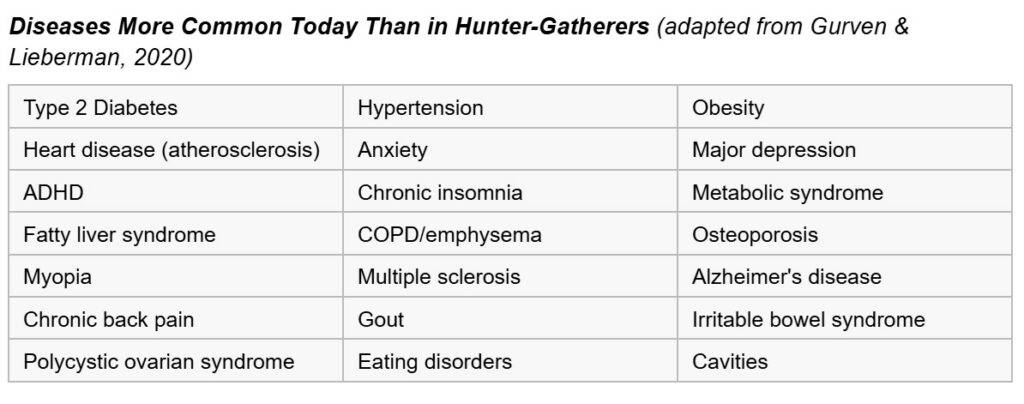
A common objection is that our ancestors did not live long enough to develop these diseases. But that doesn’t hold. Research on contemporary hunter-gatherer populations, including older members who regularly reach their 60s and 70s, reveals minimal chronic cardiovascular disease, obesity, or diabetes. Their body composition is significantly healthier than that of modern populations of the same age. Lifestyle factors, not just longevity, are driving these trends.
3 Ways Consumerism Promotes Chronic Disease
This is where Keynes becomes relevant again. If consumerism keeps us financially dependent, and if financial dependence forces us to work long hours at whatever job is available (not necessarily the one we would choose if money were not the primary concern), then consumerism makes healthy living more difficult. Here are the problems.
#1 Modern employment is a health hazard
More than 80% of American workers are largely sedentary at work. Similar trends are emerging globally. Given the pace of modern working life, many people start the day with fast, highly processed foods and understandably end it too tired to prepare a nourishing meal for themselves and their family. Over decades, this directly develops into a chronic illness.
The connection with consumerism is precisely what Keynes did not foresee. Economic growth has not translated into leisure. This has resulted in bigger homes, more possessions, and a higher basic cost of living that keeps us tethered to demanding jobs. Overconsumption, in essence, is what locks us into working conditions that make us sick.
#2 We designed ourselves from our natural environment
Consumerism has transformed our physical environments from natural to increasingly artificial. But we evolved in natural environments. Americans now spend more than 90% of their time indoors. Our Paleolithic ancestors spent 100% of their time outdoors.
Lack of exposure to natural light, fresh air and green spaces is associated with a range of adverse health consequences. It’s not difficult to understand why anxiety, depression, and other mental health disorders are increasing alongside all other chronic illnesses.
Think of the modern garage. This requires a driveway, which requires a paved road built for each household. We have effectively understood the need to use our legs meaningfully. Children travel from home to school by bus or car. Adults drive to work. The result is that generations of people arrive at the end of each day having spent almost no time outside and using their bodies for almost nothing.
#3 Financial dependence determines which industries survive
This is the argument that I find the most underestimated.
A financially independent person works for a fundamentally different reason than someone who depends on their employer for their income. Financial independence, or the ability to stop working without ever running out of money, means that you work primarily because you are passionate about the product or service. Money is a desirable side effect. In contrast, a person who is financially dependent on their employer (the vast majority) must work for money, and the product or service is the side effect.
On a societal scale, the implications are significant.
Think about food. Between 60 and 70 percent of America’s food supply has been redesigned to maximize addiction and consumption, often to the direct detriment of its customers’ health. McDonald’s employs hundreds of thousands of people. Hypothetically, if half of these employees were financially independent, a significant proportion would leave for more meaningful work. McDonald’s would shrink in size and sell less harm to the public. This result, even if we have been taught that it is good for the economy, is good for the population.
Think about tobacco. Philip Morris sold cigarettes while knowingly misrepresenting health risks, suppressing research for years, and marketing to children to establish early addiction. Beyond executives, their workforce was made up of ordinary, hard-working people who were simply trying to make a living. They were not passionate about smoking, but they were financially dependent on their income. Without these workers, companies like Philip Morris would not have been able to operate on a large scale. Financial independence of even a fraction of this workforce would have hollowed them out from within.
The most important point is that financial independence fundamentally realigns the incentive structure of work. Financially free people choose work that is meaningful to them. And meaningful work, at scale, tends to be very different from the industries that currently cause the most harm to human health.
More information here:
Has all this consumption made us happier?
What if all this consumption—bigger houses, better cars, and an abundance of things our grandparents never imagined—made us happier? Wouldn’t that justify certain compromises?
According to the World Happiness Report 2018, despite dramatic increases in GDP per capita in recent decades, average happiness has declined slightly. One of the contributing factors cited is the increase in chronic diseases discussed above. In other words, all this spending increases chronic illness, and chronic illness decreases happiness.
According to research, what increases happiness? The list is fairly consistent across studies: physical activity, nutritious diet, good sleep, feeling safe, feeling useful, time spent with family and friends, and feeling like you have agency in your own life.
Notice what these things have in common. Besides food and security, they are free. In other words, once your basic needs are met, the best things in life are free.
The order
If mindless consumerism is a key driver of the chronic disease epidemic, then prescribing is a direct result of it. You must consume conscientiously.
No, this is not a call to return to Paleolithic life. Modern medicine, vaccines, clean water and an abundant food supply are real success stories. But my point is that we can get real benefits from it…
Gn Health

