Democrat Roy Cooper is well ahead of Republican Michael Whatley in the race for North Carolina’s open U.S. Senate seat as voters are unhappy with President Donald Trump, according to a new WRAL/WSOC poll.
Whatley, a longtime member of the Republican Party, was endorsed by Trump and largely focused his campaign on carrying out Trump’s agenda if elected to the U.S. Senate. He has consistently trailed Cooper, the former governor, in polls this year. The new poll, released Tuesday, shows a continuation of this trend.
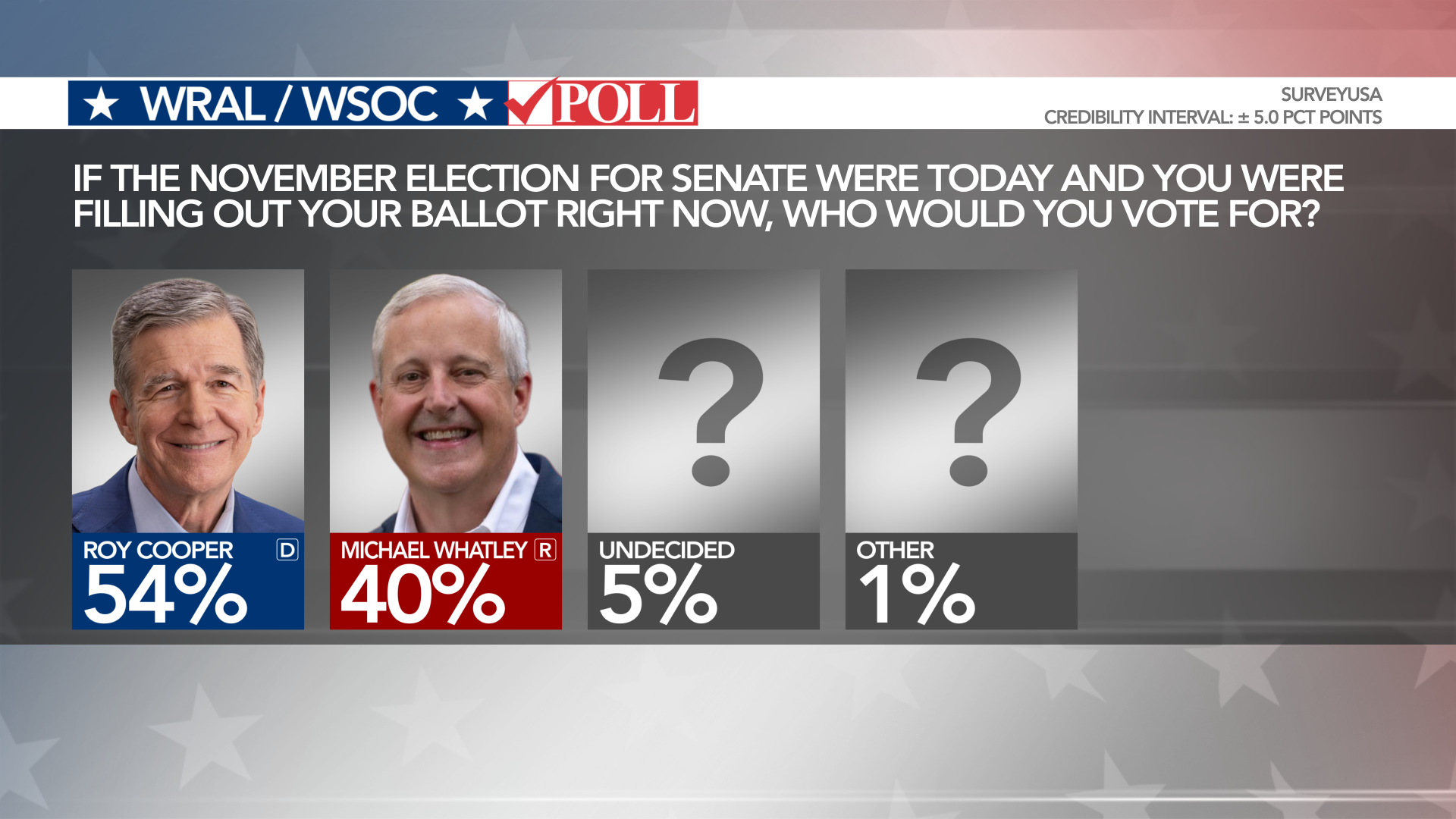
It showed Cooper with a 14-point lead among likely voters: 54% said they would probably vote for Cooper, while 40% said they would vote for Whatley. About 5% were undecided and 1% said they would vote for another candidate. Green Party candidate Michael Dublin and Libertarian Shannon Bray are also running in the 2026 midterm race to replace Republican U.S. Sen. Thom Tillis, who is not seeking re-election.
A spokesman for Whatley’s campaign said undecided voters were still in play and Whatley had worked hard to court them.
“Michael Whatley has met with communities across the state holding nearly 400 campaign events, meeting with communities from Murphy to Manteo while Roy Cooper hides in his basement,” Whatley spokesperson DJ Griffin told WRAL in a written statement. “We are confident that this race will continue to tighten and that Michael Whatley will win in November.”
Cooper campaign manager Jeff Allen, meanwhile, said they aren’t ruling out Whatley yet and are also continuing to court undecided voters.
“A Democrat hasn’t won statewide federal office in almost two decades, and North Carolina is a 50-50 state,” Allen said. “We are building a campaign to win every vote and make sure North Carolinians know that Roy Cooper will fight for them, while Michael Whatley continues to enrich himself at their expense.”
Cooper has also consistently led fundraising, and in recent days Whatley stopped airing television ads, as did a major national conservative group that withdrew millions of dollars it had planned to spend to boost Whatley’s campaign.
The poll, conducted by polling company SurveyUSA for WRAL and WSOC-TV in Charlotte, was conducted Oct. 7-11 among 900 North Carolinians, 643 of whom had already voted by mail or indicated they were likely to vote. Early voting begins this week. Election day is November 3. The poll had a credibility interval of 5 percentage points. A credibility interval is similar to a margin of error but takes more factors into account and is considered by some pollsters to be a more precise measure of statistical certainty.
Elections in North Carolina for federal elections such as those for the Senate and the presidency of the United States are almost always close. For this reason, political analysts had predicted that Whatley would narrow the gap as Election Day approached.
“The common expectation that many of us had was that Cooper’s lead would diminish and we would enter some sort of normal election dynamics in North Carolina — where basically the margin of victory would be within the margin of error of a poll,” said Michael Bitzer, a political scientist at Catawba College, whose own Sept. 30 poll gave Cooper a 12-point lead. “I’m not sure we’re seeing that at this point.”
Tillis did not seek re-election this year after falling out of favor with Trump for voting against Trump’s signature piece of legislation, the 2025 spending bill that Trump and his supporters called the “One Big Beautiful Bill Act.” Whatley strongly supported the law — and criticized Cooper for saying he would have voted against it like Tillis did.
The law cut Medicaid, a health care program for low-income families, by more than $1 trillion to finance tax cuts that largely benefited corporations and wealthy earners. Tillis said that’s why he opposes it: More than 25 percent of North Carolina’s population is on Medicaid, and Tillis and other critics say it would siphon billions of dollars from the state’s health care economy by excluding people from the program, which could lead to the closure of even more rural hospitals.
In his new book, “How to Lose Friends and Upset Presidents,” Tillis suggests that Whatley’s chances of replacing him in the Senate might have been doomed from the start, since politics required Whatley to fall in line with Trump’s policies, like those health care cuts. Whatley has also repeatedly defended Trump’s tariffs and the war in Iran, while Cooper has called for an end to both.
Tillis writes in the book that he told the president directly that Trump “followed the advice of some (people) on a health policy that was going to hurt North Carolina and kill Whatley’s chances.”
Whatley has become closely aligned with Trump. Whatley’s campaign website says his top priority is “implementing Trump’s agenda in the United States Senate.”
Chris Cooper, a Western Carolina University political scientist who is no relation to Roy Cooper, said in an interview that Whatley’s overall, pro-Trump stance clearly helped Whatley win the GOP primary in March, but it could hamper his chances now, in part because the popularity of top political leaders can affect how people vote in all kinds of elections.
Trump’s approval rating has plummeted since he returned to office, instituting sweeping tariffs and then attacking Iran — actions that have driven up the price of fuel, groceries, household goods and more. Trump said the price hike was worth it to carry out his agenda.
Trump unpopular, Stein popular
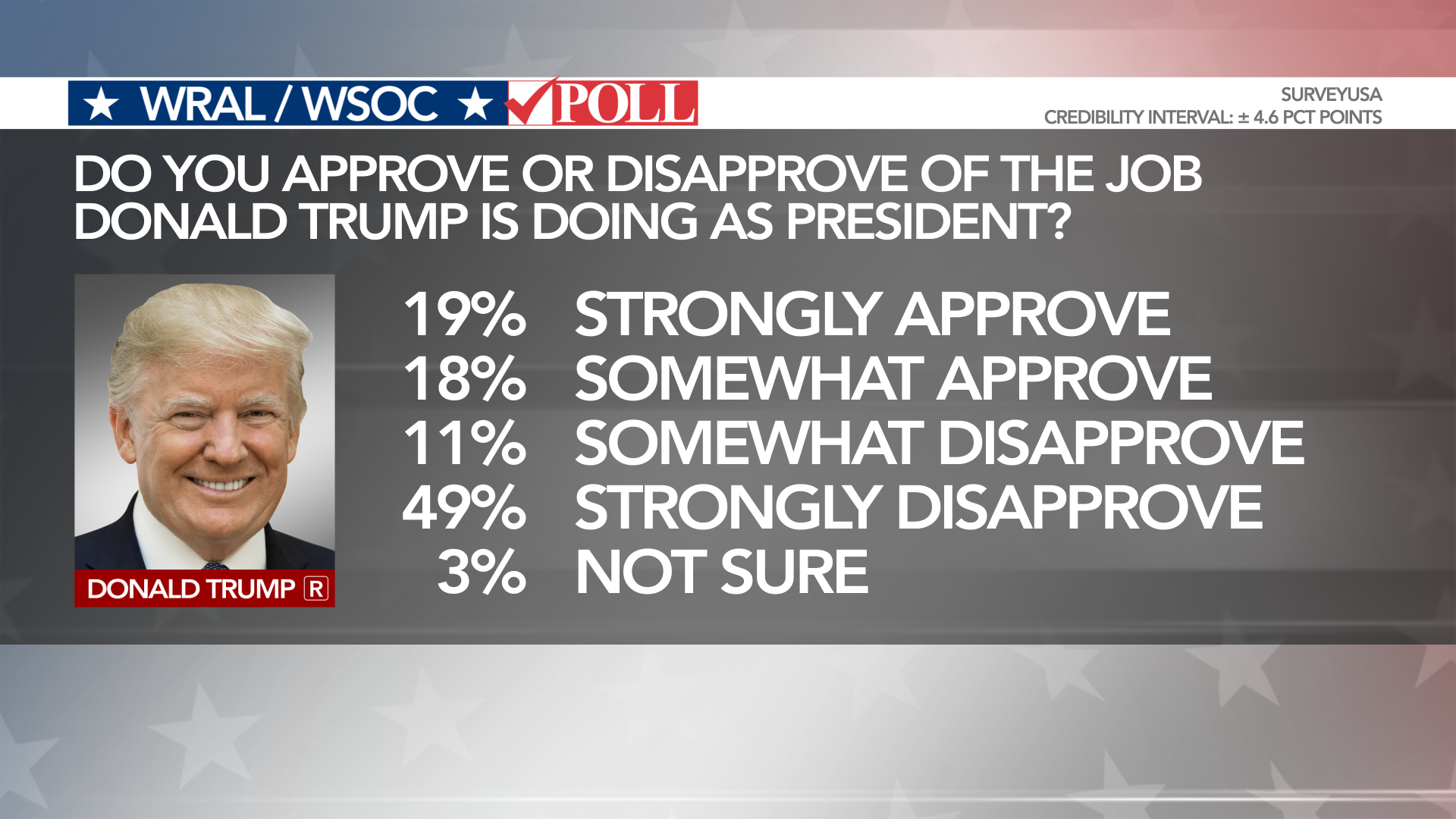
The new WRAL/WSOC poll shows Trump is unpopular with likely voters in North Carolina this year, despite winning the state with 51% of the vote just two years ago over Democrat Kamala Harris. According to the poll, only 37% of likely voters statewide approve of the job Trump has done in the first half of his new term, and 60% disapprove of his handling of the presidency.
That could reflect growing dissatisfaction with Trump’s policies, such as those on tariffs and Iran, which have driven up prices despite his 2024 campaign promises to lower prices, political analysts say. It could also reflect the fact, seen in other elections over the past decade, that large numbers of Trump supporters are simply not likely to vote if Trump is not personally on the ballot.
Trump himself is well aware of this dynamic. When he visited North Carolina last month to deliver a campaign speech with Whatley, Trump urged the Gastonia audience: “Pretend I’m on the list. Because actually, I am. We have to win this election.”
Bitzer said Trump’s low favorability is not unique to North Carolina.
“It’s a very pro-democracy year,” Bitzer said. “Republicans are playing defense. I think we’re seeing that in other U.S. Senate elections. In Kansas, in Ohio, in Alaska.” National political groups that gained financial support from Whatley redirected that money toward races in some of those states.
Polls often show races getting closer in the final weeks of an election, so the fact that that’s not happening this year could be due to Trump’s poor approval ratings, said Cooper, a political scientist at Western Carolina University. “The national environment keeps getting better for Democrats,” he said. “So you might normally expect to see Republicans go home. But not when the environment continues to improve for Democrats everywhere else.”
The poll also asked voters about a politician who was not on the ballot this year. Democratic Gov. Josh Stein won’t be up for re-election until 2028. But overall, according to the poll, voters are much happier with how he has handled his first two years in office than with Trump. It found that a plurality of respondents – 46% – approved of Stein’s performance as governor and 32% disapproved.
Stein won the most lopsided gubernatorial election in recent state history in 2024, beating scandal-plagued Republican challenger Mark Robinson by a margin of 55% to 40% — roughly the same margin this new poll shows Cooper leading over Whatley. An October 2024 WRAL News poll showed Stein up 15% over Robinson, the same margin by which he ultimately won.
Gn usa