
The man was then transferred to intensive care, where he quickly recovered. A day after the operation, doctors were able to remove his breathing tube. He developed mild weakness on his right side, but this resolved two days later. Scans of his brain showed steady improvement: slight bleeding and swelling, and there was some air in his brain tissue where the knife was. But otherwise it seemed healing. He developed no infections and had no seizures.
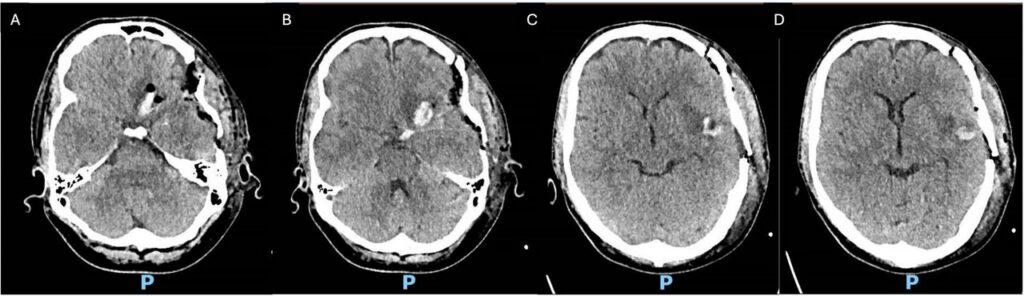
(A–D) Postoperative axial CT images demonstrating expected changes along the surgical tract, including intracranial air, minor hemorrhage, and edema extending toward the inner table of the left temporal bone. There is edema adjacent to the anterior limb of the left internal capsule, correlating with the transient postoperative weakness on the patient’s right side.
(A–D) Postoperative axial CT images demonstrating expected changes along the surgical tract, including intracranial air, minor hemorrhage, and edema extending toward the inner table of the left temporal bone. There is edema adjacent to the anterior limb of the left internal capsule, correlating with the transient postoperative weakness on the patient’s right side.
Credit: BMJ Case Reports, 2026
Despite the “dramatic intracranial trajectory,” his language function was preserved and he suffered no loss of movement or coordination, they reported. He was discharged from the hospital and at follow-up appointments remained “neurologically healthy,” with ongoing eye and mental health care.
Lucky Recovery
As for how the injury happened, his doctors still don’t know. “The mechanism is unclear,” they wrote. However, they noted that he had a history of depression.
Doctors reflected on how lucky the man was to have survived and made such a full recovery. Such injuries that pass through the eyes and brain are rare. When they do occur, they are usually due to “high velocity mechanisms” such as gunshots or other ballistic injuries. Knives, shanks and nails fit into the rarest “low speed mechanisms”. Such “low-velocity penetrating brain injuries result in substantial morbidity and mortality due to hemorrhage, vascular injury, abscesses, meningitis, cerebrospinal fluid leak, seizures, and neurologic deficit,” they wrote.
But such happy cures are not rare; they cited reports of other remarkably unexpected recoveries from apparently devastating brain injuries. This includes the famous case of Phineas Gage, a railroad foreman who survived an accident in 1848 that sent a large iron bar directly into his head. The rod entered under his left cheekbone and exited through the top of his head. (Although he survived and recovered, Gage’s personality reportedly changed after the accident. Doctors involved in the knife wound case did not mention any such personality changes.)
“Echoing classic and contemporary examples of severe frontal lobe penetration with unexpectedly preserved neurological function, including Phineas Gage and a reported nail gun injury, this case highlights that outcome may depend less on external gravity than on a precise trajectory in relation to critical vascular, cortical, and subcortical structures,” the doctors concluded.
Gn Health

