
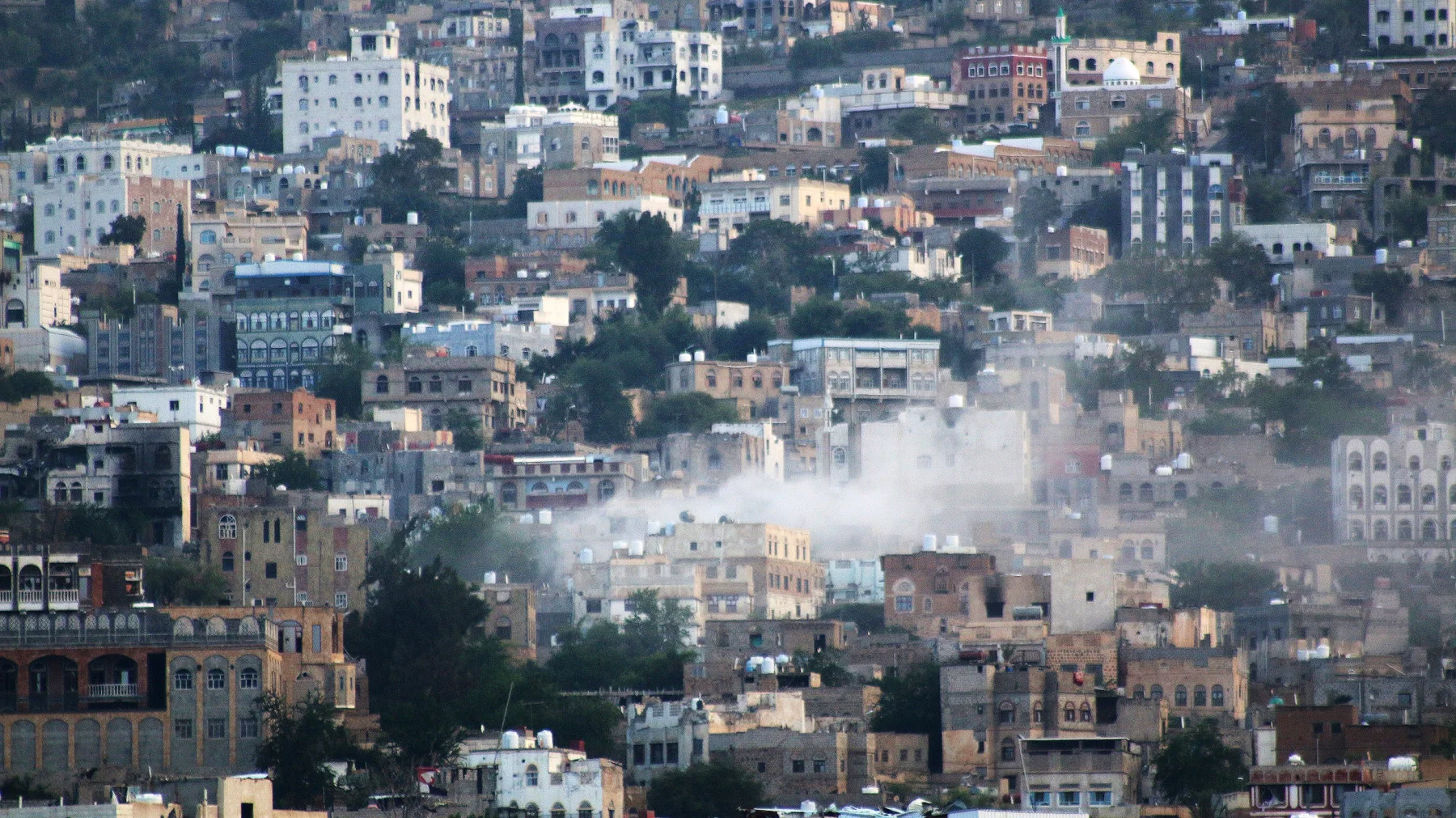
FILE – Smoke rises after an attack by Houthi rebels on the city of Taiz, Yemen, October 21, 2015. (AP Photo/Abdulnasser Alseddik, File)
Abdulnasser Alseddik/AP
hide caption
Abdulnasser Alseddik/AP
Drinking water has been scarce in Taiz for more than a decade, but the problem has reached crisis level in recent weeks as Iran-backed Houthi rebels lay siege to Yemen’s third-largest city in their escalating conflict with government forces.
The needs of Taiz’s more than 1 million residents are now barely met, aid groups say, as access to wells is limited, desalination plants run out of fuel and water delivery trucks are largely blocked from entering the city.
Families ration every drop. Before Taiz was besieged, Hadil al-Shahid and her two young children consumed about 10 liters (about 2.6 gallons) of bottled water per day for drinking and cooking; now they make the same amount last for about four days.
“We stopped drinking coffee and tea, which we drank daily,” al-Shahid said in a telephone interview.
Families like al-Shahid’s are paying up to 75% more for bottled water than a few weeks ago, and some have started buying water on credit.
The siege of Taiz – a strategic gateway to southern Yemen – is not only restricting water supplies. Food shortages have caused food prices to skyrocket. Fuel is also scarce, making it difficult to maintain basic services such as hospitals and sanitation, compounding public health risks.
Amnesty International has called on the Houthis to immediately open roads to the city, saying Taiz is being pushed “to the brink of a serious humanitarian catastrophe”.
Houthis strangle Taiz and cut off residents’ access to wells
Yemen descended into civil war in 2014, when the Houthis seized much of the country’s north, including the capital Sanaa, and forced the internationally recognized government into exile. Since then, Taiz has been at the heart of the fighting.
War damage to Taiz’s aging water infrastructure has amplified pressures from population growth and frequent droughts that have led to dwindling groundwater reserves. Residents began paying for water delivered by trucks, a fairly reliable alternative – until recently.
By August, Yemen had become a growing front in the war against Iran. The Houthis intensified their advance on Taiz last month, after a lightning-quick capture of the port city of Mokha, an area about 130 kilometers (80 miles) away that is vital for controlling shipping across the Red Sea.
As Houthi forces took control of more land and roads around Taiz, residents’ access to nearby wells was cut off and water deliveries from outside the city declined.
Truckers who managed to transport water to Taiz in some cases tripled their rates to undertake the perilous journey.
As Taiz’s fuel reserves dwindle, its water department is struggling to maintain limited operations and desalination plants are operating well below capacity.
The city also suffers from fuel and food shortages.
Since August, Taiz province, which includes the city and surrounding areas, has taken in about half of the people displaced from other parts of Yemen by the fighting, about 124,000 people, according to U.N. migration experts. This only adds pressure on Taiz’s limited supply of water and other basic necessities.
Some displaced families are now living in makeshift shelters or tents and surviving on one meal a day, said Jens Laerke, a spokesman for a U.N. division that focuses on emergency aid.
Fuel for cooking and transportation has also become scarce – and more expensive. The price of cooking gas has more than quadrupled, according to Hani Bafaqih, a water, sanitation and hygiene expert with humanitarian organization CARE in Yemen. To survive, some families cook over wood, charcoal or cardboard fires.
These fuel shortages have made it more difficult for community kitchens to provide free hot meals to families and have also forced waste collection services to close.
“The shortages feed on each other. Without fuel, water pumps, generators for hospitals and solid waste collection, the risk of disease, including cholera, increases,” Laerke said. Health risks are exacerbated by thirsty families drawing from unprotected wells that could be contaminated by waterborne diseases, he said.
Food prices are also soaring. According to aid organizations, flour and rice are about 50% more expensive than they were over the summer, and fruits and vegetables are hard to find.
Ahmed Abdel Gaber lives with nine other members of his family in the ruins of another building after being displaced from their home by the fighting. He used to earn money by transporting construction materials, but this income is no longer stable and his family can barely survive.
“We rely heavily on people’s help and donations to get food,” he said in a telephone interview.
Al-Shahid, owner of a hair salon, said his income also declined a few weeks ago. The salon was forced to close as its former clients began prioritizing their spending on food and water. Her 10-year-old daughter and 5-year-old son now eat mostly rice, bread and cheese, she said.
Why Taiz is important to the Houthis
Although the Yemeni government still controls central Taiz, the siege makes it difficult to supply its forces there. In the hills surrounding Taiz, government forces are trying to push back the Houthis but are encountering strong resistance, particularly to the east of the city.
Taking control of the city of Taiz is vital for the Houthis if they seek to advance south towards Aden and Lahj, analysts say, but it will not be easy.
“Any attempt by the Houthis to seize parts of the city, much less take it entirely, would likely require a prolonged and costly battle, with significant casualties among Houthi fighters,” said Ahmed Nagi, a senior analyst at the International Crisis Group.
Three Houthi officials said the rebel group controls about 80% of the countryside surrounding Taiz and several key neighborhoods in the city. The Associated Press could not independently verify the claims of the officials, who spoke on condition of anonymity because they were not authorized to brief the media, but Yemen’s Foreign Minister, Afrah al-Zouba, acknowledged the rebel group’s strengthening grip on the city.
The Houthis’ fight for control of the city is made much more difficult because of the large civilian population, officials said.
Earlier this week, missiles fired by the Houthis struck a residential neighborhood in Taiz, killing two teenage girls and drawing attention to the dangers facing civilians.
Abdel Gaber said he could hear loud explosions every day from the fighting taking place about 5 kilometers (3 miles) away. The family does not return to their home in a mountain village out of concern for safety.
Leaving Taiz is not an option for al-Shahid because the costs of traveling and renting a house in another province are prohibitive.
“Staying at home is inevitable – whether it is a matter of life or death,” al-Shahid said.
Gn headline

