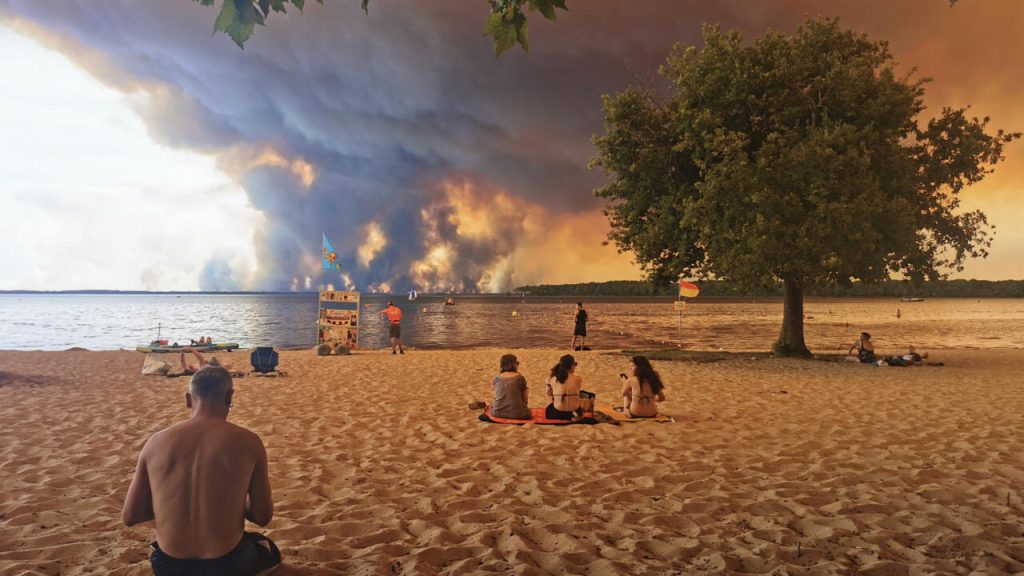
The lull is precarious in Gironde. The mega-fire ravaging the Bordeaux region remains stabilized, but unfavorable weather is already favoring the resumption of fires on Wednesday July 29. After ten days of respite, a fourth episode of heatwave sets in. Peaks of over 40°C are expected in the South-West, where winds could worsen the situation.
On the front line, the firefighters. Already 126 of them have been injured in the department. Nationally, four firefighters lost their lives during the recent fires, and the flames devoured more than 42,000 hectares in Gironde, around 4,500 in Var and more than 3,500 in Landes.

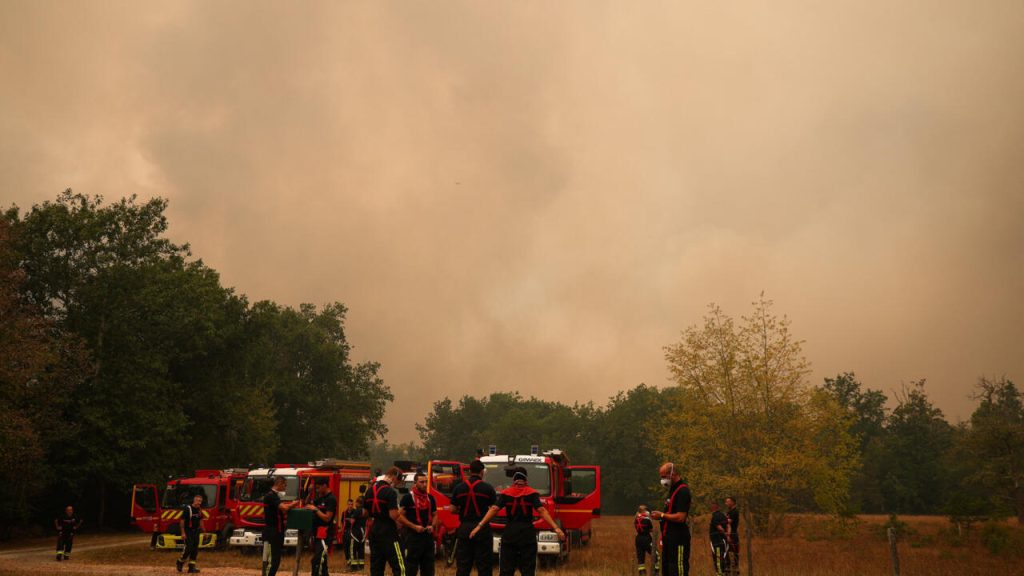
Firefighters deploy their watering hoses to fight fires near La Berle-de-Cassy, in Gironde, Wednesday July 29, 2026 © Emma Da Silva, AP Photo
Tuesday evening, 2,700 firefighters remained mobilized in Gironde, according to the prefecture. Among them, a Northerner. Commander Yaël Lecras, vice-president of the national union of professional firefighters, operates on the outskirts of the Gironde commune of Marcheprime. Between two outbreaks of flames, he agreed to speak with France 24.
France 24: What are your feelings after almost a week of fighting the flames?
Yaël Lecras: We are driven by the desire to work to put out these fires, to be of service. This is something quite impressive, because the burned areas are really large, with a lot of personal property that has disappeared. But what is remarkable is the commitment of the population to defend their territory. We are there “simply” to provide support.
Because for now, the citizen is really at the heart of his own defense. Local elected officials did a remarkable job welcoming the reinforcements. We observe everywhere a synergy between people who have means: many individuals with tanks bring water, to allow us to have it more quickly, or in more strategic places. Everyone does what they can, where they are. Everyone does their part.
What resources are you lacking?
There are people everywhere here: command reinforcements, water carrier reinforcements, ambulances, medical resources. All these everyday means are deployed. What is rather lacking are heavier, national means, air means. And what will especially cause difficulty are human resources.
The civil security budget has increased by 25% in ten years. Except that activity has increased by almost 45% – mainly due to emergency personal assistance, which is part of our daily lives.
The professional firefighters hired here devote their working time to Gironde, and we do it with pleasure. But it is also working time, which we will not have available in our departments upon return. Very concretely, if a firefighter has worked 200 or 300 hours in Gironde, that is 200 or 300 hours that he will not be able to work in his own department.

Firefighters intervene as flames and smoke rise during a forest fire, in Saint-Jean-d’Illac, Gironde, on July 27, 2026, as shown in this screenshot from a video. © Kara Nabil, Reuters
Hence the excesses: professionals who want to operate here take out a volunteer contract to come and work during their rest time. And it’s not just the Gironde that’s burning. This is a subject that is a little less publicized, but which will pose organizational difficulties for departmental fire and rescue services.
Is volunteering, which today represents 78% of the workforce, the solution?
We are constantly bombarded with this. Except that in the heart of summer, volunteering shows signs of exhaustion. And we do not have results that match the efforts invested: we have difficulty recruiting, difficulties in keeping them in activity, and it must be said, training problems. Training that we reduce to put personnel in our trucks, to maintain figures.
In addition, the backbone (professional firefighters, Editor’s note), on which volunteer firefighters are grafted, is not evolving to meet the challenges. We therefore have a weakening spine, and volunteers more and more quickly injected into the operational system. However, learning to attack a fire, provide rescue, provide emergency care, all of this really takes time to acquire a good skill. Double concern therefore: the safety of personnel, and the quality of the assistance provided.
In France, climate skeptics represent 2% of the population while occupying media space. How do you experience it?
Those who deny global warming need to open their eyes. This affects us, yes, because we are at the end of the chain. If we are not aware of the problem, if we do not do prevention, we cannot then be surprised when events like the Gironde fires occur.
We work on the curative part: we intervene when nothing holds. And we can clearly see that we are reaching our capacity limits, given the challenges. If we don’t deal with climate change, our model will have to evolve, because we won’t be able to hold up.
If we only focus on firefighting resources, we only focus on curative measures. If we do not act to prevent this warming, to limit it, if we do not really have an active phase to fight against it, even if we put curative means in front, they will always be insufficient.
A third of French people recognize climate change, but deny its human origin. What do you answer them?
It’s a cognitive bias. Believing this reassures us, because the challenge seems dizzying: global warming seems something over which we have no room for maneuver, when in fact, we have a lot of control on a daily basis. People who think it’s not due to human activity should just look at the facts. And, above all, realize that it is not something scary: once again, everyone can do their part. As long as we can do something, we do it: on global warming, we cannot give up before we have even started trying to act.
Also readMultiplication of fires: the human brain guilty of climate denial?
We, firefighters, obviously experience the phenomenon, and not only on fires: on floods too, on storms, in France but also during screenings abroad.

What would you like the French to understand?
We always think that the firefighters will hold on and they do in fact do what is necessary to hold on. But the risk is that the image of firefighters and the quality of the assistance they provide are altered, because we do not put human resources into it, and because we do not pay attention to civil security on a daily basis. It is given when there are fires or floods. We need to reform this system. He won’t last another five years.