
Good morning. You are reading the Up First newsletter. Subscribe here to receive it in your inbox, and listen to the Up First podcast for all the news you need to start your day.
Today’s best stories
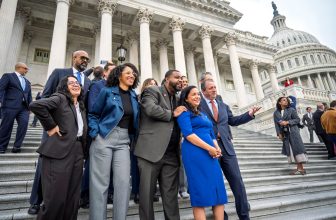
Vote counting ends for 2026 midterm elections, revealing a better image of the domination of the Democrats. Fifty-six percent of voters chose Democrats in House races, compared to 42% for Republicans. The 14-point gap is the largest margin won by Democrats in 50 years. The party officially won the largest majority in Congress since the early 1990s. Take a look at NPR’s breakdown of U.S. House races, by the numbers.

Artificial intelligence causes major fluctuations in the stock market as investors speculate on the future of the tech boom. As AI stocks have pushed markets to record highs and supported the economy, concerns are growing about a possible bubble. Investors expected artificial intelligence giant Anthropic’s stock market debut last week to lift markets, but Wall Street instead suffered one of its worst weeks in recent memory.
- 🎧 The National Association for Business Economics released a survey asking businesses about their experiences with AI. NPR’s Scott Horsley reports First that one in five reported measurable, widespread productivity gains, while about half said they saw gains, but they were not widespread. About 30% were not using AI or felt it was too early to assess its impact. Austan Goolsbee, head of the Federal Reserve Bank of Chicago, pointed out that significant investments in AI are already affecting the economy, contributing to inflation by increasing demand for construction materials and electronic components. Although proponents believe AI could eventually help reduce costs and limit inflation, Goolsbee tells Horsley that the Federal Reserve needs to address inflation issues now.
Poland has called an emergency NATO session for today after Russia fired three cruise missiles into its territory. The incident highlights what’s at stake for European countries in Russia’s war against Ukraine, prompting countries along NATO’s eastern border to seek increased air defense support. Poland plans to present proposals to increase surveillance capabilities and deploy more F-35s to intercept incoming missiles and drones.
- 🎧 NATO anti-missile systems and flights were successfully activated, but Polish authorities claim that bad weather prevented them from intercepting the Russian missiles, according to journalist Teri Schultz. No injuries or damage were reported. More than a year ago, NATO created the Eastern Sentinel to strengthen air defense after a large swarm of Russian drones entered Poland. Experts are now examining the potential shortcomings of this defense. If this attack was deliberate by Moscow, Russia risks serious consequences by endangering the lives of people on the ground in a NATO country, Schultz said.
Delegates at COP31 in Antalya, Turkey, failed to agree on a plan this weekend to fight fossil fuels, the main cause of climate change. The event lasted two days longer than expected, making it the longest in the history of these summits. Nearly 200 countries have failed to finalize their targets for electrification and financial aid to developing countries, or to address the impacts of climate change. The European Union rejected any conclusion that did not argue for a transition away from fossil fuels, while oil-producing countries such as Saudi Arabia opposed the position. Fossil fuels contribute about 73% of global emissions.
- 🎧 In the end, the EU decided that it was better to have no agreement on the COP than to have a deal It wasn’t about fossil fuels, says NPR’s Rachel Waldholz. She adds that money was another major problem. Developing countries have called for increased support to combat climate change, emphasizing that they have contributed very little to climate change but often face the worst impacts. Rich countries have agreed to provide funding under the Paris Climate Agreement. The United States has been absent from the discussions due to the Trump administration’s withdrawal from international climate negotiations. Many smaller and developing countries are strong advocates of these negotiations, seeing them as an essential platform to ensure their voices are heard alongside larger countries, says Waldholz.
Books we love

NPR’s annual reading guide, Books We Love, is back with more than 380 new recommendations from staff and trusted reviews. This year’s picks cover a range of genres, including fiction, cookbooks, children’s reads, poetry and science fiction. Don’t worry if this seems overwhelming; Interactive filters will help you narrow down your list and find your next great read. And why stop at this year’s readings? The Books We Love archive contains 14 years of recommendations, so you can discover over 4,700 amazing books, all in one place. This year’s edition of Books We Love is dedicated to Rose Friedman, who edited a dozen editions and worked at NPR for 15 years before her death this year at age 38. Friedman was one of the original founders of Books We Love, formerly known as The Book Concierge. In her honor, start exploring and find something wonderful to read today.
Behind the story
by Marie Godoyeditor-in-chief and scientific and health correspondent

Clinical Services Supervisor Dale Weiser poses for a portrait at the Chester County Health Department in West Chester, Pennsylvania, October 28, 2026.
Daniel Vasta for NPR
hide caption
Daniel Vasta for NPR
People warned me that it might be difficult to get the Amish to talk to me as a journalist – and probably impossible to get their permission to record their voices. This doesn’t bode well for compelling radio storytelling.
Yet as I traveled to Lancaster County, Pennsylvania, last month to report on the largest and deadliest measles outbreak in the United States in decades, I knew I wanted to hear directly from the hardest-hit community.
So I turned to a good old report on shoe leather. My producer and I mapped Amish-owned businesses in and around Lancaster County and spent a day driving from store to store. At each stop we introduced ourselves and explained what our story was about. We asked the Amish (easily identifiable by their traditional dress) about their views on the measles epidemic and vaccination. While some declined to speak, others explained how measles had affected their families and communities, and why they had or had not decided to get vaccinated. To my surprise, one woman even let me record her voice.
Outside a farm supply store in a rural town, I encountered an Amish woman who was visibly pregnant. Measles can have devastating consequences during pregnancy. She told me that her husband and two children had gotten vaccinated to protect herself and her unborn child. She initially refused to give me her name, then got into a car driven by her non-Amish driver. As they were pulling out of the parking lot, the driver stopped to ask what media outlet we were with. “Oh, NPR!” » said the driver when we answered. Then she turned to her Amish passenger and said, “Don’t worry, you can trust them.”
Part of gaining trust is showing up, showing respect, and really listening. Rumor has it that you are trustworthy. Pennsylvania public health officials have also used a similar approach to gain the trust of the Amish as they seek to increase vaccination rates amid the current outbreak. You can find out more here.
3 things to know before you leave

Bottles of Roundup weed killer are displayed on a shelf at a Home Depot store on June 25, 2026 in North Hollywood, California.
Justin Sullivan/Getty Images North America
hide caption
Justin Sullivan/Getty Images North America
- Bayer could pay up to $7.25 billion to settle lawsuits alleging its weedkiller Roundup caused cancer. A Missouri judge gave final approval to the nationwide settlement.
- Popular South African program Read Alex is tackling the children’s literacy crisis and inspiring them to write. The initiative resulted in the launch of a book for an anthology titled From Gomora to the worldfeaturing stories written by children.
- Orchestra Noir transforms 2000s hip-hop and R&B classics into choreographed, energetic symphonic spectacles. Beyond performances, the all-black ensemble creates a cultural bridge through its post-show ritual, when musicians meet their multi-generational audiences.
This newsletter was published by Suzanne Nuyen.
Gn headline