
- Ford collected data on the battery health of approximately 36,000 Mustang Mach-E electric SUVs and shared the results.
- Battery degradation is one of the biggest concerns among car buyers, but Ford’s data shows there’s not much to worry about.
- Even Mach-Es with 100,000 or 200,000 miles on the clock retained most of their original range.
This is one of the most common questions I get asked about electric vehicles: “How long will the battery last?” Naturally, people want to know their car will go the distance before spending tens of thousands of dollars on a new car with technology new to them.
More and more research shows that modern electric cars hold up very well to years of normal use. And a large study on Ford Mustang Mach-E SUVs proves it even more.
The Detroit automaker collected battery health data from 36,000 model year 2021 Mach-E SUVs sold in the United States and Canada. The findings, released Monday, should help allay fears that electric vehicles are deteriorating like smartphones, which struggle to maintain a charge after a few years of daily use.
On average, cars drove 55,000 miles in 5.2 years and retained 92% of their battery’s usable capacity. That means a top-of-the-line 2021 Mustang Mach-E with 305 miles of EPA range would theoretically be rated around 280 miles today. All cars in the study are equipped with nickel-cobalt-manganese (NCM) batteries, since Ford has not introduced a lithium-iron-phosphate (LFP) battery for the Mach-E starting with the 2023 model year.
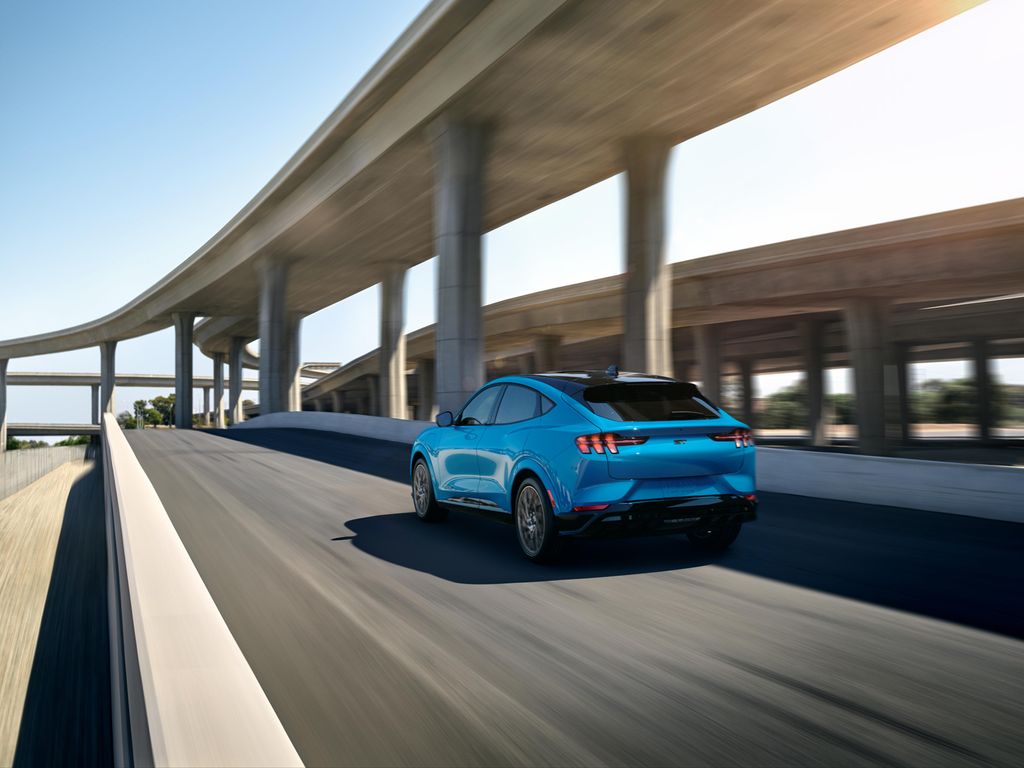
The 2021 Ford Mustang Mach-Es studied retained an average of 92% of its battery health after five years of driving.
Photo by: Ford
Ford physically tests the cells in the lab and attempts to predict battery degradation using computer models before a model is launched, Kevin Vander Laan, technical manager of the automaker’s high-voltage battery cells and systems, told me in an interview. But the real test comes after a car has spent years on the road.
“Our ballot slowly seeps in over time,” he said. “So here we are with a five-year report card, and it looks great.”
Interestingly enough, driving twice as many miles as average over the same period had virtually no impact on overall battery health. Ford says the more than 2,000 SUVs with more than 100,000 miles on the odometer have retained more than 91 percent of their battery capacity.
The few drivers who put some 40,000 miles on their Mach-E each year still had a healthy battery after five years. Ford says the more than 30 cars in its data set that have driven more than 200,000 miles had battery health of 88 percent.
Of course, these are just averages. Your results may therefore vary depending on many factors. Electric vehicles that spend their lives in the hot American Southwest tend to age more quickly than those driven in more temperate climates. Likewise, electric vehicle batteries that are frequently quickly charged to 100% and drained to near empty typically wear out more quickly than those that are kept in the 20% to 80% happy zone.
Ford nevertheless believes that the distribution of results is encouraging for its battery engineers: 95% of 36,000 cars fell between 87% and 97%.
The results are consistent with what other research has found about the aging of electric vehicles. Some early electric vehicles (notably the first generation Nissan Leaf) had less sophisticated battery thermal management and therefore experienced significant degradation. But modern electric vehicles tend to age much more gracefully.
According to Recurrent, a company that tracks the range retention of used electric vehicles that opt in, the average electric vehicle retains 97% of its initially observed range after three years and 95% after five years.
In September, battery health startup Aviloo published the results of 500,000 electric vehicle battery tests. After 150,000 kilometers (about 93,000 miles), most models studied were between 90% and 94% healthy. The Hyundai Ioniq 5, BMW i4 and Mercedes EQA stood out with values close to the top of this range. The Mustang Mach-E did about as well as Ford’s data shows: 92.5 percent battery health. The Tesla Model 3 and Model Y scored 88.9% and 90.3%, respectively.

The 2027 Ford Mustang Mach-E Trail
Photo by: Ford
Ford makes some familiar recommendations for drivers looking to make sure their electric vehicles last as long as possible. The company recommends managing extreme temperatures by parking in the shade on hot days and preconditioning the cabin while the vehicle is plugged in. She also recommends relying on Level 2 charging for daily driving and using Level 3 DC fast chargers sparingly.
Vander Laan says the lessons learned from this generation of electric vehicles and their performance are contributing to the development process for Ford’s next-generation electric cars, like the sub-$30,000 Fathom pickup coming out next year.
“It’s really a lifelong learning,” he said. “We have a design that we understand deeply, the data comes in, we learn from it and pass it on to the corporate engineering teams here.”
Contact the author: Tim.Levin@InsideEVs.com
Gn bussni

