
(Kitco NewsWire) – Spot prices for gold and silver fell sharply Friday in late U.S. trading as a technology-driven stock market selloff intensified liquidation pressure on precious metals, offsetting support normally provided by falling Treasury yields and heightened geopolitical uncertainty. Crude oil prices rose more than 2% following another tanker attack in the Strait of Hormuz, reinforcing inflation fears and expectations that the Federal Reserve’s monetary policy will remain tight. Spot gold traded near $3,879.90 an ounce, down $141.60, or 3.52 percent, while spot silver traded near $49.015, down $3.150, or 6.06 percent, on the session.
U.S. economic reports on Friday presented a mixed picture of moderate wage growth and weakening regional manufacturing activity. The employment cost index rose 0.8% in the third quarter, matching expectations and slowing from 0.9% in the second quarter. Chicago’s October purchasing managers’ index fell to 55.3 from September’s 58.8, missing expectations near 56.1 but remaining above the 50-point threshold separating expansion from contraction. The weaker wage and manufacturing figures released Friday follow a stronger-than-expected third-quarter gross domestic product report released Thursday, which showed the U.S. economy grew at an annualized rate of 3.4%, down from 2.2% in the second quarter. Personal consumption expenditure inflation in September accelerated to 3.6% annually, while core PCE inflation rose to 3.1%, reinforcing concerns about continued underlying price pressure.
Market positioning remains split between resilient economic growth, persistent inflation and increasing risk of financial market instability. The Federal Reserve left its benchmark interest rate unchanged between 3.75% and 4.00% on Wednesday, with two policymakers favoring an immediate 25 basis point increase. Interest rate futures continued to reflect substantial expectations of further tightening in December, although moderation in employment costs and Friday’s sharp decline in stock markets provided a counterbalance to the inflationary implications of strong GDP growth and rising energy prices. Treasury yields fell as investors sought the relative safety of government bonds, with the benchmark 10-year yield falling toward 4.93% and the two-year yield approaching 4.58%. However, gold continued to fall, suggesting that forced liquidation, portfolio rebalancing and broader prospects of restrictive monetary policy have outweighed immediate safe-haven demand.
The situation in the Strait of Hormuz and between the United States and Iran remained a major source of uncertainty in the energy market Friday after another commercial oil tanker was attacked in the strategic waterway. The ship was struck by explosive devices attached to its hull by a small boat, underscoring the continued vulnerability of commercial shipping despite regional diplomatic efforts to reduce tensions. Responsibility for the attack has not been established. The incident intensified fears that a new military confrontation between Iran and the United States could further disrupt Middle East energy exports, especially as markets weigh the possibility of additional military action after the Nov. 3 U.S. midterm elections. Negotiations involving Washington, Tehran and regional mediators have yet to result in a confirmed settlement, leaving disagreements over sanctions, maritime security and the future of commercial access via Hormuz.
Crude oil futures rose more than 2% on Friday, reaching their highest levels since late April as traders weighed the possibility of further disruptions in Gulf energy supplies. December Brent crude futures gained $2.76, or 2.4%, to settle at $117.64 a barrel after hitting $118.00 intraday. The more actively traded January Brent contract was up $2.63 at $113.43, while Nymex WTI futures rose $2.12, or 2.08%, to $104.12. Brent gained around 13.6% in October, while WTI rose 15.2%, reflecting ongoing concerns over security of supply in the Middle East and the inflationary consequences of regional conflict.
For gold, the latest Hormuz attack has strengthened underlying geopolitical demand, but rising crude prices have also increased the risk that inflation remains persistent and the Federal Reserve maintains restrictive monetary policy. Bullion’s sharp decline despite falling Treasury yields indicates that the broader sell-off in financial markets was the most immediate influence on Friday’s trading. Silver suffered significantly larger losses as weakness in precious metals coincided with concerns about industrial demand, stock market valuations and restrictive financing conditions. The widening gold-silver ratio reflects silver’s greater sensitivity to deteriorating risk sentiment and concerns over manufacturing activity.
North American stock markets ended sharply lower on Friday as disappointing corporate earnings and concerns over artificial intelligence-related investments sparked heavy selling in technology stocks. The Dow Jones Industrial Average fell about 1.1% to close at 51,770.31, while the S&P 500 fell 1.8% to 7,580.07, its biggest daily decline since June. The Nasdaq Composite Index fell 2.9% to end near 25,437 points as weakness in semiconductor and major technology stocks dominated trading. Intel plunged nearly 29% following disappointing profit forecasts, while concerns over Amazon’s capital spending added to pressure on the technology sector. The Russell 2000 index fell 1.7% to 2,811.84, indicating that selling extended beyond large-cap growth companies. Canada’s S&P/TSX Composite Index also fell sharply, losing more than 2%, as weakness in precious metals and other resource mining stocks compounded a broader deterioration in risk sentiment.
European stock markets closed lower on Friday as weakness in the technology sector and concerns over rising energy prices weighed on investor confidence. The pan-European Stoxx 600 index fell about 0.4% to 646.73, while Germany’s DAX lost 0.9% to finish near 25,819. France’s CAC 40 index slipped 0.1% to around 7,962, while Britain’s FTSE 100 index outperformed, rising 0.1% to around 10 736. The Euro Stoxx 50 fell around 1.2%, reflecting heavier losses among major continental companies. European tech stocks were particularly weak as the U.S. semiconductor selloff hit global valuations, while rising crude prices added to concerns about inflation, corporate margins and the outlook for regional monetary policy. Despite Friday’s losses, the Stoxx 600 ended October higher, reflecting gains from earlier in the month.
Major external markets see Nymex WTI crude oil futures rising and settling at $104.12 per barrel, while December Brent crude futures finished at $117.64. The yield on the 10-year U.S. Treasury note declined toward the 4.93% area as demand for government bonds increased during the stock sell-off. The US dollar was relatively strong, supported by defensive demand and expectations of restrictive policy from the Federal Reserve. (The Kitco Global Index shows how much of gold’s current performance is driven by the dollar versus the gold market itself.)
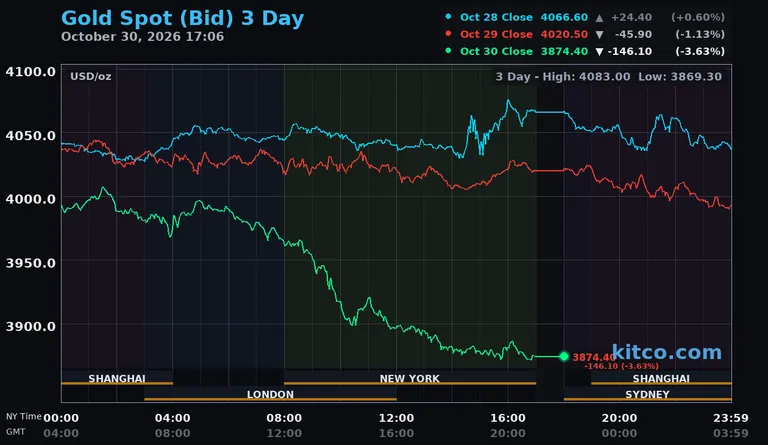
Technically, the next upside objective for spot gold prices is to push prices back above the $3,890.00 to $3,910.00 resistance zone, with a sustained recovery targeting $3,943.00 and then $3,975.00. The bears’ next short-term downside price objective is to hold prices below $3,890.00, with deeper downside targets at $3,800.00 and then $3,780.00. The first resistance is seen at $3,890.00 and then at $3,910.00. The next support zone lies between $3,780.00 and $3,800.00, following the breakdown below the former support zone of $3,890.00.
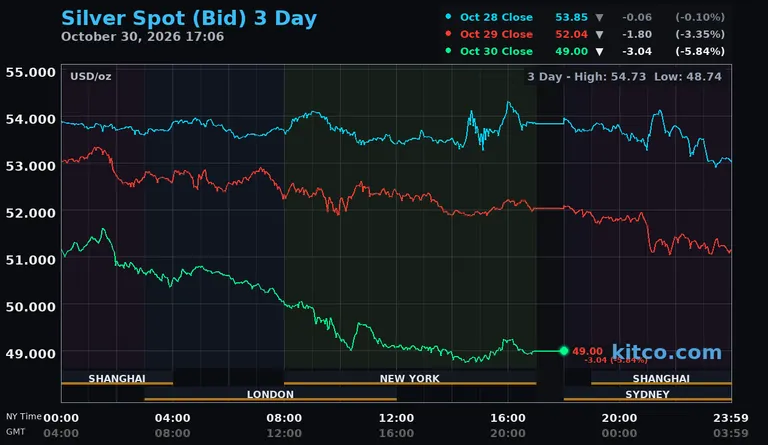
Spot silver’s next upside objective is to bring prices back above the $51,000 to $52,000 resistance zone, with a sustained move targeting $52,690 and then $55,000. The next downside price objective for the bears is a sustained break below $49,000, with deeper downside targets at $48,000 and then $47,000. The first resistance is seen at $51,000 and then at $52,000. The next support lies at $49,000 and then in the $47,000-$48,000 zone.
View live precious metals prices for gold, silver, platinum and palladium — in USD, CAD and 12 other currencies.

Disclaimer: The opinions expressed in this article are those of the author and may not reflect those of Kitco Metals Inc. The author has made every effort to ensure the accuracy of the information provided; however, neither Kitco Metals Inc. nor the author can guarantee such accuracy. This article is for informational purposes only. This is not a solicitation to trade any commodities, securities or other financial instruments. Kitco Metals Inc. and the author of this article accept no liability for loss and/or damage arising from the use of this publication.
Gn bussni

