
AUSTIN, Texas (KTRK) — When Rae Heath stops at a gas station to fill up during long bike rides, she says she always notices the colorful products near the checkout counter.
“I walk up to the counter and just look at what they have and don’t say anything to the guy at the counter,” Heath said.
But Heath actually has a lot to say.
The colorful packages lined up right next to the cash register are the reason her son isn’t coming home.
Heath, a 19-year-old music student at Oklahoma State University who dreamed of playing in an orchestra pit, died in April of what federal health officials call “gas station heroin.”
“I talked to him on my birthday,” his mother said. “He just seemed really out of place.”
According to his autopsy, Jonas died of toxicity caused by 7-Hydromitragynine (7-OH), kratom, and a 7-OH derivative.
Kratom is a plant native to Southeast Asia, and in small doses it can help someone concentrate, but in large doses it can act as a sedative, said Wendell Campbell, a drug intelligence agent in Houston’s high-intensity drug trafficking area.
Traces of 7-OH occur naturally in dried kratom, but chemical labs are now mass producing it synthetically to make tablets, drinks, and vape concentrates.
The Food and Drug Administration warns that 7-OH is up to 13 times more potent than morphine.
“It’s something that an individual can become addicted to pretty quickly,” Campbell said. “When you develop an opioid use disorder or addiction to 7-OH, you need to have it every day.”
Although Narcan, a life-saving drug known to quickly reverse opioid overdoses, has been effective for drugs like fentanyl, Campbell said it now takes four to six doses of Narcan to reverse a single 7-OH overdose.
On a mobile device? Click here.
13 Investigations have found that deaths linked to kratom and 7-OH have increased since the state began tracking them.
In 2017, the Texas Department of State Health Services recorded 14 deaths from kratom and 7-OH.
In 2023, when concentrated 7-OH products flooded the market, state data reported 114 deaths.
So far this year, from January to the end of August, Texas has already seen 111 deaths linked to kratom and 7-OH.
Source: US Food and Drug Administration
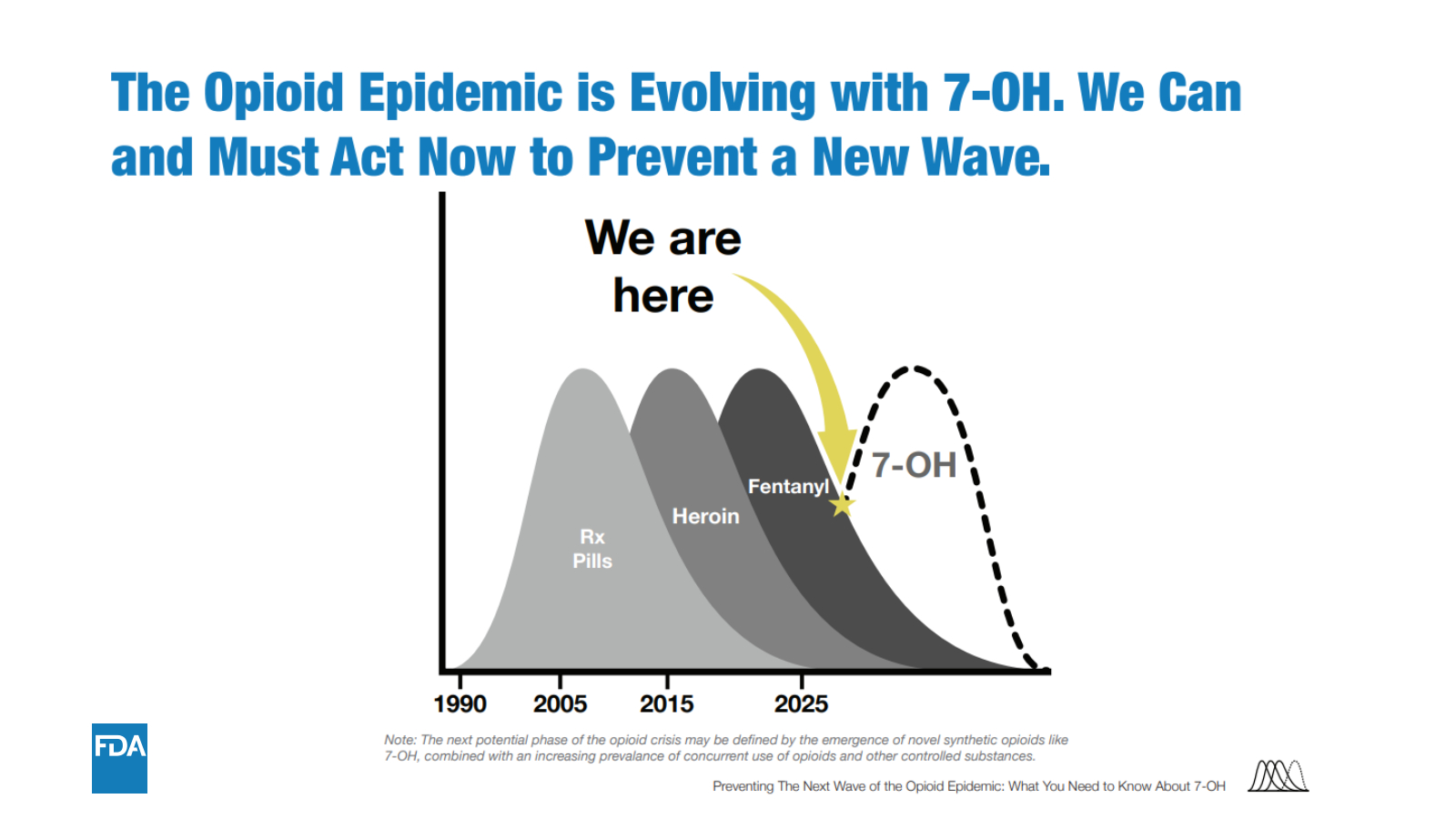
A graphic released by the FDA explicitly presents 7-OH as the next growing wave of the opioid epidemic after prescription pills, heroin and, more recently, fentanyl.
With 7-OH, the window between first use and death or potential overdose can be quick.
From what Heath has pieced together, she believes her son began taking kratom and progressed to 7-OH less than two months before his death.
“It’s not the same realm as kids experimenting with pot and THC. It’s something completely different and much more deadly,” she said.
Heath turned his grief into advocacy and last month launched the nonprofit 7-OH Truth Project to educate others.
This is not the same realm as kids experimenting with pot and THC. It’s something completely different and much deadlier
Rae Heath, her son died of an overdose of 7-OH and kratom
She’s also talking to Texas lawmakers about a bill to criminalize drugs.
The bill, which she hopes will be introduced in the next legislative session, would classify kratom extracts and synthetic 7-OH as Schedule I controlled substances, hit unlicensed manufacturers and sellers with criminal charges, invoke civil penalties and require mandatory reporting of overdoses.
“If it saves another 19-year-old boy, another 17-year-old girl from the same fate, then I think it’s such a meaningful and significant thing,” Heath said.
In Texas, products containing more than 2% concentration of 7-OH already violate state law, but weak enforcement has kept the product accessible.
In April, the Texas attorney general filed a lawsuit against two California-based online kratom retailers for selling products containing between 86 and 96 percent of the alkaloid content of 7-OH, which is supposed to be capped at 2 percent.
Other states have demonstrated targeted enforcement work.
California authorities took action last year after Los Angeles County recorded 10 local 7-OH overdose deaths between 2025 and early 2026.
“We were alerted by our medical examiner that we were seeing overdose cases involving 7-OH that appeared to be the cause of the overdose. So we quickly issued health alerts, made sure the community was aware, and then we enforced part of the California law that allowed us to enter facilities and conduct inspections where we were looking for 7-OH in kratom products and ordering retailers to take them off the shelves,” said Dr. Brian Hurley, acting director and medical director of the Bureau of Substance. Abuse prevention and control within the Los Angeles County Department of Public Health.
Hurley said they have conducted 5,000 inspections throughout the county and identified and removed kratom products from nearly 500 locations.
Since the enforcement action began, Hurley said Los Angeles County has no more 7-OH-related deaths.
“We saw a direct line, or timing, between when we took these enforcement actions and when we saw a decline in 7-OH overdoses, so that would be a lesson that I would like other jurisdictions to take into account,” Hurley said.
7-OH tragedies continue to make national headlines.
Famed music producer Tay Keith was found dead in his Nashville apartment in June, according to ABC News. The network reports that, according to his autopsy, he died from a mixture of drugs, including 7-OH.
Last month, two University of Mississippi students were found dead on the same day. Federal prosecutors then arrested a local smoke shop owner and his son for allegedly supplying drugs to students.
The arrests show a level of accountability that Heath wants to see enshrined in Texas law.
A bill was proposed in the Texas Senate during the last legislative session in 2025 with similar goals related to kratom and 7-OH, but it did not pass.
When it comes to combating addictive drugs in the community, Mike McDaniel, executive director of the Houston High Intensity Drug Tracking Area, said law enforcement can’t do it alone.
What I can assure you about Houston, Texas and our region is that we are very united in our approach.
Mike McDaniel, Executive Director of Houston HIDTA
He said that whether at the federal or state level, he is optimistic that there will soon be positive changes when it comes to dealing with this wave of deaths from 7-OH.
“That’s why we partner with addiction treatment professionals, the (medical examiner’s) office,” McDaniel said. “What I can assure you about Houston, Texas and our region is that we are very united in our approach.”
This week, the U.S. Department of Justice already filed an emergency action and notice of intent to make 7-OH a Schedule I drug, which would put it in the same classification as drugs like heroin and LSD.
Lawmakers can begin introducing bills in November for next year’s session, and Heath plans to be at the Capitol to fight for Jonas’ Law.
“I would do anything to get Jonas back, no exceptions, of course, but if this law passes and these things are banned, at least his life will have done something good for others,” Heath said.
Contact 13 investigators
Do you have any advice? A problem to solve? Submit a tip below. If you don’t have a photo or document to include, simply click ‘skip upload’ and submit the details. (On mobile? You can open our form by tapping here.)
Copyright © 2026 KTRK-TV. All rights reserved.
Gn Health

