
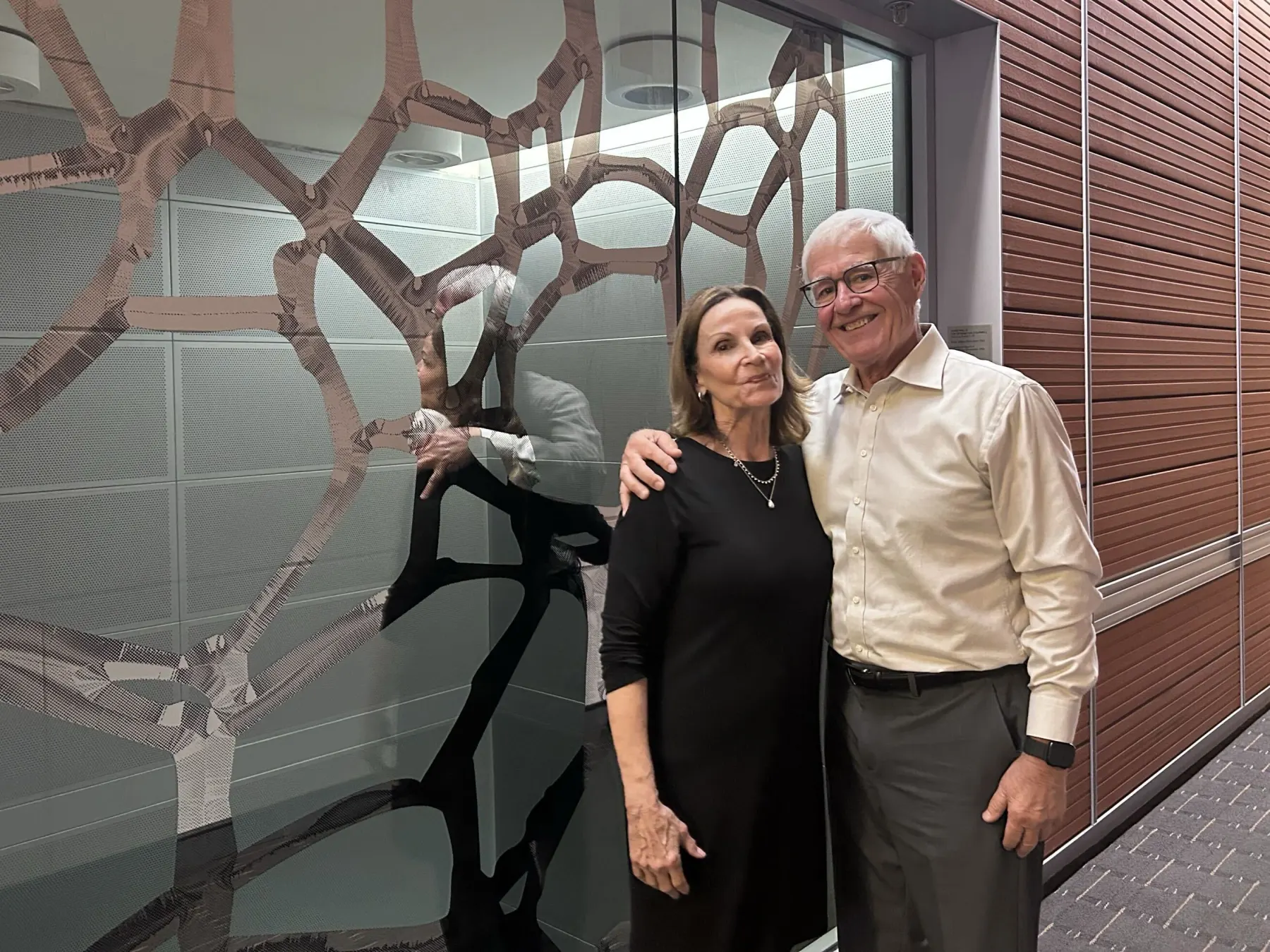
Donna Gustafson (left) and her husband, Ed Gustafson. Donna received her first mRNA cancer vaccine seven years ago to treat her pancreatic cancer.
Yuki Noguchi/NPR
hide caption
Yuki Noguchi/NPR
Donna Gustafson lives the fantasy of a cancer patient.
At 72, the retired accountant hikes, travels, lifts weights and exchanges adoring glances with Ed, the husband she married 50 years ago. All of these moments happen despite her showing no evidence of the stage II pancreatic cancer that was supposed to kill her years ago.
“I had 100 percent quality of life; I got back to where I was before,” Gustafson says.
“She’s better than that,” her husband intervenes. “She’s sassier and she’s in the best shape of her life – there’s no doubt about it.”
Seven years ago, Gustafson became the world’s first recipient of an mRNA vaccine designed to treat pancreatic cancer, a highly fatal disease diagnosed in about 70,000 Americans each year. There are few effective treatments for the disease, but Gustafson’s was a personalized treatment. version, created from samples of his tumor, aimed at reprogramming his immune cells – essentially training them to recognize cancer cells’ distinctive mutant proteins and kill them.
mRNA vaccines are having a moment
It’s been a big year for cancer vaccines using mRNA, especially after drugmakers Merck and Moderna last month released results from the first successful major trial of mRNA vaccines against skin cancer, showing a 42% reduction in recurrences and deaths over two years.
A combination of technologies using mRNA, genomics and AI created these vaccines, which are also being tested on lung, kidney, bladder and brain cancers. But researchers don’t yet understand why some trials have failed, while others are showing stunning results thanks to people like Gustafson.
Want the latest stories on the science of healthy living? Subscribe to NPR Health report.
Gustafson, who splits her time between New Jersey and Florida, says she wasn’t afraid to be the first to test this concept against pancreatic cancer. She thanks her three adult daughters for finding her and bringing her into the trial. “It was a no-brainer,” she says. “I knew that statistically my chances of survival were low and I was very happy to be offered some hope.”
Gustafson received nine doses of the vaccine, as well as surgery and chemotherapy. She was part of a small clinical trial involving 16 pancreatic cancer patients. The vaccine worked on half of the patients, and seven of them are still alive today.
For patients receiving these vaccines, treatment is also a simpler option. It’s not comparable to chemotherapy, which requires hours of infusion and is accompanied by “barbaric” after-effects for his wife, says Ed Gustafson with a shudder.
On the other hand: the photos didn’t look like anything, says Donna Gustafson. “I had no symptoms, no side effects – to the point where I was afraid it might not help.”
But it was. Very quickly.
Surgeon and scientist Vinod Balachandran led the trial at Memorial Sloan Kettering Cancer Center in New York. The vaccine used in his research is made in a vast laboratory consisting of corridors of freezers, offices, centrifuges and cytometers. Patient responses to treatment are measured in the laboratory. The oncologists and mathematicians who work there are dedicated to decoding pancreatic cancer and then reverse engineering the mRNA needed to fight it.
A research analyst displays a graph on her computer, showing dozens of superimposed green lines, each representing the number of times an immune cell reproduces, Balachandran says.
Looking at the graph of Donna Gustafson’s immune cell count, Balachandran notes how the lines rise, then stay high and flat — “a 10,000-fold increase” — reflecting how the mass of her immune system produced cancer-attacking cells, and kept them going, for years after her last injection. “It just tells us that this response is lasting,” Balachandran says.

Balachandran says it was the strength and durability of such responses in half of the patients that, for him, blew up the possibility of mRNA vaccines. “Well, if you could generate such a strong immune response against the most serious cancers, could that also enable the development of vaccines against a wide range of human cancers?” he says.
A promising future
This technology is now at an inflection point – with patients, doctors, researchers and investors. The National Cancer Institute, for example, is working on a partnership with private companies to accelerate research and development of more mRNA cancer vaccines. Balachandran and Sloan Kettering are among them, with plans to expand production of personalized vaccines for patients on site.
Donna Gustafson says she and her husband have felt extremely lucky over the past seven years.
“I have seen two more grandchildren born and raised, many birthdays, holidays and Christmases with my family,” she says.
She and her husband have created and checked off many items on their bucket list: skydiving, the summit, their 50th anniversary celebration, and hope for many more to come.
“We’ve done so much – we probably would have done a lot more,” says Ed Gustafson, before his wife repeats, “…if we hadn’t had this experience.”
“We live a lot more day to day now,” Ed Gustafson says, looking at his wife.
Gn Health

