
Republican Mike Rogers and Democrat Abdul El-Sayed faced off on stage Wednesday in the second and final debate amid increasingly bitter circumstances. Michigan Senate Race. El-Sayed repeatedly claimed that his opponent was and would be a “puppet” for President Trump in the Senate, while Rogers portrayed his opponent as untrustworthy and trying to flee from past, more left-leaning positions.
THE neck to neck race is one of the most closely watched midterm elections in the country and could help determine which party wins control of the Senate. Democrats hope to take advantage of Mr. Trump’s unpopularity and voters’ frustration over inflation and the war in Iran. Republicans have sought to capitalize on divisions between progressives like El-Sayed and more moderate Democrats over Middle East policy and Medicare for All.
Robin Buckson-Pool/Getty Images 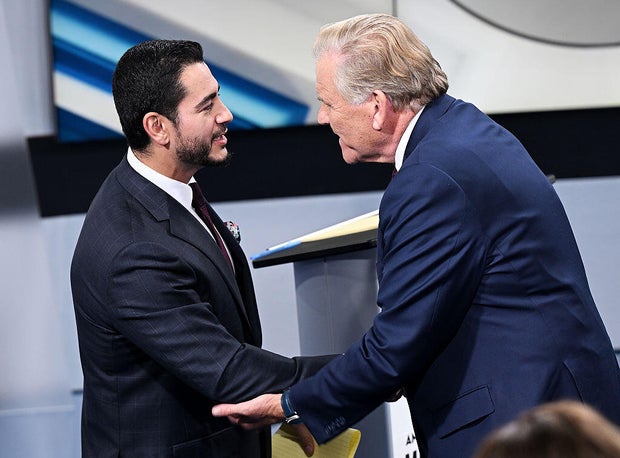
El-Sayed called Rogers’ platform a “MAGA vision” and argued that the former congressman “stands with Donald Trump on all of his worst policies, the policies that raise the price of your gas, making it impossible to buy your groceries.” The former Democratic health official responded to the attacks by inviting the public to play “MAGA bingo.”
“He’s going to pander to Donald Trump because he’s a puppet to that man,” El-Sayed said.
Rogers retorted at one point, saying, “He wants to talk about Donald Trump. The bingo game should be: “How many times can he put Trump in an answer?” » »
Asked by reporters after the debate if he planned to attend Mr. Trump’s rally in Michigan on Sunday, which El-Sayed mentioned, Rogers said he would attend but did not yet know all the final details.
During the debate, Rogers argued that El-Sayed had not been honest about his program, accusing him of engaging in a “pattern of deception.”
“Think about this: There are so many Democrats coming out today and saying they can’t vote for Abdul El-Sayed because he’s too extremist,” Rogers said. He also claimed that he “does exceptionally well with Jewish Democrats who are literally afraid,” referring to the reluctance of certain members of the community to support El-Sayed, a frequent critic of the Israeli government.
The debate was a little calmer than that of the two candidates first confrontation earlier this monthwhich featured insults and interruptions in virtually every response. But it was still trying.
One of the most controversial moments came after Rogers tried to link El-Sayed to the Muslim Brotherhood and suggested that it had the same supporters as terrorist groups like Hamas – allegations that El-Sayed vehemently opposed.
Earlier this month, several media outlets reported on social media posts from El-Sayed’s half-sister suggesting that the Democratic candidate’s mother had supported the Muslim Brotherhood, an Islamist group and political movement founded in her home country of Egypt.
El-Sayed denied any connection to the organization and stressed that he had not been raised by his biological mother since his parents’ divorce when he was young. Rogers said El-Sayed was trying to portray himself as “a victim.”
“You can smile and you can smile and you can speak very nicely, but I’ll tell you what, it’s a risk to our national security,” Rogers said. He told reporters after the debate that he wondered whether El-Sayed would be able to obtain a security clearance if elected.
El-Sayed called the allegations “shameful.”
“He keeps bringing up this question about this association with an organization that I was never a part of, because of my mother, who is a nurse in Missouri?” said the democrat. “That doesn’t make any sense, and it’s actually really beneath you, Mike.”
El-Sayed insisted on Rogers the war in Iranpointing to the conflict as the cause of high consumer prices and presenting the Republican as a hawk who is waging “a war for everything”.
“We need a war powers resolution, rather than a senator who will stand with Donald Trump in this war that made no sense when it started and certainly makes no sense now,” El-Sayed said when asked how he plans to reduce costs.
Rogers has called for an end to the warbut also said during the debate that if Iran were allowed to control the Strait of Hormuz or build a nuclear weapon, gas could rise even more.
Moderators asked El-Sayed whether he considered Iran a significant threat to U.S. national security. It was a variation of a question posed during the first debate, when El-Sayed was asked whether Iran or Israel posed a greater threat, which he called a “ridiculous assumption.”
El-Sayed said Wednesday that “there is no doubt that Iran posed a threat,” but he asserted that “that threat was contained” by the Obama-era deal that limited Iran’s nuclear program. Mr. Trump I terminated this agreement during his first term.
Rogers said Iran is “absolutely” a threat and argued that El-Sayed’s previous answers on Iran were “absolutely doomed to fail if you’re thinking about sending someone…to the United States Senate.”
Meanwhile, Rogers pushed El-Sayed to push some of his progressive political views, including his support for Medicare for All, a single-payer health care plan.
“Money in your pocket? You’ll be lucky to have any damn pants when you’re done,” Rogers said, arguing that El-Sayed’s policies would require significant tax hikes.
El-Sayed responded by saying, “Right now, the ones taking the money out of your pocket are the big corporations buying his campaign.” Asked by CBS News after the debate about the cost of the plan, El-Sayed argued that if implemented, it would cost less than current health care costs, and said the platform had bipartisan support.
On pricesEl-Sayed criticized Mr. Trump’s tariffs but said he was open to some import duties. He said: “You don’t give all the chemo at once, at the same time. »
Rogers called the president’s tariffs a “mixture,” questioning the trade war with Canada but saying “the reshoring of manufacturing is underway.”
Gn usa

