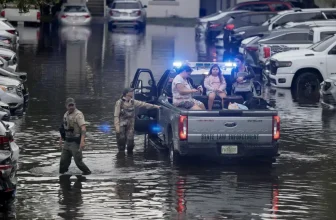
An atmospheric river has unleashed ungodly rains on San Francisco, turning streets into murky lakes and manhole covers into gushing gushes. geysers (opens in a new tab). The days seemed over this week, but the worst may be yet to come.
The same stronger (opens in a new tab) The atmospheric river is expected to hit the Bay Area just before Thanksgiving, with the highest king tides (opens in a new tab) of the year.
“If I were considering flooding near my block or my house, I would expect it to be worse next week,” Kristina Hill, an associate professor of landscape architecture, environmental planning and urban design at UC Berkeley, said Thursday.
Why did the city flood so quickly on Wednesday? As cliché as it sounds, it was the perfect storm.
First, there was a lot of rain in a short time. Wednesday was one of the rainiest days in November save (opens in a new tab) in more than 100 years, and it caused one of the heaviest hourly rains the city has ever seen, according to Daniel Swain, a climatologist at the University of California Agriculture and Natural Resources.

“This is now the third or fourth time in the decade that something comparable has happened in San Francisco,” Swain wrote on X (opens in a new tab). Heated tropical waters powered by El Niño (opens in a new tab)which occurs every two to seven years and is driven by climate change, has intensified wind and rain.
Second, unlike many cities, San Francisco has an underground system that doesn’t separate stormwater from wastewater: rain and everything that goes down the toilet goes through the same pipes. Indeed, the system was built in the 19th century, a time when merging the two streams seemed like a good idea because stormwater was thought to help remove human waste, Hill explained.
But the logic of the past poses a problem in the present. Since the 1970s, when federal environmental protection laws took effect, the city can no longer simply dump its untreated sewage into the bay and ocean. So when heavy rains overwhelm the pipes, as happened Wednesday, the water has no other way but to rise.
In parts of San Francisco, this creates a health risk as raw human sewage mixes with flooding. The solution, Hill said, could be to build tunnels or pipes to free up more space so the extra water can drain, as Chicago and Washington, D.C., have done.

Third, there is climate change. Two centuries of burning fossil fuels have warmed the planet, melting polar ice and expanding the oceans. The water level in the bay has risen eight inches in the last century, according to a state agency (opens in a new tab)and it is predicted to increase by another 10 by 2050. As the ocean rises, it brings up groundwater, making low-lying areas like the Mission vulnerable to flooding, Hill said.. And in the Bay Area, Hill’s research (opens in a new tab) shows that rising groundwater could reach thousands of contaminated sites, from Richmond and West Oakland to Hunters Point.
Put it all together – another atmospheric river, even more powerful; king tides; and a city still soaked from this week’s storm – and next week doesn’t look good. And beyond that, the oceans raised by global warming are not decreasing.
“Sea level rise is one of the issues when the horse left the stable,” Hill said. “We put ourselves in this situation and now we have to live with it.”
Gn usa