
What is particularly interesting about the Xe3P is its pipeline. The XMX engines have been redesigned, moving from the four-deep systolic design on the standard Xe3 to a 16-deep processing on the Xe3P. Additional details include support for the FP4 data format alongside FP8, as well as large register files of 1 MB per core and a 512 KB L1 cache per core. In total, there are 256 Vector engines and 256 new XMX engines, each divided into groups of eight per Xe3P core. Additionally, in the Xe3P, there is no graphics processing element to produce images, as the silicon is designed only for AI inference workloads that require lengthy context and agent tasks.
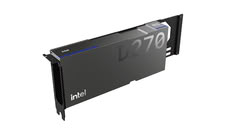

The accelerator is designed as a 350W air-cooled PCIe 5.0 x16 card, allowing it to fit into conventional server infrastructure without the need for dedicated liquid cooling. Intel also leverages its common Xe software foundation and support for established AI frameworks to facilitate deployment. Customer sampling is ongoing, but pricing, general availability and independent performance results have not yet been disclosed. Ultimately, cost per token generated and software maturity will determine whether Series D can compete with established AI acceleration platforms. Intel envisions a single card powering models with up to 300 billion parameters, with an 8x GPU cluster running models with billions of parameters without issue.
Gn bussni

