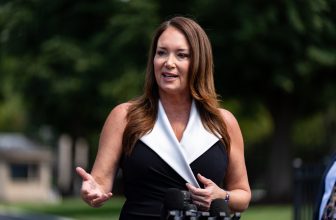
At a July 2023 Senate hearing on protecting Social Security, Sen. Ron Johnson, Republican of Wisconsin, described the program’s trust funds as a “four-drawer file.”
Source: US Senate
A new Senate Budget Committee hearing Wednesday revived an old Social Security question: Is the program, which provides monthly benefits to millions of Americans, a Ponzi scheme?
Senate Budget Committee Chairman Ron Johnson, a Republican representing Wisconsin, called Social Security a “legal Ponzi scheme” in his opening remarks. But experts say his comments overlook how Social Security works and the real dilemma lawmakers face over its looming funding gap.
A Ponzi scheme is an investment fraud that uses funds from new investors to pay existing investors, according to the Securities and Exchange Commission, Johnson wrote in his chairman’s hearing memo. He said Social Security fits the description if you take out the word “fraud.”
Johnson’s comments follow his Wednesday morning interview on Fox Business, where he said, “At this point, there’s really no way to fix Social Security.” »
“You can’t fix it, you just close it and then hope you can get some of your money back,” Johnson said during the Fox Business interview.
“As far as I know, this is the first time in decades that a senior senator, chairman of the budget committee, has said he would rather shut down Social Security than fix it,” Sen. Ron Wyden, D-Ore., said during the hearing.
At the Senate hearing, Johnson said his comments during the television interview were “imprecise” and that he was speaking generally about Ponzi schemes, not Social Security, which need to be abolished.
Johnson said he wants lawmakers to pass legislation to ensure that seniors’ Social Security benefits aren’t cut, “and then roll up our sleeves and let’s solve the real problem, which is $24 trillion in deficits over 10 years.”
The Congressional Budget Office projects a cumulative federal budget deficit of $24.4 trillion over the next 10 years.
Johnson proposed a bill Wednesday that would allow Social Security retirement benefits to be funded through general revenue once that trust fund reaches its insolvency date.
Critics say it’s not a viable solution. Using the general fund to finance Social Security would “completely explode the national debt” and cost 165% of gross domestic product over 75 years, Maya MacGuineas, president of the Committee for a Responsible Federal Budget, a nonpartisan organization, said in a statement.
Social Security “operates with its own budget”
The way Johnson described the program at the hearing was “out of touch with how the American public understands and knows about Social Security,” said Bill Sweeney, senior vice president of government affairs at AARP, a nonpartisan, nonprofit organization representing Americans ages 50 and older.
“The Budget Committee should know that Social Security is not part of the budget,” Sweeney said. “It operates on its own budget.”
Social Security affects the unified federal deficit and debt held by the public when spending exceeds dedicated revenue, according to the CBO. Treasury securities held by Social Security trust funds are considered intragovernmental debt, which is included in the gross federal debt but not in the public debt.

Social security benefits are mainly financed by social security contributions. When program revenues exceed its costs, the excess is invested in special U.S. Treasury securities held in the trust funds.
Social Security is not allowed to borrow money and cannot take on debt, according to Sweeney.
“He never contributed a dime toward the debt,” Sweeney said. “It’s not part of the national debt because it’s part of a separate budget.”
The challenge of financing social security
Social Security trust funds could be depleted within the next six to eight years, based on current projections. If this happens, Social Security benefits could be reduced.
In six years — the fourth quarter of 2032 — the Social Security retirement trust fund could run out, Social Security administrators predicted in June. At that point, 78% of these benefits would be payable.
In eight years — the third quarter of 2034 — Social Security’s combined retirement and disability trust funds could run out, when 83 percent of scheduled benefits would be payable, according to projections by Social Security administrators.
If payroll tax revenues had kept pace with the level of gross domestic product over the past four decades, the program would be able to pay full benefits through 2059, an additional 25 years than current projections, according to a recent AARP study.
During the hearing, Johnson showed a photo of the trust funds, which he said is a “four-drawer file in Parkersburg, West Virginia.”
Johnson also mentioned the trust fund records during a hearing in July 2023. In 2005, then-President George W. Bush was shown paper evidence of U.S. Social Security obligations during a visit to the Public Debt Office in Parkersburg.
Even though politicians’ actions seem to suggest that trust funds aren’t real, experts say they are legitimate.
“It’s all about scaring people into believing that Social Security isn’t going to be there for you when it’s time to retire,” Sweeney said. “That’s been the case for 91 years, and there’s no reason to believe it won’t.”
Wednesday’s Senate hearing was a “missed opportunity” for a more in-depth discussion of the challenges facing Social Security, said Jason Fichtner, a witness at the hearing and executive director of the LIMRA Retirement Income Institute, a research initiative within the insurance trade association LIMRA.
Plans such as raising or eliminating the taxable maximum for employee Social Security contributions could worsen the program’s financing problems 20 or 30 years down the road, but would not make the program solvent for the 75-year target, according to Fichtner, a former Social Security Administration official.
Additionally, improving Social Security wouldn’t solve the government’s larger budget problems, leaving the economy still vulnerable to stress in the bond market, he said.
“The other problem is fear,” Fichtner said. “We are now seeing evidence of people claiming Social Security early because of their fear that trust funds will run out of money or that Social Security will not be able to pay their benefits.”
A June 2025 AARP survey found that 49% of respondents who had recently applied for or planned to apply for Social Security benefits sooner than expected were primarily motivated by fear that the program would run out of money.
“Social Security is very good at solving problems, and it’s a thorn in the side of the federal government because it has done a horrible job managing many aspects of our finances,” said labor economist Kathryn Anne Edwards, a witness at the hearing and a senior fellow at the National Academy of Social Insurance, a provider of research and policy analysis on social insurance and economic security programs.
“But Americans don’t see it that way,” she said.
More than half of Social Security recipients surveyed say benefits are their primary source of income, according to an August AARP poll.
Social Security reform provides an opportunity to expand the program to meet the needs of Americans, Edwards said. Adding universal paid family and medical leave to the program could help individuals and families who don’t currently have access to those benefits, she said. Additionally, strengthening unemployment insurance could help ensure financial security amid AI-related job losses, Edwards said.
Senators elected Nov. 3 will take office when the retirement fund’s exhaustion date arrives in 2032. The next session of Congress could be an opportunity to hold “serious” hearings on the future of Social Security, Sweeney said.
The Senate Budget Committee hearing Wednesday followed other recent hearings on the future of the program, including a Senate Finance Subcommittee hearing in June and a Senate Full Finance Committee hearing in August.
Gn headline