
Hurricane Isaiah strengthened by a tropical storm Wednesday evening and is expected to make landfall along the U.S. Gulf Coast this weekend, threatening parts of Mississippi, Alabama and the western part of the Florida Panhandle. This is the first hurricane of the 2026 Atlantic season.
A hurricane warning was issued Wednesday for the northern Gulf Coast, from Ocean Springs, Mississippi, across Alabama to the Florida Bay-Gulf County border.
Florida Governor Ron DeSantis declared a state of emergency in more than two dozen counties in his state, and Alabama Governor Kay Ivey declared a state of emergency for 40 counties.
Maps show hurricane’s path
Isaias had maximum sustained winds of 75 mph and was located about 460 miles southwest of the mouth of the Mississippi River, according to the National Hurricane Center.
Forecasters said they expected Hurricane Isaias, pronounced “ees-ah-EE-ahs,” to make landfall Friday night or early Saturday.
CBS News 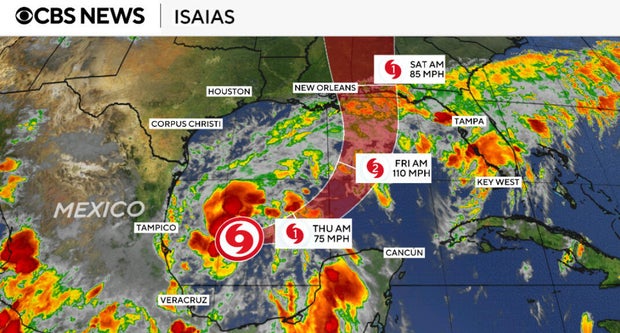
“Isaias is expected to strengthen into a powerful hurricane as it approaches the northern Gulf Coast on Friday,” the National Hurricane Center said. “Life-threatening storm surge is expected.”
Along with the hurricane warning, a tropical storm warning was issued from the Jefferson/Plaquemines Parish line in Louisiana to Ocean Springs, and from the Bay/Gulf County line to the Aucilla River in Florida. A storm surge warning was issued from the mouth of the Mississippi River to Yankeetown, Florida.
CBS News 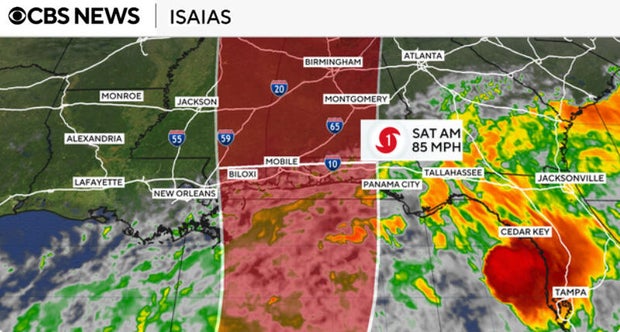
The hurricane center is forecasting 3 to 7 inches of rain and up to 10 inches in some places along the coast from southeastern Louisiana to the Florida Panhandle. Much of the Southeast, and as far north as the Tennessee Valley and the Carolinas, could see heavy rain.
The latest for a first hurricane since 1905
Isaias’ development into a hurricane Wednesday marked the latest date in 121 years for the development of the first hurricane of the Atlantic season, narrowly missing a record set on Oct. 8, 1905, according to National Oceanic and Atmospheric Administration data.
The season, unusually calm in the Atlantic this year, extends from June 1 to November 30.
An Atlantic hurricane season typically produces an average of 14 named storms, seven hurricanes and three major hurricanes, according to the hurricane center, which used climate data collected between 1991 and 2020 to calculate these numbers. The first named storm of a season normally forms in mid-to-late June, while the first hurricane tends to form in early to mid-August, and the first major hurricane often occurs in late August or early September.
Forecasters predicted there would be less storm activity in the Atlantic than usual this year, but so far it has been even quieter than expected. Meteorologists say this is largely due to the appearance of a strong El Niño during the summer, which generally correlates with cooler water temperatures and greater fluctuations in wind patterns over the Atlantic, conditions that inhibit the growth of tropical systems. The Pacific, meanwhile, experienced a series of unusually active hurricanes.
Gn usa