
A new hypothesis from the Hebrew University of Jerusalem (HUJI) proposes that our fundamental sense of being conscious – the “I within” – originates in the brainstem, the rod-like structure at the base of the brain that connects the cerebrum and cerebellum to the spinal cord. This anciently evolved part of the brain acts as a vital control center for life-sustaining autonomic functions and serves as the primary pathway for motor and sensory signals.
Close your eyes and cover your ears. Much of the world around you fades from sight and sound, but your sense of being present – of being aware – remains. What creates this fundamental feeling of being “you”?
Drawing on evidence from pain research, brain injury, and anesthesia, researchers suggest that the cerebral cortex processes much of the information we receive, while brainstem circuits cause this information to be felt consciously.
Veteran pain expert Professor Marshall Devor and neuroscientist Dr. Mark Baron of HUJI and Harvard Medical School’s Beth Israel Deaconess Medical Center have just published their findings in the prestigious journal. The neuroscientist under the title “Brainstem Theory of Consciousness”.
So far, neuroscientists have identified the source of conscious experience primarily in the cerebral cortex – the folded outer layer of the brain that is responsible for complex functions including language, recognition and planning. This outermost layer of gray matter tissue in the brains of humans and mammals is divided into the left and right hemispheres, is approximately two to four millimeters thick, and contains approximately 15 billion neurons. Its wrinkled, folded texture consists of raised ridges that greatly increase the surface area so that more neurons can fit inside the skull.
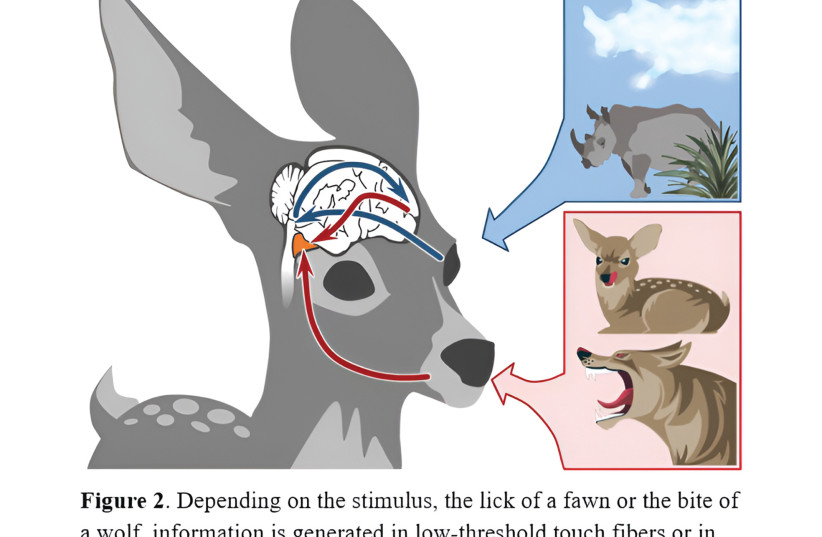
Swimming against the tide, HUJI experts suggest that the fundamental ability to feel and experience originates in older, “primitive” brainstem circuits.
The article brings together existing experimental findings and clinical observations to develop this theory without claiming to establish a proven mechanism for consciousness. They base their argument on the widespread experience of pain.
Detecting a noxious stimulus and feeling pain are disconnected entities. “The nervous system can trigger an automatic ‘reflexive’ withdrawal from danger, but pain also involves a subjective experience: It hurts,” Devor said. The Jerusalem Post in a long interview. He and Baron argue that evidence from brain stimulation, seizures, neurological damage and other research suggests that this feeling does not depend on the cortex in the same way that complex visual or auditory experiences do.
For example, they note that even significant cortical damage usually leaves pain intact or even increased, whereas such damage can severely degrade vision and hearing. Loss of consciousness is rare. On the other hand, damage to certain regions of the brainstem systematically leads to coma. They argue that the brainstem can do more than just keep the cortex awake: it can generate the basic capacity for conscious experience of pain and, by extension, also of the other senses of smell, touch, taste, hearing and sight.
Having spent much of his scientific career studying pain, Devor said the field gradually led him to study the mystery of consciousness. His theory distinguishes between information that the brain processes in a robotic way, like a self-driving car, and the feeling of consciously experiencing that information. Recognizing a face, fearing an animal will attack you or understanding a sentence requires complicated processing, he said.
Researchers suggest that the cortex does most of this work and evaluates the benefits or dangers that might come with it. “Our brains are constantly flooded with sights, sounds, smells, and physical sensations. Because you can’t pay attention to everything at once, the brainstem filters out the background ‘noise’ and sends only the most important signals to your conscious mind. It decides which sensory signals are moved to the front of your mind so you can actively focus, and which are ignored in the background.”
This distinction could help explain why damage to particular cortical regions can eliminate specific abilities, such as seeing or recognizing objects, without necessarily eliminating the person’s basic awareness.
“In our model, the cortex and the brainstem work together – the cortex provides detailed information about the world, and brainstem mechanisms shed light on subjective experience on aspects that merit conscious attention,” continued Devor, who made aliyah to Toronto, studied psychology at Princeton University and earned a Ph.D. at the Massachusetts Institute of Technology, completed a postdoctoral fellowship at University College London, and then joined the HUJI Institute of Life Sciences.
The authors draw particular attention to a region of the brainstem called the mesopontine tegmentum, where previous research has identified circuits involved in coma following brain injury and loss of consciousness during surgical anesthesia. They argue that studying this area and its connections could help researchers test brainstem theory and explore how neural activity becomes a subjective experience.
However, they said that while the precise mechanism remains unresolved, it is surely biological. Their paper offers a framework for further investigation rather than a complete explanation of how the brain generates consciousness.
“Development of more powerful information processing”
Ultimately, Devor and Baron call for greater attention to the brainstem in investigating how the brain creates our most fundamental experience: being here, feeling something, and knowing the world from the inside out. “The most fundamental feeling of being conscious has ancient roots, while the richness of what we humans experience reflects the later development of more powerful information processing,” Devor said.
Describing the “inner self” as the raw consciousness of the individual – like the redness of a surface or the sting of pain – Devor called the brainstem the true source of the self. “A frog can stick its tongue out where an insect is,” he explained. But extracting complex information about fitness from visual contrasts falling on the retina – like distinguishing a distant cloud from a charging rhino – requires enormous computing power.
“This only became available with the development of the mammalian neocortex, centuries after sensory processing was already well established in the brainstem,” he added.
Devor remembers attending a conference a long time ago claiming that babies didn’t need anesthesia during surgery because they “weren’t conscious yet.” He disagrees: “A fertilized egg doesn’t feel pain, but no one knows if a fetus feels pain. I think it’s when the brainstem develops.”
Researchers distinguish between nociception – the nervous system detecting potentially harmful stimuli – and the actual experience of pain. When asked specifically where neural signals transform into the subjective sensation of pain, Devor pointed to the anatomy of the brain: “It’s in the brainstem, which is about the size of your thumb, long and skinny. If an electroencephalogram is flat, doctors will say the person is ‘brain dead,’ but the brainstem may still be active. They can’t speak, but they might still feel pain.”
Since Devor suggests that the ability to experience pain arose very early in evolution, before the development of the mammalian cerebral cortex, he was asked which organisms first possessed this rudimentary form of consciousness. “I think reptiles, but maybe even fish, can have pain awareness and awareness. They have primitive vision.” But do fish and reptiles have subjective experiences – that there is actually something you feel about being a fish or a reptile? “We don’t know,” he replied.
When asked what experiments he would most like to see conducted to test his hypothesis, Devor responded that there are “ways to selectively manipulate brainstem activity while monitoring subjective experience. Functional MRI, clinical MRI, and CT scan look at the cortex, but the brainstem is so small and surrounded by bone that it makes imaging very difficult. However, these techniques are increasingly powerful and so there should be more research. I am doing research. laboratory experiments on rats and mice.
If the team’s theories prove correct, they could change the way doctors assess consciousness in patients with severe brain injuries, coma, or impaired consciousness. “If we knew how this can be done, it could help people in a coma,” Devor said. “Every hospital has anesthesiologists, but they don’t conduct research on how they work. Their job is to put people to sleep and bring them back to life. Maybe this article will help get more young doctors involved in this field.”
Gn Health