

Want to bookmark your favorite articles and stories to read or view later? Start your independent membership today.
Join us today
Already a member? Log in
A federal judge has temporarily blocked Donald Trump’s administration from building a 250-foot triumphal arch that the president wants to use as a “prime military complex” to dominate Washington, DC.
The ruling Thursday evening by District Judge Tanya Chutkan came less than an hour after a federal planning commission made up of Trump allies approved the plans, following several hours of public comments urging the commission to reject it.
The National Capital Planning Commission, which the president has packed with his appointments, approved the project around 10:30 p.m. despite lengthy public testimony calling for the commission to avoid settling for mere approval and demands from members of Congress and veterans groups suing the administration to shut it down.
Chutkan’s order bars the administration from working on the project for at least two weeks while a legal battle plays out.
The latest developments also follow a series of court filings in legal battles against the project, suggesting construction could begin imminently near Memorial Circle, across from Arlington National Cemetery, although the costs and burden on taxpayers remain unclear. In court filings, the administration said a company was prepared to launch a “construction mobilization” as soon as the commission approved the plans.
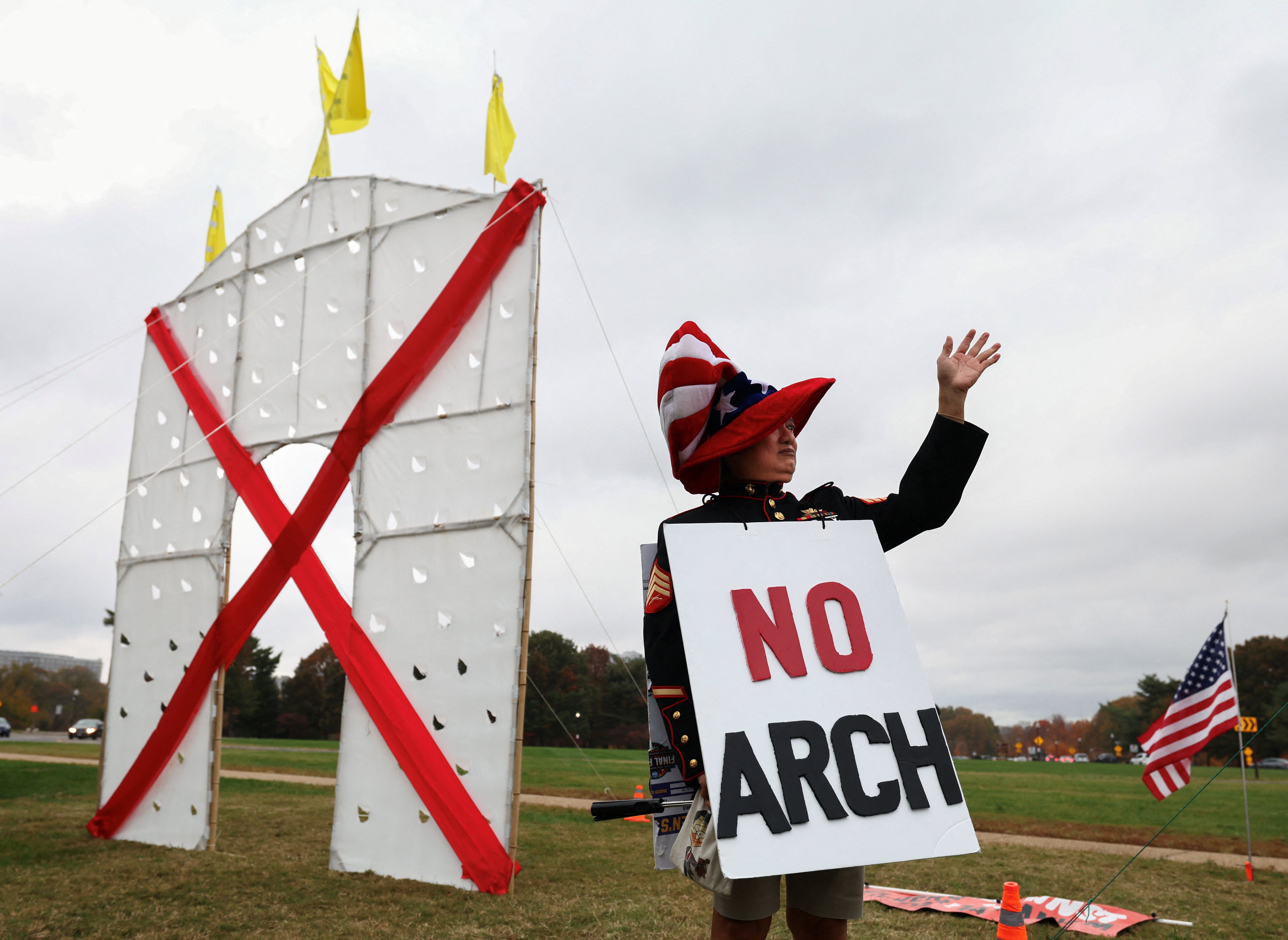
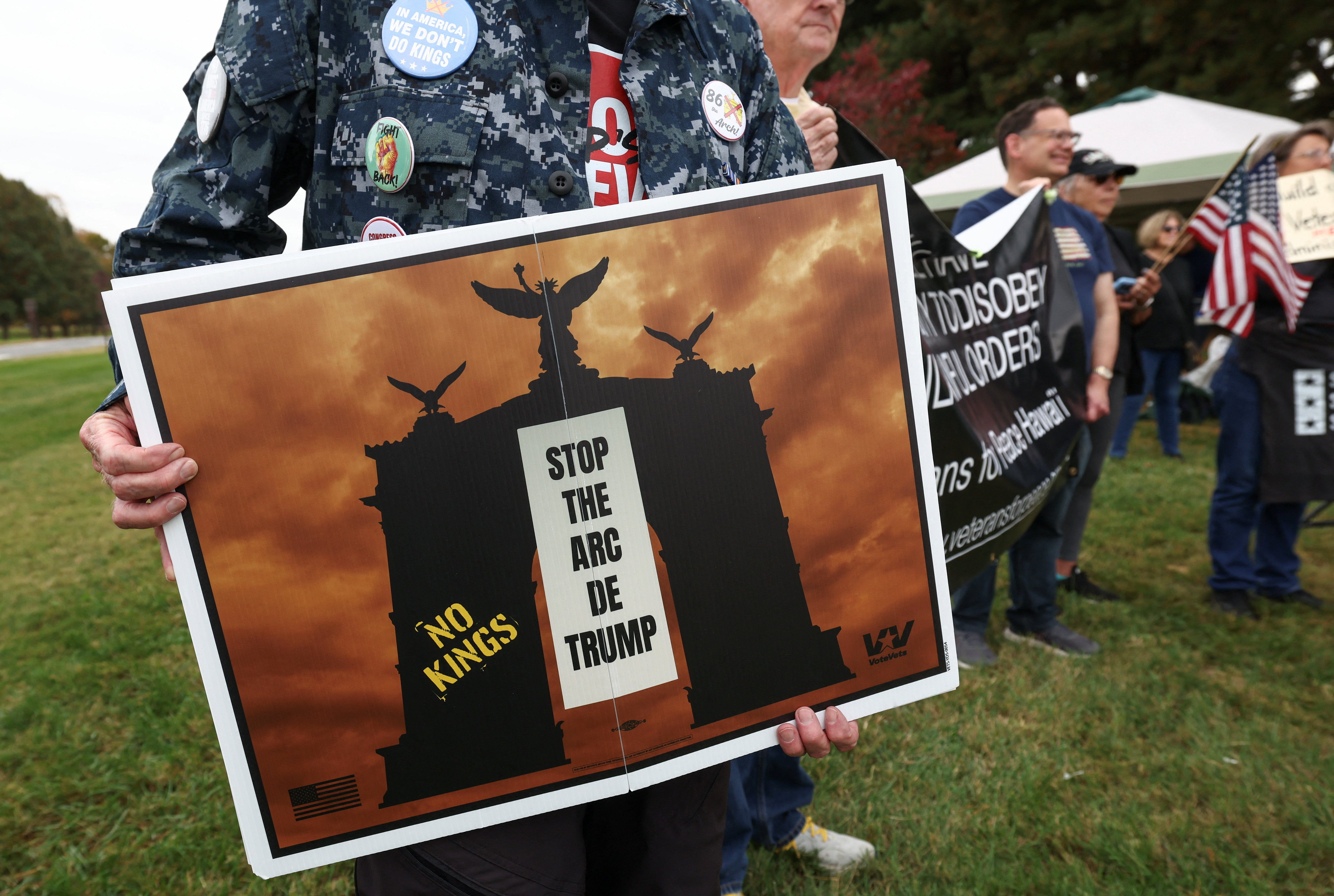
Protesters gathered at the site Thursday, holding fake displays of the arch with a huge red “X” on it and signs reading “stop the Trump Arch.”
Michael Lemmon, the lead plaintiff in a lawsuit opposing construction of the project, told the commission that construction was “purely illegal” without explicit authorization from Congress, which it did not receive.
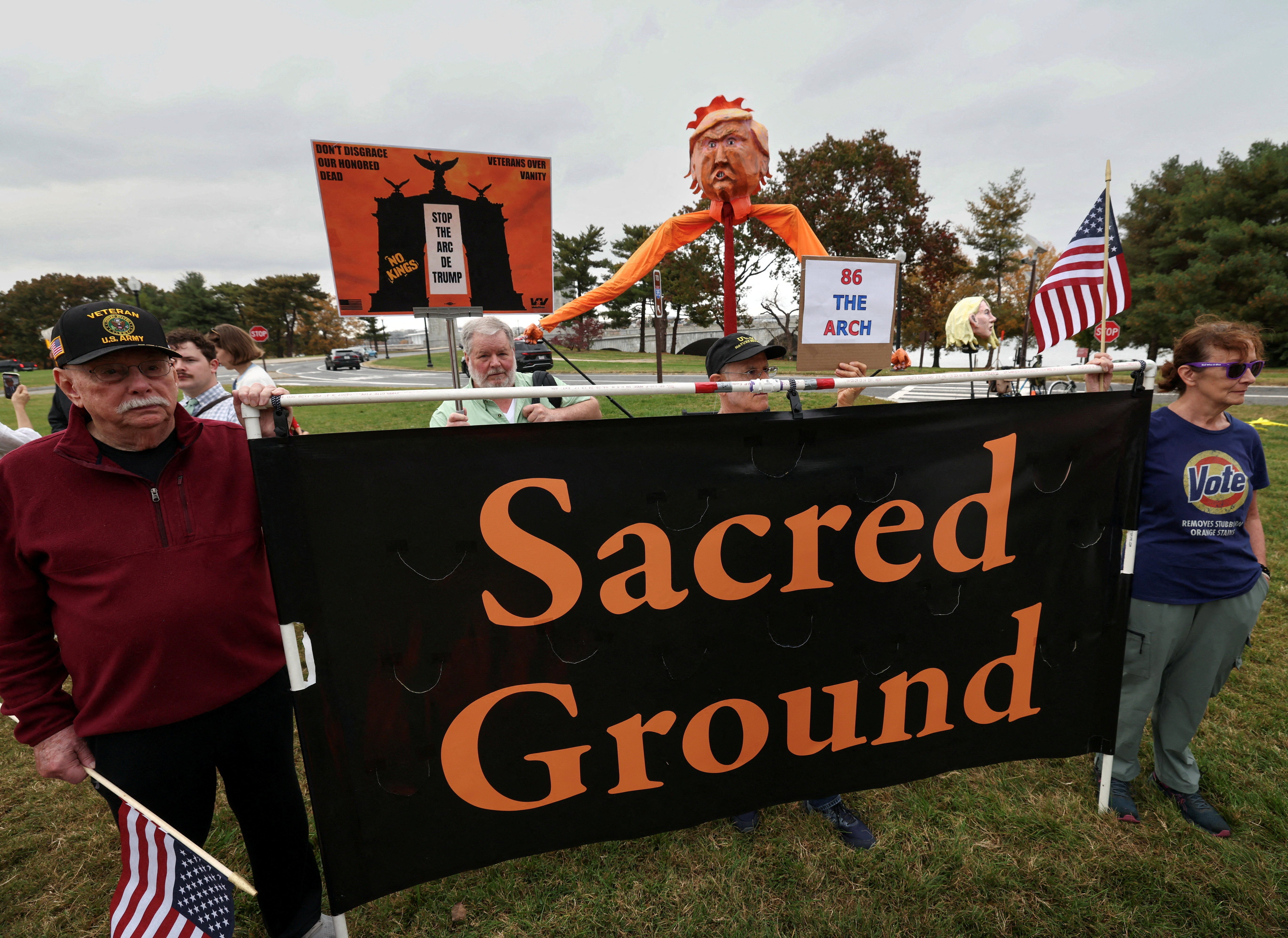
The monument would also compromise the “sacred ground” of Arlington National Cemetery, where tens of thousands of U.S. veterans are buried, Lemmon said.
Building a monument that overshadows “sacred ground” for the U.S. military is “frankly blasphemous,” said Lemmon, who is among the Vietnam War veterans suing to stop the project.
The administration’s planning efforts “led to a predetermined outcome”: “deliberate exclusion of Congress,” which the panel “abandoned to accommodate the president’s personal wishes, according to Lemmon.”
Washington Council President Phil Mendelson, who serves on the National Capital Planning Commission, repeatedly pressed administration officials at Thursday’s meeting to explain why, exactly, the president should build it — and what it is for.
When asked why the capitol needed the Trump arch, Republican Rep. Andrew Clyde told Mendelson it would “commemorate and celebrate our nation, and we need this arch.”
Following Republicans’ seismic defeats in the midterm elections, the president moved aggressively to complete his legacy Washington projects, including holding a ceremony to install a steel beam in a ballroom under construction at the White House and holding a signing ceremony in the Oval Office to designate the room as a federally protected monument.
The president has spent the last year promoting the arch project, which he compared Wednesday to “the Arc de Triomphe, but better” and “more beautiful in fact, much more beautiful,” he said of the Paris monument. Trump’s version would be 80 feet taller.
The administration argued that the project would fulfill a century-old Congressional vision for a landmark at the site. Mark Paoletta, a White House official who chairs the commission, said during Thursday’s meeting that leaving empty space at the site “dishonors our veterans and leaves unfinished a key monumental gateway to Arlington that Congress authorized.”
“It’s a national shame,” he said.
But the president, top Cabinet secretaries and Justice Department officials also argued that the ark should be built to repel drones and serve other vital “national security” purposes.
The Trump administration has repeatedly invoked “national security” arguments to promote its pet projects, including building a ballroom on the site of the former East Wing of the White House, which it demolished.
In court filings, Defense Secretary Pete Hegseth and Homeland Security Secretary Markwayne Mullin outlined plans for a militarized ARC capable of deploying snipers and countering drones and targeting other “ever-evolving” threats.
“The Ark is a generational national defense opportunity to mitigate these evolving threats,” Hegseth wrote to the court. “It will be used as a dual-use structure: a major national monument that also incorporates military utility to support territorial defense. »
The monument will also house “counter-sniper personnel,” he said.
Mullin argued that the administration needs a “centralized, elevated infrastructure node in a key geographic location” for drone “detection” as well as “disruption and mitigation.”
Interior Department official Gregory Wischer did not elaborate on military plans for the project, but told the panel Thursday that “the current design of the ark is capable of accommodating national security functions as outlined by the president.”
Nothing in the administration’s submission to the commission refers to the military. Site plans and visual renderings recently released by the Interior Department also do not include information about Trump’s proposed “military” features.
But Paoletta said the “purpose” of the monument was not part of the commission’s review process.
The president unveiled plans for the monument last year with renderings that bear a strong resemblance to the Arc de Triomphe and Soldiers and Sailors Memorial Arch in Brooklyn, with the president’s favored neoclassical architectural style dominating his plans in Washington.
Asked last year by White House reporters who the project was for, Trump replied: “Me.”
At a court hearing last week, the judge overseeing the case against the project asked why the administration was moving so quickly, “apart from the executive’s desire to dazzle the city.”
“What’s the harm in waiting?” » asked the judge during the October 30 hearing. “Why is he in a hurry to build this ark?
Deputy Assistant Attorney General Robert Stander told him the ark was an “absolutely high priority project.”
The next day, officials from Washington, D.C. and Virginia sued the administration, arguing that the structure had not obtained congressional authorization and was moving forward with a proposed height that is “nearly double” the legal limit for buildings in the nation’s capital.
“It is entirely foreseeable that once construction begins, Defendants will argue – as they have in other cases – that an order to stop construction would irreparably harm the federal government,” the plaintiffs wrote. “The Court should not allow this cynical gamble to succeed. »

Hegseth’s top aide, Ricky Buria, told the panel Thursday that the monument and its location “honor our veterans, honor our heroes and just show those past and present in our uniformed service that we will do anything for them.”
“That’s exactly what we need to see in this circle,” he said.
Democratic Rep. Jared Huffman, among the members of Congress who pushed the commission to block the plans, said Trump’s bow would “dishonor America, our ideals and our laws.”
The commission should vote against it, he argued, “rather than indulge a president who thinks he’s a king.”
The structure would “disrupt the solemn connection between the Lincoln Memorial and Arlington’s national security” and instead invoke “emperors and kings who build grand schemes for themselves.”
“It’s a tribute to Donald Trump,” Huffman said. “He told us specifically.”
Gn headline

