
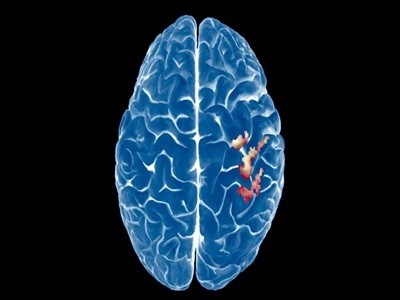
The region called the insula is buried deep beneath the wrinkled surface of the brain (artist’s illustration).Credit: Alexander Leemans/UMC Utrecht/Scientific Photo Library
Scientists have mapped one of the most mysterious parts of the human brain in unprecedented detail1. Their findings detail how this region, the insular cortex or insula, is organized to support the brain’s processing of bodily sensations such as pain. The mapping also details a pathway that allows the cortex – the seat of higher-order cognition – to work with the insula to affect bodily perceptions.
A region of the insula is responsible for the sensation of pain in certain parts of the body. Another region generates sensations, such as nausea, felt by the internal organs. A third region, in front of the insula, “talks” with other brain areas involved in cognition and emotion, suggesting that it influences not only sensations, but also how the brain interprets them.
Contrary to what was previously thought, the insula “doesn’t just read the body. It partly influences the story of how the body should feel,” says study co-author Josef Parvizi, a physician-scientist at Stanford University in California.
The study is “quite an accomplishment,” says Lucina Uddin, a cognitive neuroscientist at the University of California, Los Angeles. It’s also one of the most comprehensive studies of the insula and how it produces bodily sensations, she adds.
The results were published today in Nature.
Buried in the brain
The insula is notoriously difficult to study in detail because it is located deep in the brain. Previous studies have suggested that this hard-to-reach region is involved in receiving signals – such as pain or pressure – from various parts of the body and then transforming them into the sensations we feel. But most research on the human insula has relied on brain imaging techniques to capture what’s happening in the insula when various sensations arise, Parvizi says.
To build a more detailed picture, Parvizi and his colleagues needed to find a way to send electrical signals to various parts of the insula in people and assess the resulting bodily sensations. But implanting electrodes deep into the brains of healthy people would be unethical. The researchers therefore turned to 87 people whose brains had been implanted with electrodes for medical reasons.
The body’s brain mapping is surprisingly stable, even after limb loss
In experiments that lasted more than a decade, Parvizi and his colleagues sent electrical currents through electrodes to various sites in participants’ insulae.
Stimulating the back of the insula produced pain, heat, and other sensations, including tingling and numbness, in specific areas of the participants’ bodies, such as the arm or leg. During this time, participants experienced more “visceral” sensations, including nausea, pressure and a feeling of fullness in the chest, when the researchers sent electrical currents to the middle of the insula.
Gn Health

