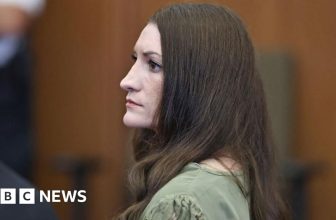
Lindsay Clancy will be tried for the second time for the murder of her three young children in 2023, a Massachusetts judge announced Monday.
Clancy and his team appeared in court for a status hearing that set a date for his retrial. Last week, Judge William Sullivan did not rule in favor of the defense’s motion to dismiss all charges against Clancy, paving the way for a new trial.
The retrial will begin March 29, giving both sides four months to prepare. The final preliminary hearing will take place on March 18.
Clancy’s first trial ended in a mistrial in September after jurors said resistance prevented the nine women and three men from reaching a unanimous decision. In the weeks following the mistrial, defense attorney Kevin Reddington filed a motion to dismiss all three murder charges.
Clancy is accused of strangling her three children – Cora, 5, Dawson, 3, and Callan, 8 months – with elastic bands on the night of January 24, 2023, before throwing herself out of her bedroom window in a suicide attempt that left her paralyzed and in a wheelchair. She was charged with three counts of first-degree murder.
Her defense argued that she was experiencing postpartum psychosis when she committed the murders and was therefore unaware of her actions at the time. The prosecution, however, argued that she planned the murders in advance and was not actually psychotic when she murdered the children.
It remains to be seen whether the arguments of both sides will remain the same in the next trial.
After Sullivan ruled against the motion to dismiss Clancy’s charges, the prosecution had to decide whether to open a new trial. Prosecutors also could have reduced the charges, moved to a bench trial, offered a plea deal or dropped the charges altogether.
Martin Weinberg, an attorney on Clancy’s defense team, argued in favor of the motion to dismiss the charges, arguing in court Nov. 2 that the prosecution must meet the manifest necessity standard to warrant a mistrial and, therefore, a new trial. He argued that the court should have questioned the holdout juror when he refused to participate in negotiations, and that if his reasons were personal, the court could have released him, allowing deliberations to continue with another juror. That didn’t happen, he said.
The jury foreman returned three notes of deadlock before Sullivan declared a mistrial, but Sullivan did not see the juror say so. — that is, questioning the juror to determine whether he could be fair and impartial — and declared a mistrial before replacing him with an alternate. Reddington then attempted a last-minute emergency stay, but Supreme Judicial Court Associate Justice Dalila Argaez Wendlandt later denied it.
On November 2, the prosecution argued that the court should determine whether manifest necessity had been satisfied based on what happened in court and what the court knew at the time of the mistrial – not what happened afterward or what the media revealed. He also asked the judge to dismiss the motion on October 29.
After the mistrial, several other jurors spoke out, including the jury foreman, and described the holdout as someone who refused to participate in discussions. They also said he failed to apply the standard of reasonable doubt when he wanted to convict Clancy of first-degree murder.

The holdout juror, Michael Desronvil, has since said he has felt harassed since the trial ended and insisted in an interview that he “had no doubt.”
On November 9, Sullivan also ruled on two other motions discussed in court the previous week.
Sullivan denied Clancy’s motion to question the holdout juror at trial and review court records related to his service. The prosecution also lost one of its motions in court last week: Sullivan rejected its attempt to block lawyers from freely discussing the case with the media.
Clancy’s initial trial captivated the nation, prompting online sleuths to investigate this unique case and draw their own conclusions. Throughout the trial, several posters insisted that Clancy could not have carried out the murders and that her then-husband, Patrick Clancy, had done it instead, stinging her.
In an interview days after the mistrial, Reddington said Clancy rejected conspiracy theories about Patrick Clancy. He also said Clancy, at the time, “wasn’t very good” and remained “suicidal.”
If you or someone you know is in crisis, call 988 to reach the National Suicide and Crisis Lifeline. You can also call the National Suicide Prevention Lifeline at 800-273-8255, text HOME to 741741 or visit SpeakingOfSuicide.com/resources for additional resources.
Gn headline