
The Mayans liked to keep their dead close. This is how they believed they could interact with their ancestors, who had ascended to heaven to become deities. And it seems that they had a very literal interpretation of the term “near”, namely laying the body parts of their loved ones near long-dead ancestors.
An international team of researchers conducted a genetic analysis of 430 samples of human skeletons and teeth recovered from known Mayan tombs and caves containing human remains. This included an elite Mayan woman who died and was buried in a cave between 250 and 400 CE. What made this burial site stand out to researchers were 226 human teeth scattered around its pelvis and upper spine — teeth that, the team’s analysis revealed, belonged to generations of his distant ancestors buried elsewhere in tombs more than 16 miles away.
Of course, you don’t have to be a geneticist to guess that not all of those teeth belonged to the woman. However, the genetic link reveals fascinating insights into Mayan burial practices and social structures, according to the team’s study, which has not yet been peer-reviewed and is currently available as a preprint on bioRxiv. Keith Prufer, an archaeologist at the University of New Mexico who co-led the study, presented the work at the annual meeting of the Society for American Archeology (SAA) earlier this year.
Till death do us part (don’t do us part)
Like many of their contemporaries, the Maya cared deeply about the afterlife. They had very specific ideas about what happened after death and how best to prepare people for their ascension to heaven. According to the newspaper, this was also linked to the way political and economic elites established legitimacy, namely that their ancestors became deities after their death.
Archaeological evidence reveals the importance of burial customs and other practices surrounding death in past societies. Caves in particular were considered “access points” for connecting with ancestors, and archaeologists hypothesized that cave burials, compared to burials in residential graves, represented “reverential burials or sacrificial deaths,” the researchers explained.
Let the genes speak
But as the researchers themselves wrote in their article, archaeological interpretations depend “largely on context.” That is, without genetic data, it is difficult to deduce how and why certain human remains were disposed of in this way, hence the latest work.
“DNA is not a silver bullet, but it’s good to have an additional data set,” Alexander Tokovinin, an archaeologist at the University of Alabama who was not involved in the new work, told Science after the SAA presentation.
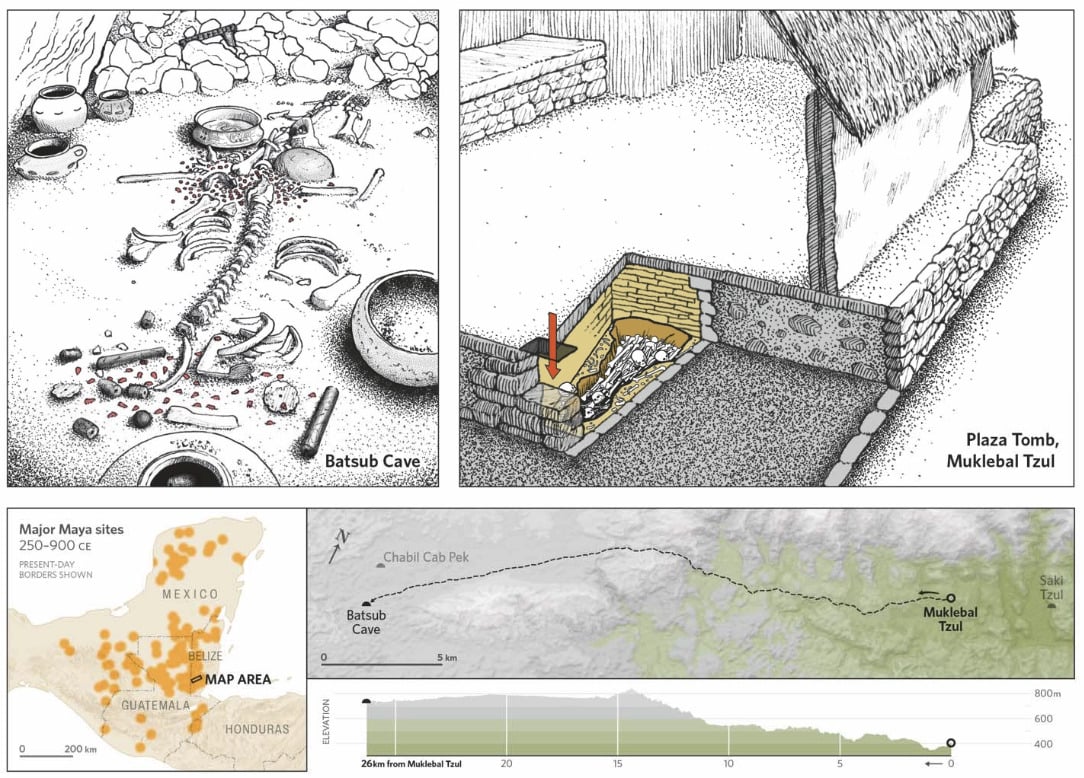
The team initially examined 487 human tooth and bone samples, generating genomic data on the remains. This included 341 samples representing at least 107 individuals from elite and non-elite Maya tombs in Belize. And again, among this collection, researchers discovered that 24 of the individuals had skeletal elements scattered in elite tombs and a cache of ritual teeth in remote locations.
“Using these, we reconstructed three lineages spanning four, six and eight generations from otherwise disarticulated and jumbled remains,” the team explained in the paper. “Even more surprising is how often items from the same individual have been recovered from multiple geographically distant sites.”
Remember the dead
Given the many undiscovered or unsampled sites in nearby areas, the team added that it’s likely that a portion of these individuals live elsewhere – again, literally. According to Science, the team declined to speak with the media until the paper was peer-reviewed. However, during the SAA presentation, Prufer said the genetic connections between the sites overlapped “much more than would be expected by chance,” Science reported.
As for the lady buried with (too many) teeth, genetic analysis indicated that the 226 teeth belonged to at least 39 unique individuals. His head was removed and replaced with an undecorated container. In addition to high-status funerary objects, the funerary arrangement could be a recreation of an underworld scene from the Mayan creation story, the team explained. None of them came from individuals considered to be outside of society’s elite. In other words, the practice of burying one’s bones in different places seems to have been reserved for those in power.
“Our data suggest an intentional strategy to anchor these lineages simultaneously in elite homes and in a cave transformed into an elaborate underground burial setting,” the researchers wrote. “Caves have long functioned as thresholds, marking the place of humans’ emergence from the mythical time and space where they were initially constituted, and thus became places where the elite communicated with these ancestral forces. »
Gn Health

