2:30 p.m.: According to Noah Trister of the Associated Press, there is a $10 million signing bonus and Peralta will even earn salaries of $23 million in each year of the deal.
1:42 p.m.: The Orioles officially announced the signing.
11:20 a.m.: The Orioles and the free agent starter Freddy Peralta reportedly agree to a five-year, $125 million contract. The deal, which is awaiting physical finalization, contains no deferred money or opt-outs. Peralta, an ACES client, was traded from the Mets to the Rays mid-season and was therefore ineligible to receive a qualifying offer. It will not cost Baltimore any form of compensation.
Peralta lands in Baltimore a day after watching Trevor Rogers departure for Chicago. Both pitchers find themselves in a similar position contractually, as Rogers also signed for five years with a slightly lower guarantee of $120 million. The O’s earned a compensatory draft pick after the first round next summer following Rogers’ departure.
Turns out he’s a pretty direct replacement for Baltimore’s president of baseball operations, Mike Elias. It’s not necessarily the case that the O’s chose Peralta and the draft pick over Rogers — the players could have geographic or team preferences — but the similar contracts will make their career arcs an intriguing subplot over the next half-decade.
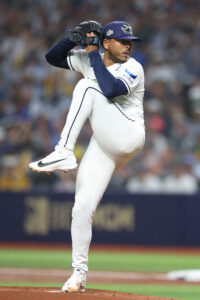
Peralta has had his ups and downs over the past 12 months. He finished fifth in the NL Cy Young voting in 2025, posting a career-low 2.70 ERA in 33 starts for Milwaukee. The Brewers, who were highly unlikely to sign him long-term, traded him to the Mets last offseason. Talks about extending spring training have not progressed, apparently because of a disagreement between the club and the pitcher over the length of the contract.
Three months later, Peralta was back on the trading block. The Mets had a nightmare season, in part because Peralta had a very disappointing tenure in Queens. He allowed just under 5.00 earned runs per nine innings in 22 starts in a Mets uniform. His strikeout rate dropped six percentage points from his final season in Milwaukee. He allowed a few extra home runs and struggled to strand runners. New York’s lackluster defense didn’t do him any favors either, but Peralta clearly wasn’t playing at the same caliber as he did with the Brewers.
The Rays acquired Peralta for three prospects at the deadline. His fortunes changed in Tampa Bay. The two-time All-Star pitched 55 1/3 innings with a 3.25 ERA in the regular season. He added 21 1/3 more with a 2.95 ERA in the postseason, helping the Rays advance to the World Series.
Although preventing late-season runs looks a lot like Peralta’s of old, he hasn’t gone back to missing bats like he did in Milwaukee. He struck out less than 20% of batters with the Rays in the regular season and posted an unimpressive 16:10 strikeout-to-walk ratio in October. Peralta’s turnaround was more attributable to a change in his batted ball results. Opposing batters had hit .313 on balls in play while he was with the Mets; his BABIP against fell to .232 for Tampa Bay.
Much of this is beyond the pitcher’s control, and is a product of team defense and batted ball variance. However, it’s not fair to attribute Peralta’s late season results entirely to his teammates and better luck. He made a significant adjustment to his repertoire, increasing the use of his changeup in Tampa Bay – a trait shared by many Rays pitchers this year. Peralta’s average fastball velocity increased from 94 to 95 mph late in the season and climbed nearly 97 in the postseason. He’s not going to stay at 97 for an entire regular season, as that’s mostly a product of adrenaline and the expectation of shorter starts, but Peralta’s speed was just as strong as it had been in Milwaukee.
The end result was a 4.42 ERA with average strikeout and walk rates (21.4% and 8.6%, respectively) over 169 innings. That’s a sharp step down from the 3.40 ERA and 29% strikeout percentage he posted over the previous three years. This is reflected in the price tag, as Peralta entered the year with an argument for a $200 million-plus contract that placed him alongside players like Max Frit And Dylan Cease. His first-half performance hinted at a potential pillow contract, but his late-season rebound landed him between Rogers and Ranger Suarez (five years and $130 million). He is paid as a No. 2 caliber starter.
Peralta brings an excellent track record of sustainability to Baltimore. He has not been placed on the injured list since 2022 and is one of two pitchers (along with Kevin Gausman) to start more than 30 games in each of the last four seasons. Peralta joins Kyle Bradish And Shane Baz in the top half of Craig Albernaz’s rotation. This pushes Brandon Young to the role of starter No. 4 and leaves a competition for the last place among Trey Gibson, Cade Povitch and a crop of talented upper minors prospects that includes Michael Forret, Nestor German, Luis De Leon and finally Anthony Eyanson.
The Orioles have built decent rotation depth, but they may still be missing a true No. 1 starter. Tarik Skubal was the only one available in free agency, and the O’s never seemed likely to compete with the Mets on a $400 million-plus contract for him. Peralta was in the mix for the second-best free agent arm available. The O’s could still look to the trade market to get a higher ceiling arm (e.g. Reid Detmers, Logan Webb), thus potentially consolidating some of their rotation prospects.
As shown by MLBTR’s Payroll Tracker, the Orioles entered the day with a projected 2027 payroll around $127 million. They opened the 2026 season north of $160 million, so they should have room for another average salary or two even after adding Peralta’s $25 million average annual value to the books. Baltimore has largely been open to reshuffling much of the roster. They should be looking for a corner outfielder and have added a bat behind home plate to split time with Samuel Basallo between the catcher and the designated hitter.
Z101’s Héctor Gómez first reported that the Orioles and Peralta were discussing a five-year, $125 million contract. Ken Rosenthal of The Athletic confirmed the deal and noted the lack of postponements or opt-outs. Image courtesy of Nathan Ray Seebeck, Imagn Images.
Gn sports