
Washington — Following the announcement that Secretary of Defense Pete Hegseth fired another army general This week, a statement shared to the media by a Pentagon official said the high-ranking officer failed polygraph exams as part of an ongoing investigation into alleged leaks of classified information to journalists. The revelation is unusual and raises questions about whether the disclosure violated federal privacy laws.
The ouster of Lt. Gen. Brett Sylvia from the Joint Chiefs of Staff was first reported by The Atlantic on Wednesday evening.
Shortly after, social media and media influencers, including CBS News, released a statement stating that Sylvia had failed three polygraph exams. Some lawyers say the disclosure could run afoul of the Privacy Act of 1974, which generally prohibits federal agencies from disclosing personal information preserved in certain government documents without the individual’s consent or other legal authorization.
Polygraph results, which are usually kept in personnel security or counterintelligence files, are protected by law.
The official’s statement also accuses Sylvia of leaking classified information about Iran and the war between Russia and Ukraine.
Brad Moss, a Washington-based attorney who specializes in national security and security clearance law, told CBS News that the Privacy Act prohibits the public disclosure of these types of details from an official’s file without the official’s consent. Courts have recognized that oral disclosures can also violate the law, and individuals can sue federal agencies for certain violations of the Privacy Act.
“It boggles the mind to see … (the) leak of information protected by the Privacy Act about an employee in order to accuse that same employee of being accused of unauthorized leaks themselves,” Moss said.
Sylvia, a highly decorated three-star general with a Purple Heart and six Bronze Star medals – including one for valor – served as director of strategy, plans and policy for the Joint Chiefs of Staff, known as the J5. He was removed from his position for what the official described as “serious misconduct.”
Sgt. Timothy Jackson/US Army via AP 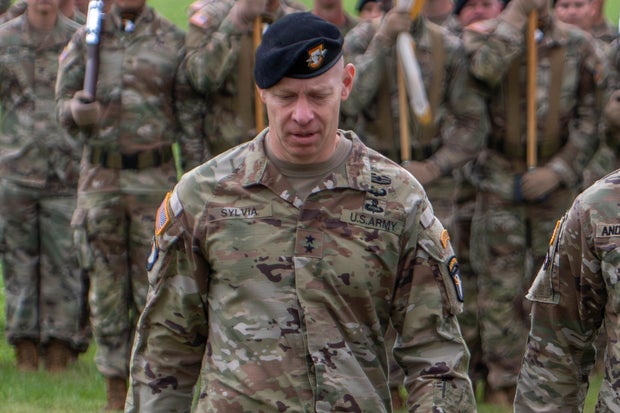
No response was returned when CBS News contacted Sylvia on Thursday. The Pentagon also did not respond when asked about the details shared by the official and the privacy law.
The official alleged that Sylvia repeatedly leaked classified information to reporters and began meeting with reporters outside the Pentagon after the department instituted an investigation. policy demanding that journalists be escorted inside the building, adding that the investigation was still ongoing and had been referred to the Justice Department. CBS News has contacted the agency for comment.
The official’s allegations could not be independently verified by CBS News, and the official did not provide any evidence to support the claims. Two other Pentagon sources confirmed told CBS News that the firing was related to the polygraph tests, but disputed the claims of the general leak of classified information.
Citing unnamed officials, The New York Times reported that Sylvia spoke to at least one reporter while on the Joint Chiefs of Staff but denied sharing sensitive or classified information. On Thursday evening, Axios reported that Sylvia admitted to leaking classified information about Ukraine and Iran to two journalists at separate media outlets over a one-year period, according to an internal investigative report obtained by the news organization. CBS News has not seen or been able to verify the contents of the internal report.
But apart from the allegations of leaking classified information is the statement that followed Wednesday’s breaking news.
Under the Privacy Act, federal agencies are generally prohibited from disclosing certain protected information maintained in the U.S. government records system without the written consent of the individual, unless a statutory exception applies.
“This is a violation of the privacy law,” Cody Harnish, a former Army officer in the Judge Advocate General’s Corps who now works as a private attorney defending U.S. military personnel, told CBS News.
“Polygraph results are protected documents under the Privacy Act of 1974. These are exactly the kinds of documents that the Pentagon withholds from requests under the Freedom of Information Act because they are protected,” Harnish said. “Secretary Hegseth cannot condone the Pentagon’s failure to comply with the statute.”
He added: “The statement reveals much more than the lie detector results. It also reveals the existence of an ongoing counterintelligence investigation, a referral to the Justice Department… and the Pentagon’s conclusive statement of “serious misconduct” in a matter that it admits is still under investigation.
Unlawful command influence, or UCI, occurs when military commanders or senior officials inappropriately interfere with the military justice process, potentially compromising the fairness of an investigation or court martial. Military courts have often described it as “the mortal enemy of military justice,” and the UCI can be real or apparent, meaning that even the perception that senior leaders are attempting to influence military investigators, prosecutors, witnesses, or judges can raise concerns about the integrity and impartiality of proceedings. Presidents and Secretaries of Defense may also engage the UCI, given their roles.
Frank Rosenblatt, a retired lieutenant colonel who also served in the Army Judge Advocate General’s Corps and is now president of the National Institute of Military Justice, disagrees that releasing polygraph information violates the Privacy Act. Instead, he expressed concerns about using polygraph data, which is not admissible as evidence in court, to publicly attack the general officer.
“This unwanted and unreliable information is being used as actual proof that he did something,” Rosenblatt said.
On Thursday morning, Pentagon chief spokesperson Sean Parnell posted a statement on his official X account saying the department has “zero tolerance for intentional and unauthorized disclosure of classified information.”
But Parnell’s statement marks a notable departure from the more detailed account previously provided by the official, which identified Sylvia by name, accused him of leaking classified information and revealed that he allegedly failed three polygraph exams.
While the earlier statement described specific allegations against Sylvia, Parnell’s subsequent statement did not identify the general or repeat those allegations.
Parnell’s statement introduced a new detail that Sylvia’s firing followed a “thorough investigation by the Air Force Office of Special Investigations.”
More than 20 generals, admirals and civilian defense leaders were fired or left their jobs since Hegseth, a former Fox News host and National Guard veteran, became defense secretary at the start of the second Trump administration.
Hegseth has made aggressive efforts to identify officials suspected of leaking information to the media. Last month, CBS News reported that some of the US military’s top officials were subjected to polygraph tests as part of a wide-ranging investigation into leaks following reports on low munitions stockpiles linked to the war in Iran.
But Hegseth also accused people of leaking classified information to the press, where investigations determined the allegations were baseless.
Last year, Dan Caldwell, Darin Selnick and Colin Carroll were drummed from their work at the Pentagon and accused of leaking classified information to the media.
Hegseth appeared on his former network, Fox News, and said he fired the men before evidence was produced by the ongoing investigation.
“When you fire people who we believe leaked classified information, and again, the investigation is ongoing and it will take time and when the evidence is produced it will go to the DoJ…once a leaker, always a leaker…and if these people are exonerated, that’s fantastic, but we don’t think, from what we understand, that it’s going to be a good day for a number of these individuals because of what was discovered in the investigation,” Hegseth said.
None of the three men Hegseth accused of leaking classified information have been charged with a crime. Caldwell later joined the Trump administration to work for the Office of the Director of National Intelligence.
Gn headline

