Vatican City — Pope Francis saw the “gates of hell” when he became aware of the depth of the clergy sex abuse scandal and had mystical visions of the devil throughout his ministry, according to excerpts from his personal diary released Tuesday by the Vatican.
Remo Casilli / REUTERS 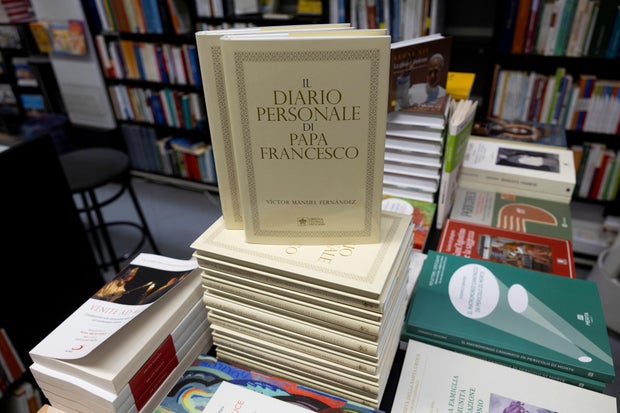
“The Diary of Pope Francis” also reveals that the Argentine pope suffered a deep spiritual crisis in 2021-2022, linked to his own temptations to exercise power in an omnipotent manner. He overcame the crisis by relying entirely on the mercy of God.
The book, published worldwide in multiple languages, offers a deeply personal and almost voyeuristic view into Francis’ mind and heart, revealing his most intimate fears, insecurities, dreams and temptations that he hid from the world. It shows him incredibly hard on himself, lamenting his own feelings of worthlessness and shame, and his complete trust in God to guide him, even from the depths of despair.
The book was prepared by one of Francis’ closest collaborators, Cardinal Víctor Manuel Fernández, the Argentine theologian who heads the Vatican’s doctrinal office. Fernández is listed as the author, as his comments contextualize Francis’s diary entries.
Fernández expressed concern to Francis’s successor, Leo
Written in a leather-bound calendar serving as a notebook, it begins in 1992, when Jorge Mario Bergoglio was auxiliary bishop of Buenos Aires. This continued throughout his tenure as cardinal archbishop of the Argentine capital and finally as pope. The last entry is from August 18, 2024. It died in April 2025 at the age of 88 after 12 years as pontiff.
Dan Kitwood/Getty Images 
Francis, the devil and a disastrous trip to Chile
The most moving sections are Francis’s revelations about his own spiritual torments and what he describes as encounters with the devil – visceral, tangible, seemingly terrifying encounters. Two happened while he was in Buenos Aires and the third after his disastrous trip to Chile in 2018.
“A few days after returning to Rome, I was in a meeting. I saw him and heard his voice, triumphant possessing everything. ‘Now I have obtained everything I wanted,'” Francis cited the devil in a January 24, 2021 entry. “Just as I cannot forget his eyes from the previous two, in this case I cannot forget the powerful rasp of his voice.”
During his trip to Chile in January 2018, Francis created an uproar discrediting victims of Chile’s most notorious attacker. After journalists, including from the Associated Press, questioned him during the press conference aboard the return flight, Francis ordered an investigation and I realized that the victims were rightthat he was wrong and that he had been misled by the Chilean hierarchy.
“Devastated by the situation in Chile and by the dialogue with the journalists on the plane,” Francis later wrote. “I realized the seriousness of the problem. (…) It was difficult for me to admit what had happened in Chile; I didn’t think it was that serious.”
François wrote on June 7, 2018, a few months after his return, that he had “seen the entrance to hell. Pagan seduction in full force” in the Chilean scandal.
In July and August 2018, as he faced the aftermath, he wrote: “What shame and harm this has brought to the Church! » and “Once more the gates of hell… May holiness and conversion abound in the midst of so many scandals.”
Spiritual crisis following the Vatican financial scandal, introspection
But Francis’ spiritual crisis will only occur in 2021.
The book dates the start of the crisis to January 24, 2021. The day before, Francis had canceled several upcoming public appearances due to what the Vatican called a resurgence of his sciatica.
Fernández reveals, however, that Francis suffered from “unbearable” pain due to an intestinal problem which, in July 2021, led to him being hospitalized for 10 days for surgery to remove 13 inches of his colon.
In January 2021, while the world was still gripped by the COVID-19 pandemic, the Vatican was completely shaken by a massive financial investigation authorized by Francis.
A few months earlier, in September 2020, Francis fired a former close associate, Cardinal Angelo Becciu, convinced that Becciu had embezzled money from the Holy See. The scandal — and Francis’ belief that a web of corruption had engulfed the Vatican’s secretariat of state — led to an unprecedented Vatican investigation and years of legal proceedings through which Francis sought to demonstrate his willingness to crack down on financial misconduct.
The trial resulted in some convictions, notably against Becciu, but much of prosecutors’ theory of a vast corruption conspiracy was rejected. The appeal process is ongoing, with Francis’ role in the investigation a key question for the defense.
There is no mention of the trial in Fernández’s text, although he alludes to it in revealing Francis’ later reflections that the spiritual crisis of 2021-2022 was “mixed with problems of governance, pressure regarding decisions to be made, aridity and desolation.”
Ultimately, Fernández writes that the crisis was primarily linked to Francis’s exercise of power, the temptation of omnipotence, and the belief that he was above the world. It’s a vice that Francis publicly admitted to in 2013, during his first interview as pope, when he acknowledged a tendency to exercise power in an “authoritarian” manner.
Significantly, Francis was tormented by something his critics often accused him of: an authoritarian, solitary style of governing in an absolute monarch and supreme leader of the world’s 1.4 billion Catholics.
For Francis, the temptation of omnipotence was the fact that the devil tempted him towards a “reductive curiosity”, or believed that he alone could solve everyone’s problems, and considered himself essentially God.
Getting out of the crisis
On December 30, 2022, Francis had apparently overcome the crisis by entrusting himself to God. Fernández writes that at that moment, Francis realized that what began on January 24, 2021, “was a powerful invitation from the Lord to become aware of an accumulation of interior darkness that he had to overcome in order to be free.”
Fernández notes that the last two major educational documents of Francis’ life, a 2023 text on trust in God’s merciful love and a 2024 encyclical on the human and divine love of Christ, are deeply spiritual texts born of the crisis. They differ in tone and content from the texts often associated with his pontificate.
Even though the book reveals some of Francis’s most intimate thoughts, Fernández claims that Francis wrote his most confidential thoughts in an indecipherable code, which is not reproduced.
The reader also wonders what Fernández left out in his selection of diary entries and what additional context he might have provided as one of Francis’ most trusted advisors.
Fernández writes that the journal contains virtually no information on Church affairs and is truly a spiritual repository. He said he had omitted mentions affecting third parties, although he included some of Francis’ personal reflections, notably on Cardinal Robert Prévost, now Pope Leo XIV: “A great pastor, a generous missionary and an irreproachable man.”
Fernández said Francis showed him the diary during one of their meetings and told him, “From this you will all see,” essentially entrusting the writings to him after his death.
Fernández said he mentioned the writings to Leo a few weeks after his election.
“I added that I wanted to study these documents, make them known and interpret the exact meaning of their contents,” Fernández wrote. “The Holy Father has shown keen interest.”
The posthumous publication of the popes’ most intimate spiritual reflections is not unusual.
Pope John XXIII’s autobiography, “Diary of a Soul,” was published by his secretary in 1960. Saint John Paul II had wanted his personal notes burned after his death, but his secretary defied his wishes and had the writings published in 2014.
Gn headline