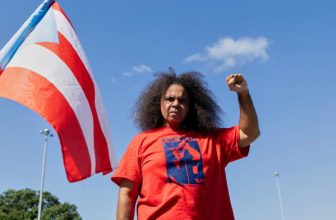
SAN JUAN, Puerto Rico (AP) — Thousands of people demonstrated in Puerto Rico’s capital Friday as anger and frustration erupted over record electricity rates, rising costs of living, deteriorating basic services and other problems.
Retirees, university students, bus drivers and others joined the protest organized by about 30 groups ranging from labor unions to religious organizations. Crowds gathered outside the Caribbean’s largest shopping mall on Black Friday for what organizers dubbed the “Day of National Outrage.”
Hundreds of protesters arrived by bus in San Juan from dozens of towns and villages across the island.
WATCH: Drought and aging infrastructure plunge Puerto Rico into water crisis
Asked about the problems facing Puerto Rico, Radamés García Badillo, 74, replied: “Where to start? The outrage is absolute.”
He noted that electricity and water services are unreliable and that his neighborhood is plunged into darkness at least once a week for several hours.
He also denounced a sharp increase in the cost of living.
“We are buying less because things are extremely expensive,” he said. “For us retirees, it’s essential to get the most out of every dollar.”
The demonstration is one of the largest on the American territory since Governor Jenniffer González took office in January 2025, and it intensified throughout the day as demonstrators took over one of the island’s main highways, forcing its closure.
“Things have never been good in Puerto Rico, but they keep getting worse,” said Verónica Ishtar, a 22-year-old visual arts student who has drawn sketches of the protesters.
This week alone, the electricity has been cut off 12 times in her neighborhood and she is struggling to pay her electricity bill.
“It’s not normal and it shouldn’t be normalized,” she said.
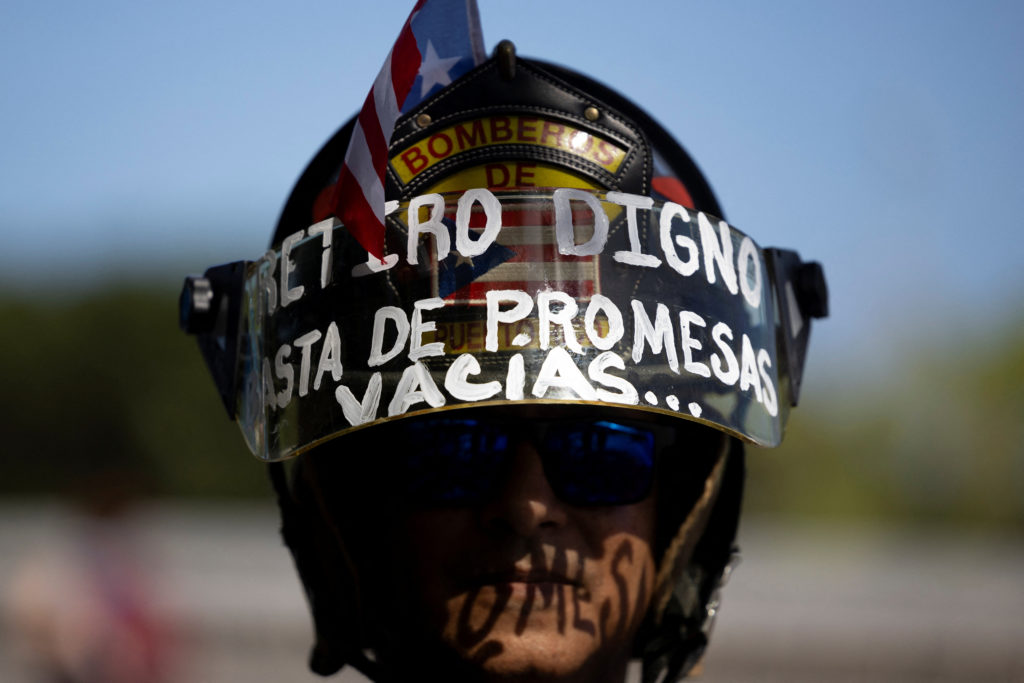
A firefighter wears a helmet with a Puerto Rican flag and a message on the visor calling for a dignified retirement during the “Day of National Outrage” protest in San Juan, Puerto Rico, November 27, 2026. Photo by Ricardo Arduengo/Reuters
Monthly electricity bills for some residential customers recently increased by about 18%, from $229 to $271.
The new rate of 33.86 cents per kWh far exceeds the average rate of 18.3 cents per kWh for residential customers in the continental United States, according to the U.S. Energy Information Administration.
Some protesters condemned Luma Energy, a private company that oversees electricity transmission and distribution on the island.
On Wednesday, Puerto Rico’s Supreme Court narrowly approved the cancellation of the government’s contract with Luma. The governor welcomed the decision, but many are now worried about the continuation of the outages.
The Puerto Rico Industries Association said the cancellation could “discourage private investment and jeopardize the continuity of ongoing projects” as crews continue to repair a network flattened by Hurricane Maria in 2017 and already weakened by a lack of maintenance and investment.
As the protest grew, one demonstrator promised a “fighting Christmas.”
Leaders of several groups that organized the protest pledged to continue pushing for change.
“We need to start channeling the anger,” said Hernaliz Vázquez, executive director of Sierra Club Puerto Rico. “We need to start organizing the outrage of people who don’t know what to do.”
Eva Prados, a politician, lawyer and human rights defender, was among the demonstrators.
She stressed that electricity bills are unsustainable and businesses are closing while Puerto Ricans face a high cost of living and basic services “that this government does not guarantee.”
Puerto Rico “waits for concrete solutions,” she said.
A free press is the cornerstone of a healthy democracy.
Support trusted journalism and civil dialogue.
Gn world