Athens — As the United States wages a costly war against Iran and Europe grapples with the bitter conflict in Ukraine, Secretary of State Marco Rubio stood in front of the Acropolis on Wednesday and reached back more than two millennia to argue that the answer to the West’s current problems can be found, at least in part, in ancient Greece.
In a scheduled sunset speech from the Pnyx, where Athenians were gathering for their democratic assembly, Rubio presented ancient Greece as the source not only of Western democracy and philosophy, but also of what he described as the figure who fueled the rise of the West.
“Here in Athens we found the first full realization of all the essential traits that would define the West,” Rubio said, citing “fierce individuality and relentless ambition,” and “a desire for discovery, adventure, risk and glory.”
He argued that modern Western societies had allowed these qualities to erode.
“The ideal of many ideologies of our time has frankly become a world of perfect security, a world without risk or failure, where neither the glory of victory nor the shame of defeat,” Rubio said. “We hold among us the most exceptional things hostage to the average, the ordinary, the mediocre.”
His remarks were delivered to approximately 250 guests, including senior Greek government officials, members of the diplomatic corps and representatives of the business, education and cultural sectors, according to a senior State Department official.
AP Photo/Mark Schiefelbein, Swimming pool 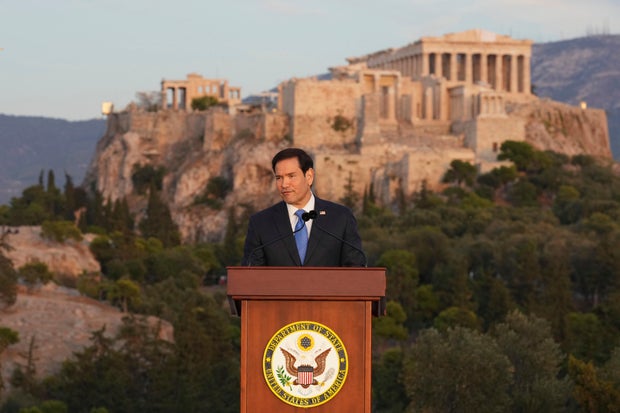
The speech expanded on themes laid out by Rubio at the Munich Security Conference in February, when he warned that Europe was facing “civilizational erasure” and argued that the United States and Europe must regain a common Western identity. Still, his conciliatory tone in Munich came as a relief to European officials after Vice President JD Vance used the same stage a year earlier to sharply rebuke the continent’s leaders.
In front of the Acropolis, Rubio traced the development of the West from ancient Greece through Rome, European Christianity and ultimately the United States, citing Alexander the Great, Caesar, Charlemagne and Columbus along the way. He described the expansion of America’s frontiers, industrial development, and the space program as later expressions of the same impulse.
Rubio said the West now finds itself at a crossroads, “because the next decade and the decisions we make will write the history of the next century.”
“The path we take will determine whether the West retains its place at the helm of the world or resigns itself to a future of atrophy, servitude and decline. We will either choose to act now or we will lose the choice to act,” he said.
“Under the leadership of President Trump, the United States has made its choice,” Rubio continued. “We choose to unapologetically pursue national power, to regain control of our critical supply chains, to reindustrialize our economy, to rebuild our defense, to fight for dominance in the technologies and industries of the future.”
The story Rubio presented was arguably selective. He said relatively little about democracy or political equality in an area closely associated with both, focusing instead on competition, national loyalty and a willingness to take risks. He argued that modern societies too often seek “perfect security” and are more concerned with the “comfort of the worst than the potential of the best.”
“The men who built the Parthenon built upwards. They believed that the highest and noblest aspiration in life was to surpass all others, to strive to be the best in all things,” he said.
This highly produced speech was delivered on a trip largely devoted to more immediate questions of American power: where American forces can operate, how NATO allies can help counter Russia and Iran, and how American energy can shift Russian supplies to Europe.
Greece was the second stop on a three-country tour that began in Iceland and ends Thursday in Portugal. In Iceland, as the United States places increasing attention on Arctic security, Rubio left open the possibility of an increased U.S. military presence, saying, “We would never do anything without cooperating with officials here on what is available.” I think there is a desire to do more together. »
In Athens, Rubio met with Greek Foreign Minister George Gerapetritis for the sixth U.S.-Greek strategic dialogue, focusing on defense, energy and regional security. At a news conference Wednesday, Rubio called Greece a “strong and model NATO ally,” while Gerapetritis said Greece could provide maritime assistance in the Strait of Hormuz if a viable peace process is established.
CBS News also asked Rubio whether he was confident that U.S. Ambassador Kimberly Guilfoyle’s tenure complied with State Department ethics rules, amid increased congressional scrutiny of allegations that Guilfoyle used his diplomatic position to benefit private business interests in Greece.
“This is not the format in which we are going to approach this topic,” Rubio said. “Suffice it to say, our embassy has done an excellent job. Our ambassador has been a strong ambassador.” Guilfoyle has denied any wrongdoing.
Rubio’s visit and Acropolis speech come at a complex time for the Trump administration.
The United States has been at war with Iran for seven months and has not yet reached an agreement to end it. Vice President JD Vance said this week that Iran should make a “significant” reduction in its uranium enrichment capacity, raising questions about whether the administration is backing away from its previous insistence on zero enrichment.
Asked by CBS News on Wednesday to clarify the U.S. position, Rubio declined to say what level of enrichment, if any, Washington might accept.
“I don’t understand what the confusion is around the nuclear program. Iran cannot have nuclear weapons. It’s simple, it’s a point and that’s the end of the story,” he said. “I’m not going to go into detail, you know, about what would be acceptable or not.”
The war has also contributed to sharply rising oil and gasoline prices, adding an economic and political cost to the country as midterm elections approach.
In his speech in front of the Acropolis, Rubio directly mentioned Iran. After discussing the Spartans at Thermopylae and Achilles’ quest for glory at Troy, he contrasted Western ideas of sacrifice with what he called a “cult of death” among Iran’s “radical mullahs.”
“Our heroes may be willing to die for their cause, but they don’t worship death,” he said.
The speech also comes as Rubio’s political future draws increasing attention. President Trump has publicly named Rubio and Vice President Vance as possible future standard-bearers for his movement.
Rubio did not openly mention his own ambitions Wednesday, but pointed to the administration’s recent accomplishments, including the Greenland deal he helped negotiate last month.
“This is a vision we have seen in action,” Rubio said, saying the deal would “reshape the Arctic and strengthen the security of all of NATO.”
“We want to win together,” he said. “We must win together.”
Gn usa