
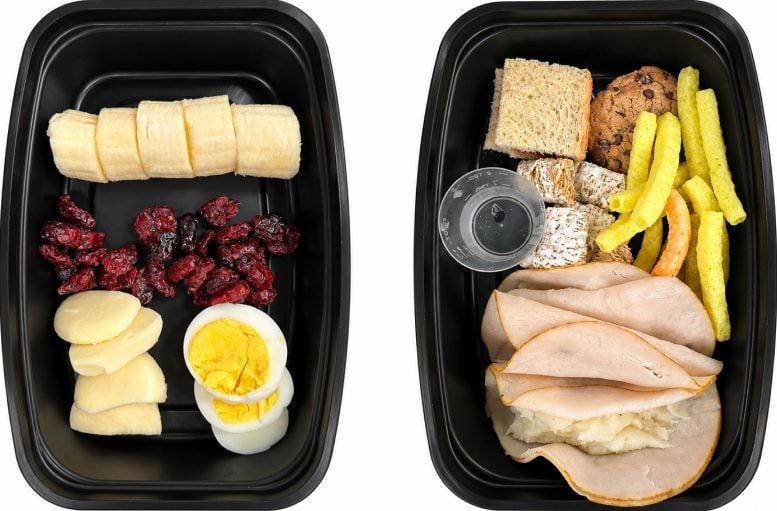
Two meals seemed almost nutritionally identical, but the ultra-processed option triggered a greater release of insulin in healthy adults, hinting at the differences that nutrition labels can miss.
Ultra-processed foods provide more than half of the average American’s daily calories, and their place in diets around the world continues to grow. Formulated to be convenient, accessible, affordable and very tasty, they can be easy to overeat. Understanding their effects on health, however, requires disentangling the influence of transformation from that of the nutrients they contain.
Meals with the same basic nutritional profile are generally expected to affect blood sugar levels in the same way. Yet in a Virginia Tech study, healthy adults expended more energy and burned fewer carbohydrates after eating an ultra-processed meal than after a minimally processed meal. Both meals contained 300 calories and were closely related in terms of carbohydrates, fat, protein, water, salt and weight. The results appeared in Natural metabolism.
“We know that the majority of ultra-processed foods are high in fat, sugar, fiber and protein,” said Alex DiFeliceantonio, an associate professor at Virginia Tech’s Fralin Biomedical Research Institute at VTC, whose lab led the study. “But if we artificially hold all these things constant, is there something in the treatment that leads to a different outcome?”
Adapted nutrients, a stronger insulin response
The researchers selected the foods using NOVA, a classification system that divides foods into four groups based on their level of industrial processing. Their ultra-processed meal included a bite of a peanut butter and jelly sandwich, deli turkey, veggie chips, a cookie, cereal, instant mashed potatoes and some water. The minimally processed meal consisted of banana slices, dried cranberries, cheese and eggs.
“Both meals contain 1 percent carbohydrate, fat, protein, calories, water and salt,” said Zach Hutelin, a researcher at the institute and first author of the study. “If these meals had a nutrition label, they would be virtually identical. » The study was part of his doctoral research in Virginia Tech’s Translational Biology, Medicine and Health graduate program.
The full study included 57 healthy adults aged 18 to 45, including 32 who completed both metabolic testing and brain imaging sessions. Participants ate the two types of meals in separate sessions, at least three days apart, allowing researchers to compare each person’s responses.

For metabolic testing, participants arrived after an overnight fast and sat on a double bed inside a metabolic chamber, a sealed, airtight room used to measure energy expenditure and metabolism. The researchers took baseline measurements, then waited an hour before giving the participants 10 minutes to eat one of the meals. Blood samples were taken immediately afterwards and six more times over the next three hours. The team tracked energy expenditure, carbohydrate oxidation, or burning of carbohydrates for fuel, as well as the response of insulin, a hormone that helps cells absorb glucose from the blood.
“We were shocked to find that each metabolic measurement differed,” Hutelin said. “What we noticed with ultraprocessed foods was that the insulin response was much higher and the blood sugar stayed a little higher for a little longer.”
Adapting nutrient amounts left some differences unresolved. The meals contained different protein sources, which could have influenced the results, and the ultra-processed meal contained more additives. Although the researchers measured total fiber, they did not explicitly measure the physical and chemical structures of the foods.
Carbohydrate burning linked to brain responses
DiFeliceantonio, a neuroscientist who studies the basic mechanisms behind food choice, also wanted to know whether metabolic responses were linked to how the brain reacted to food cues. On another day, participants underwent functional magnetic resonance imaging, or fMRI, while viewing images of nutritionally highly and minimally processed foods. These included foods served during metabolic testing. The scans measured brain activity by tracking changes in blood flow in different regions.
For each food pictured, participants indicated how much they would be willing to pay for it. Their responses gave the researchers a measure of subjective value to compare with brain activity. Participants did not report being willing to pay more for ultra-processed or minimally processed foods.

The differences in how the participants burned carbohydrates after the two meals were nevertheless linked to differences in their brain responses to the food images. One notable finding involved the ventral striatum and nucleus accumbens, brain structures involved in learning, motivation and reward. The association suggests a link between the body’s response to meals and the brain’s response to food cues, although it does not establish that these differences cause people to eat more.
“A key debate in the literature is whether associations (of ultra-processed foods) with poor health outcomes are driven by nutritional composition rather than processing,” said Carlos A. Monteiro of the University of São Paulo. Natural metabolism. Monteiro is a Brazilian epidemiologist whose research on obesity led to the development of the international NOVA classification used in studies of nutrition and public health. He highlighted the Roanoke team’s examination of brain activity as well as metabolism. “This is a novel and important contribution, because the brain ultimately regulates eating behavior.”
Unraveling the health risks of ultra-processed foods
Whether these short-term responses help explain the health effects associated with ultra-processed foods remains to be determined. Chronically high blood sugar increases the risk of diseases such as diabetes, but measurements taken more than three hours after a meal cannot establish long-term consequences.
“If you look at this population-level data, people who eat high amounts of ultra-processed foods have higher rates of health problems — obesity, cardiac events, type 2 diabetes and even some mental health metrics,” DiFeliceantonio said.
The experiment tested a single pair of 300-calorie assorted meals in healthy young adults. DiFeliceantonio, who also holds an appointment in the Department of Human Nutrition, Food and Exercise in Virginia Tech’s College of Agriculture and Life Sciences, would like to examine other populations, track responses over longer periods of time, and test larger meals and more combinations of minimally and highly processed foods.
“We want to look at specific factors, such as commercial additives or specific processing steps, that might lead to different metabolic responses,” DiFeliceantonio said.
Reference: “Metabolic and Neural Responses to Ultraprocessed Foods: A Randomized, Controlled, Crossover Study” by Zach Hutelin, Monica Ahrens, Mary Elizabeth Baugh, Emmanuel Nartey, Delbert L. Herald III, Alexandra L. Hanlon and Alexandra G. DiFeliceantonio, October 5, 2026, Natural metabolism.
DOI: 10.1038/s42255-026-01619-4
The research was funded by a National Institutes of Health research grant through the National Institute of Diabetes and Digestive and Kidney Diseases and by a National Science Foundation Graduate Research Fellowship.
Never miss a major breakthrough: join the SciTechDaily newsletter.
Follow us on Google and Google News.
Gn Health

