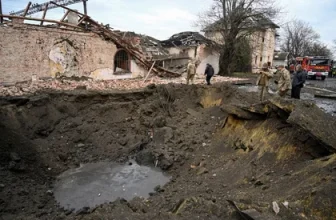
The Saudi-led coalition fighting the Iran-backed Houthis in Yemen said Friday its forces had struck targets used by rebels to smuggle and transport weapons, while rebels attacked neighboring Saudi Arabia with missiles and drones.
The exchanges came days after the Saudi-led coalition launched a major air campaign in Houthi-controlled areas of Yemen.
In Iraq, military troops and police who protect the country’s energy industry deployed to a town south of the capital after the government apparently reached a compromise with a powerful Iran-backed militia it had accused of smuggling oil into that country.
Additionally, energy analysts say Middle East oil exports in November are down slightly from October, when exports were roughly at pre-war levels. The reasons for this drop in November include Iranian attacks on oil tankers.
Here is the latest news from the Middle East on Friday. Read our full coverage here.
Saudi Arabia says it targeted Houthi smuggling operations
The Saudi-led coalition fighting the Houthis in Yemen said Friday it was targeting the rebels’ smuggling and transport operations of weapons and ballistic missiles in Yemen’s main Red Sea port of Hodeidah.
He added that he carried out a military operation in Sanaa, Yemen’s rebel-held capital, on Friday morning, targeting the Houthis’ military capabilities to prevent attacks on civilians in Yemen and Saudi Arabia.
The Saudi-led coalition also said the kingdom intercepted five drones and a ballistic missile fired by rebels Friday morning. Riyadh, the kingdom’s capital and largest city, was among the targets.
The interceptions took place a day later Rebels supported by Iran said they targeted Saudi airports, air bases and the financial hub of Riyadh. The Houthis did not immediately comment on or claim responsibility for Friday’s attacks, but the two sides exchanged threats to strike key ports in their respective territories.
Earlier this week, Saudi Arabia launched a massive air campaign over Houthi-controlled territory in Yemen.
Iraqi forces deploy in area known as stronghold of Iran-backed militias
Iraqi security forces established a command headquarters on Friday on the outskirts of the Jurf al-Sakhar region, south of Baghdad, in a bid to assert control over a long-time stronghold of an Iranian-backed militia, Kataib Hezbollah.
Tensions flared after the government called on the militias to stand down, amid allegations they were using the region for oil smuggling. Kataib Hezbollah had threatened to fight security forces if they attempted an incursion.
Two Iraqi officials, speaking on condition of anonymity because they were not authorized to comment publicly, said the government and Kataib Hezbollah had reached an agreement under which security forces could enter but the militia would not withdraw immediately.
The deal followed negotiations facilitated by Esmail Qaani, commander of Iran’s Quds Force, a branch of the paramilitary Revolutionary Guards responsible for operations outside Iran and which plays a key role in Iran’s influence and ties with its allies across the Middle East.
Under the agreement, the Iraqi army, federal police and energy sector police deploy to the area. In a compromise, the deployment also includes fighters from the Popular Mobilization Forces, a collection of predominantly Shiite armed groups close to Iran that are officially part of the Iraqi security forces. Kataib Hezbollah would withdraw its fighters within a month.
— By Qassim Abdul-Zahra
Oil almost reaches pre-war levels despite increasing attacks, analysts say
Substantial quantities of oil continue to flow into the global economy from Middle Eastern producers, despite a recent increase in Iranian attacks on shipping, according to energy sector analysts.
About 80% of the pre-war quantity of oil is exported, most of it via the Strait of Hormuz, under the protection of American forces. Oil is also transported by pipelines leading to ports on the Red Sea and Gulf of Oman that tankers can reach without taking the dangerous passage through the strait.
Oil flows in the first two weeks of November fell about 20 percent, to about 13 million barrels per day, compared to October, when exports were roughly equivalent to pre-war quantities of 15 to 16 million barrels per day, according to Rystad Energy.
Reasons for the decline in November include Iranian attacks that discourage tankers from attempting to cross the strait, and reduced flows through a key Saudi pipeline to the Red Sea port of Yanbu, which has been repeatedly attacked.
Despite falling exports in November, oil prices have fallen in recent days because the global economy is less hungry for oil than it was before the war. This is due to rising prices and falling demand in China.
Somalis protest against ‘Emirati aggression’ in Mogadishu
Hundreds of protesters in the Somali capital accused the United Arab Emirates of sowing division in the coastal East African country by supporting separatist regions and armed groups opposed to the government.
Thursday night’s protest in Mogadishu came after Somali officials announced that they were expelling the ambassador of the United Arab Emirates, accusing the country of violating the sovereignty of Somalia.
The UAE has been accused of interference in several African countries, including Sudan, where it has been accused of supplying weapons to rapid support paramilitary forces in the country’s civil war.
Somalia is a strategic priority for outside powers, in part because of its geographic location across the Gulf of Aden from Yemen, placing it on critical maritime routes connecting Gulf Arab states to global markets.
Emirati companies, including Dubai-based port operator DP World, have invested heavily in ports in parts of Somalia, bypassing Mogadishu and dealing directly with authorities in semi-autonomous regions.
___
McHugh reported from Frankfurt, Abdul-Zahra from Baghdad, Khaled from Cairo and Metz from Jerusalem. Omar Faruk in Mogadishu, Somalia, contributed to this report.
___
This report will be updated throughout the day as new developments emerge.
Gn world