We all understand that exercise is good for us, but the details are confusing: What types of exercise are best for what types of people? How much should we exercise each week and at what intensity level?
These are the questions that researchers are interested in.
A new study published in iSciencefrom Chinese and Swedish researchers, examines whether the order of our exercises makes a difference on health benefits, particularly on blood sugar (glucose) levels in people with type 2 diabetes (T2D).
Aerobic and cardio work (like cycling) helps fight diabetes by increasing sensitivity to insulin, the hormone that encourages cells to absorb glucose.
Resistance training (like lifting weights) also helps by increasing muscle mass and the amount of glucose absorbed by the muscle into the bloodstream.
What is less clear is the best order for these types of exercises.
The new study showed that how they are performed actually makes a difference – aerobic then resistance (AR) or resistance then aerobic (RA) – although either order is beneficial.
The differences appeared in average and nighttime glucose measurements, as well as HbA1c, a blood test that reflects average blood sugar levels over the previous two to three months.
“Current research on the impact of exercise sequence on blood glucose variability is limited, particularly regarding people with diabetes,” the researchers write in their published article.
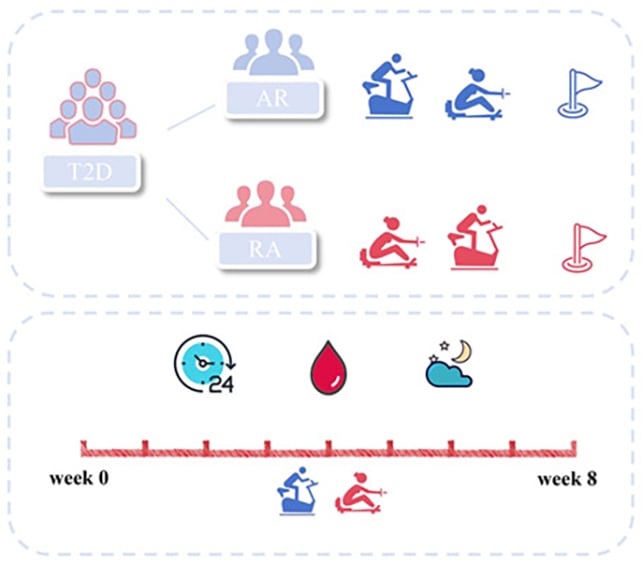
“The present randomized study investigated the effects of sequence in a combined exercise program (AR vs. RA exercises) on glycemic control in people with T2DM.”
The study involved 56 Chinese participants, with an average age of 62.5 years. All of the volunteers had type 2 diabetes and none of them exercised regularly.
Half the group was asked to do 30 minutes of cardio followed by 30 minutes of strength training, three times a week, for the eight weeks of the study. The other half did the same amount of exercise, but did the weights first, then the cardio.
Compared to their own baseline levels, the cardio-first group saw significant reductions in average blood sugar and nighttime blood sugar. Neither decreased significantly in the weight-first group.
However, participants weighed first showed less variability in their blood sugar fluctuations – levels remained more stable overall.
Among participants who did not take insulin, fasting insulin levels fell in both groups during the study period.
 ))>
“Similar conventional improvements were observed in both sequences, but aerobic initially lowered average/nighttime blood glucose at the cost of greater variability, while resistance initially minimized fluctuations,” the team writes.
Although the researchers did not directly measure glucose levels in the muscles, they hypothesize that cardio exercise first drains some of the fuel stored in the muscle, so that the muscles then absorb more glucose from the blood.
The benefits likely also extend into the evening and night, thanks to improved insulin sensitivity and improved glucose regulation, the study authors suggest.
“The AR sequence likely provides greater benefits in nighttime blood glucose management through the combined effects of improved insulin sensitivity and glucose regulation, as opposed to the PR sequence,” the researchers write.
Individual biology and other conditions will likely also play a role. The study references a previous paper in which the results on the order of exercises were reversed to some extent, for people with type 1 rather than type 2 diabetes.
There are a few limitations to mention: 56 participants is a relatively small number, and participants’ eating and drinking habits were not tracked, which may have had some impact on the results.
However, even with these limitations, there is good evidence that exercise order may be important when managing your blood sugar with type 2 diabetes.
The broader evidence is mixed. A separate randomized trial comparing the same two sequences in people with type 2 diabetes concluded that the order made little difference to blood sugar control or physical fitness.
This study adds to this picture rather than settling it, and open questions about why a difference might arise will require larger trials to answer.
“Future studies are needed to verify our results in larger populations with T2DM and to further elucidate the underlying mechanisms of how exercise sequence may influence glucose metabolism,” the researchers write.
The research was published in iScience.
This article was fact-checked by Rebecca Dyer and edited by Rebecca Dyer. Although we are proud of our process, we are only human. If you spot an error, please let us know.
Gn Health