Jewish extremists carried out at least four arson attacks and acts of vandalism against Palestinians across the West Bank on Sunday night, mainly in the Ramallah area and the South Hebron Hills.
Yashar President Gadi Eisenkot on Sunday accused National Security Minister Itamar Ben-Gvir and Finance Minister Bezalel Smotrich of bringing the West Bank to the brink of anarchy, following a series of nightly arson attacks on Palestinian villages that he called “Jewish terrorism in every sense of the word.”
Prime Minister Benjamin Netanyahu has not commented on the incident and rarely comments on similar incidents in the West Bank. This is true even as U.S. Democrats signal a new push, now that they are poised to take power in both houses of Congress, to join the European Union and other Western countries in implementing some level of sanctions related to such incidents.
Settler violence continues after October 27 elections
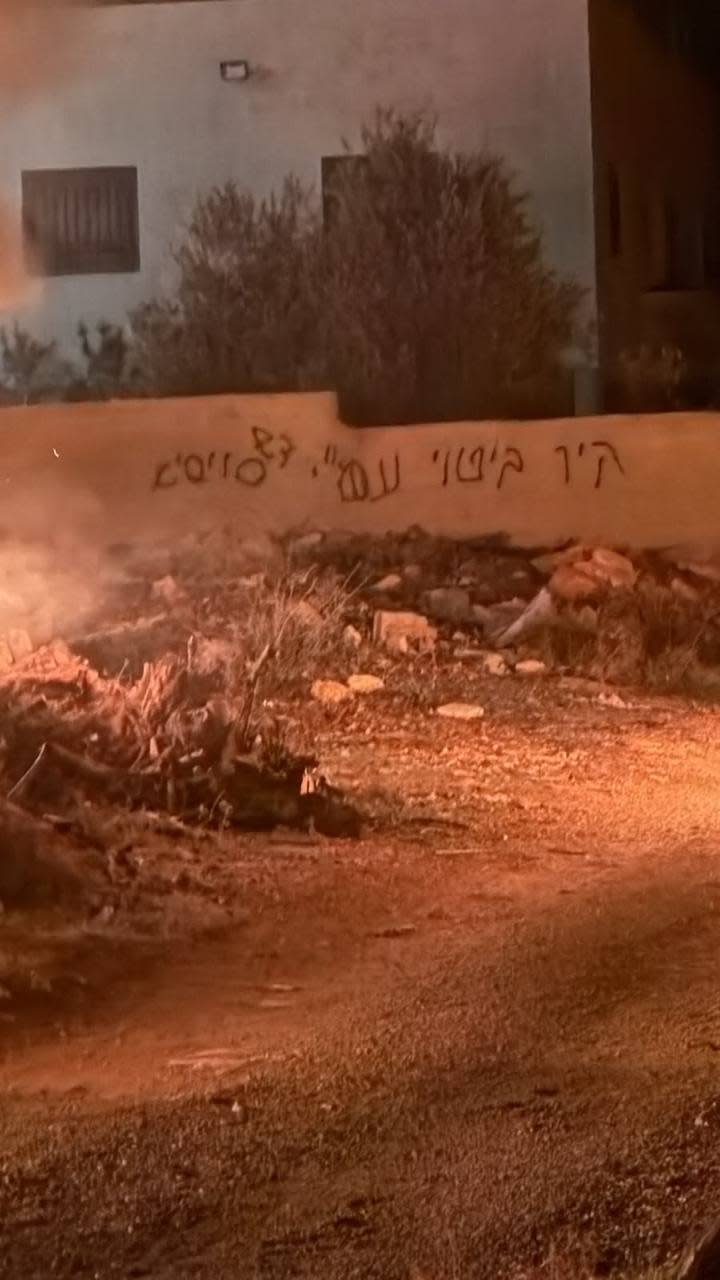
In addition to arson and attempted arson targeting vehicles and other property belonging to Palestinians, the incidents also involved Hebrew-language graffiti containing threats and calls for revenge.
While some expected the wave of Jewish extremist violence to subside after the October 27 elections, attacks have continued and there has still been no concerted crackdown by the government.
Israeli police and the IDF issued statements Sunday morning confirming that an investigation had been launched and that officers and forensic investigators from the Judea and Samaria district would collect evidence at the scene, accompanied by the military.
However, the IDF, police and Shin Bet (Israel Security Agency) failed to make a single arrest, a trend that has been repeated for most similar incidents in recent months.
There have been rare incidents in which significant numbers of Jewish extremists were arrested, but these generally only occurred when senior Trump administration officials intervened personally or even threatened the government with consequences if real action was not taken.
Before Ben-Gvir became Minister of National Security and Katz became Minister of Defense, there had already been criticism of the inadequate enforcement of Jewish extremist violence, but the frequency and severity of the incidents were much lower.
Ben-Gvir has openly pressured police not to aggressively go after Jewish extremists, with former police chiefs saying many members of the police high command should be fired to address the problem.
Katz has been blocking administrative detention of Jews since January 2025, even though more than 3,000 Palestinians remain in detention and despite strong criticism from the IDF and Shin Bet that freezing detention in the case of Jews would lead to an uncontrollable situation.
Shin Bet Director David Zini agreed with Katz when he took office in October 2025, departing from the agency’s traditional vision.
But even Zini pressed Katz to reinstate administrative detention months ago after a series of serious incidents, with the defense minister still ignoring the advice of all professional security bodies.
Among the villages targeted were Deir as-Sudan, the neighboring village of al-Mughayyir, al-Malik, and Deir Abu Mashal in Ramallah governorate, as well as At-Tuwani in the South Hebron Hills.
Footage documenting the incidents showed Palestinian property and vehicles being set on fire or targeted in attempted arsons.
Hebrew graffiti posted at the scene included the words “Revenge” and “By blood and fire Judea has fallen, by blood and fire Judea will rise.” Another inscription read: “Sincerely, tefillin. Do not play with fire.”
While Palestinian terrorism remains a much larger and deadlier problem, Israeli security forces have cracked down hard every time a new Palestinian terrorist incident occurs in the West Bank, even though they often fail to catch the stone throwers.
Series of attacks follows previous West Bank violence
Earlier this month, arson incidents involving Palestinians and Jewish extremists were reported in various parts of the West Bank, including incidents targeting vehicles and construction equipment.
Israeli security forces have taken minimal action against unauthorized settler outposts linked to violent activity, including the dismantling of four illegal outposts following repeated incidents of violence and illegal activity.
Eisenkot said that “the night of arson in Judea and Samaria is Jewish terrorism in every sense of the word, and it must be called by its name: acts of sabotage carried out by extremist groups burning vehicles and homes undermine regional stability, put human lives at risk, and seriously undermine the national security of the State of Israel and its foreign relations.” »
Eisenkot placed responsibility for the deteriorating security situation on Ben-Gvir and Smotrich, accusing them of pursuing policies that brought the West Bank to the brink of anarchy.
In response, Ben-Gvir accused Eisenkot of exploiting allegations of Jewish terrorism for political purposes, saying the former IDF chief of staff was seeking support from Arab parties for a future government.
“Eisenkot has no idea about the facts or the investigation, but he is quick to declare it Jewish terrorism, demands administrative detention and wants to throw them into the Shin Bet basement,” Ben-Gvir said.
“Why? Because it is simply an advance payment that Gadi is making to Ahmad Tibi, before the day his government is formed with the help of supporters of terrorism.”
Ben-Gvir did not present a counter-narrative regarding who carried out the attacks.
Former Shin Bet chief Avi Dichter has called for the use of administrative detention against violent Jewish extremists in the West Bank, warning that their actions undermine Israeli security gains, harm the settlement movement and expose Israel to international sanctions.
In a strongly worded statement, Dichter, who is nominally still Minister of Agriculture and Food Security – but who failed to enter the new Knesset and could therefore retire from politics any day now – described those responsible as “a group of lawbreakers at best and terrorists at worst” who succeed in “slashing the tires of the settlement enterprise in Judea and Samaria.”
Dichter’s statements appeared to show that he had held back some criticism of the government’s handling of Jewish extremist violence in the West Bank for as long as he had hopes of remaining in politics, but that now that he was on the verge of stepping down, he felt freer to denounce failures on the issue.
He warned that military gains achieved at considerable cost were being eroded by repeated incidents of violence.
“The victories and gains that we have achieved through enormous efforts and the blood of our soldiers are being wiped out night after night ‘thanks’ to riots and acts of violence,” Dichter said.
Yair Golan: the West Bank on the verge of the “third Intifada”
The leader of the Democrats, Major-General. (res.) Yair Golan, warned that the weekend’s attacks signal that the West Bank is on the brink of a third Intifada, also accusing the government of encouraging Jewish terrorism and failing to protect Israel’s security.
“Judea and Samaria are on the verge of an explosion. Anyone who wants to prevent a third Intifada must replace the current government, which is giving a tailwind to Jewish terrorism and abandoning security,” Golan said.
He accused Jewish extremists of targeting innocent Palestinians and IDF soldiers, warning that their actions were “leading Israel to unprecedented international isolation.”
Democratic MK Yaya Fink also called on Knesset Foreign Affairs and Defense Committee Chairman Avigdor Liberman to convene an emergency hearing following the attacks.
Fink accused Netanyahu, Ben-Gvir and Finance Minister Bezalel Smotrich of bearing political responsibility for the violence, calling for immediate parliamentary action against those responsible.
“The voice is the voice of Netanyahu, Ben-Gvir and Smotrich, but the hands are those of the Jewish terrorists,” Fink said, invoking the biblical verse about Jacob and Esau.
Gn world